

balance on water showed that 15% of the injected volumes escaped the cell due to a
lack of imperviousness. Considering pollutants, substantial removal yields were
achieved despite the short treatment: 54.1%, 35.6%, and 29% for PAH, TPH, and
BTEX, respectively. Based on the soil density, we calculated that 9.8 Æ 0.7 kg and
10.1 Æ 2.3 kg were removed from the soil for PAH and TPH, respectively.
Considering the mass balance on TPH extracted, 4.3 kg were recovered in liquid
effluent, 5.8 kg were removed in the gas phase, while 1.6 kg left the cell on sides.
TPH removal in the gas phase occurred because of venting, enhanced by the foam or
not. Foam effectiveness to enhance hydrocarbons removal from soils in the flowing
gas phase has been shown in mass balance experiments at the lab scale (Table 1.4)
and in literature (Mulligan and Eftekhari 2003; Longpré-Girard et al. 2016). One
hundred and four kilograms of LB surfactant were injected into the soil during the
treatment, while 7.8 kg were recovered and reused thanks to the UF of the recovered
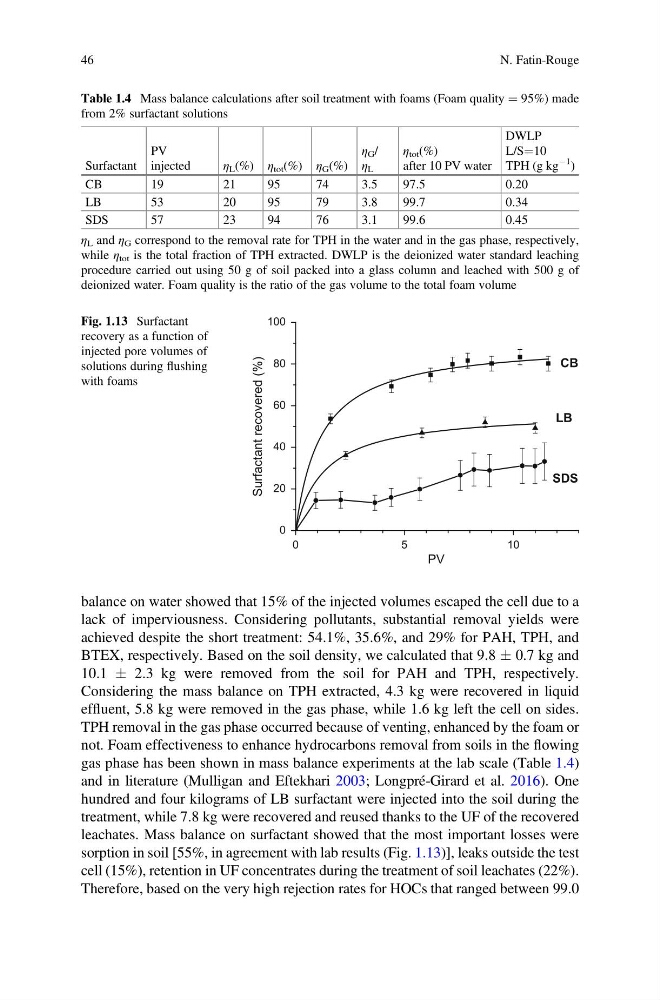
leachates. Mass balance on surfactant showed that the most important losses were
sorption in soil [55%, in agreement with lab results (Fig. 1.13)], leaks outside the test
cell (15%), retention in UF concentrates during the treatment of soil leachates (22%).
Therefore, based on the very high rejection rates for HOCs that ranged between 99.0
Table 1.4 Mass balance calculations after soil treatment with foams (Foam quality ¼ 95%) made
from 2% surfactant solutions
Surfactant
PV
injected
η L (%) η tot (%) η G (%)
η G /
η L
η tot (%)
after 10 PV water
DWLP
L/S¼10
TPH (g kg
À1
)
CB
19
21
95
74
3.5
97.5
0.20
LB
53
20
95
79
3.8
99.7
0.34
SDS
57
23
94
76
3.1
99.6
0.45
η L and η G correspond to the removal rate for TPH in the water and in the gas phase, respectively,
while η tot is the total fraction of TPH extracted. DWLP is the deionized water standard leaching
procedure carried out using 50 g of soil packed into a glass column and leached with 500 g of
deionized water. Foam quality is the ratio of the gas volume to the total foam volume
0
5
1 0
0
20
40
60
80
100
CB
Surfactant recovered (%)
PV
LB
SDS
Fig. 1.13 Surfactant
recovery as a function of
injected pore volumes of
solutions during flushing
with foams
46
N. Fatin-Rouge
lack of imperviousness. Considering pollutants, substantial removal yields were
achieved despite the short treatment: 54.1%, 35.6%, and 29% for PAH, TPH, and
BTEX, respectively. Based on the soil density, we calculated that 9.8 Æ 0.7 kg and
10.1 Æ 2.3 kg were removed from the soil for PAH and TPH, respectively.
Considering the mass balance on TPH extracted, 4.3 kg were recovered in liquid
effluent, 5.8 kg were removed in the gas phase, while 1.6 kg left the cell on sides.
TPH removal in the gas phase occurred because of venting, enhanced by the foam or
not. Foam effectiveness to enhance hydrocarbons removal from soils in the flowing
gas phase has been shown in mass balance experiments at the lab scale (Table 1.4)
and in literature (Mulligan and Eftekhari 2003; Longpré-Girard et al. 2016). One
hundred and four kilograms of LB surfactant were injected into the soil during the
treatment, while 7.8 kg were recovered and reused thanks to the UF of the recovered
leachates. Mass balance on surfactant showed that the most important losses were
sorption in soil [55%, in agreement with lab results (Fig. 1.13)], leaks outside the test
cell (15%), retention in UF concentrates during the treatment of soil leachates (22%).
Therefore, based on the very high rejection rates for HOCs that ranged between 99.0
Table 1.4 Mass balance calculations after soil treatment with foams (Foam quality ¼ 95%) made
from 2% surfactant solutions
Surfactant
PV
injected
η L (%) η tot (%) η G (%)
η G /
η L
η tot (%)
after 10 PV water
DWLP
L/S¼10
TPH (g kg
À1
)
CB
19
21
95
74
3.5
97.5
0.20
LB
53
20
95
79
3.8
99.7
0.34
SDS
57
23
94
76
3.1
99.6
0.45
η L and η G correspond to the removal rate for TPH in the water and in the gas phase, respectively,
while η tot is the total fraction of TPH extracted. DWLP is the deionized water standard leaching
procedure carried out using 50 g of soil packed into a glass column and leached with 500 g of
deionized water. Foam quality is the ratio of the gas volume to the total foam volume
0
5
1 0
0
20
40
60
80
100
CB
Surfactant recovered (%)
PV
LB
SDS
Fig. 1.13 Surfactant
recovery as a function of
injected pore volumes of
solutions during flushing
with foams
46
N. Fatin-Rouge