

R ¼ 100 Â 1 À
C P
C R
ð1:26Þ
where C P and C R are total concentrations for a molecule or species in the permeate
and in feed solutions, respectively. Conversely, transmission, T, is defined as the
percentage of solute or solid that is not retained by the membrane.
T ¼ 100 À R
ð1:27Þ
The membrane configuration refers to the membrane geometry and its position in
space in respect to the flows of the feed and permeate fluids. There are four main
categories of membrane configurations used: plate and frame, spiral-wound, tubular,
and hollow fiber. The choice of a specific membrane configuration is made on the
basis of compactness, easiness for cleaning operations that are frequent, and the
required cross-flow velocity for the feed flow in order to limit membrane clogging
and especially concentration polarization (IAEA 2004).
The interest of membrane technologies for the treatments of soil leachates has
been recognized for a long time (Sikdar et al. 1998; Das et al. 1999). The selection of
the membrane properties depends both on the size of the solutes or particles to be
separated, and on the respective affinity of the solutes for the membrane material and
the solvent. The smaller the solutes are, the smaller is the pore size of the membrane
and the higher the process energy is required. Clarification and desalination refer to
the removal of solids and solutes, respectively.
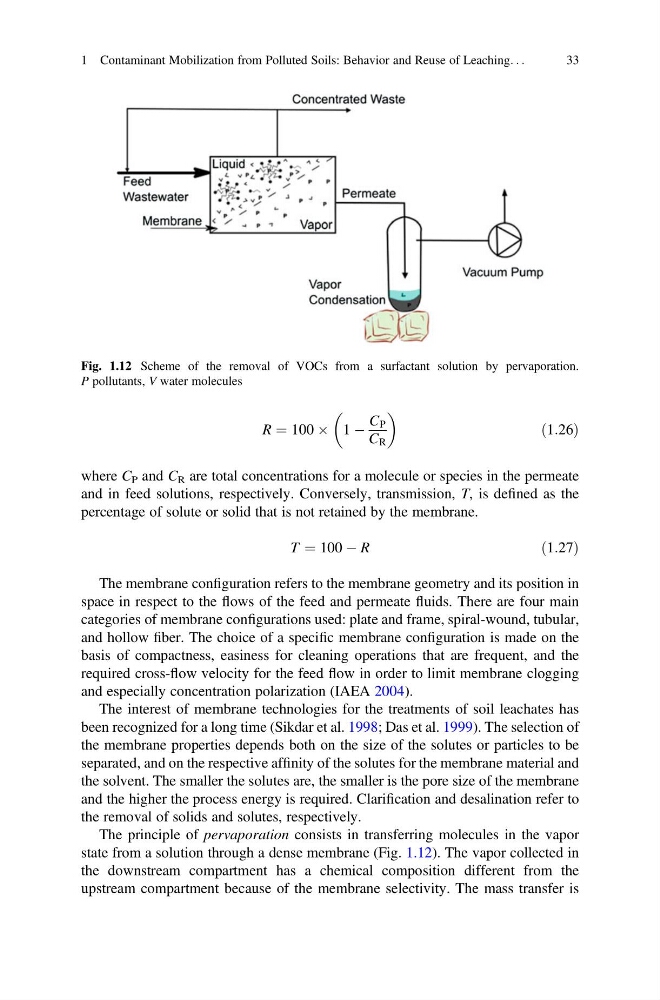
The principle of pervaporation consists in transferring molecules in the vapor
state from a solution through a dense membrane (Fig. 1.12). The vapor collected in
the downstream compartment has a chemical composition different from the
upstream compartment because of the membrane selectivity. The mass transfer is
Fig. 1.12 Scheme of the removal of VOCs from a surfactant solution by pervaporation.
P pollutants, V water molecules
1 Contaminant Mobilization from Polluted Soils: Behavior and Reuse of Leaching. . .
33
C P
C R
ð1:26Þ
where C P and C R are total concentrations for a molecule or species in the permeate
and in feed solutions, respectively. Conversely, transmission, T, is defined as the
percentage of solute or solid that is not retained by the membrane.
T ¼ 100 À R
ð1:27Þ
The membrane configuration refers to the membrane geometry and its position in
space in respect to the flows of the feed and permeate fluids. There are four main
categories of membrane configurations used: plate and frame, spiral-wound, tubular,
and hollow fiber. The choice of a specific membrane configuration is made on the
basis of compactness, easiness for cleaning operations that are frequent, and the
required cross-flow velocity for the feed flow in order to limit membrane clogging
and especially concentration polarization (IAEA 2004).
The interest of membrane technologies for the treatments of soil leachates has
been recognized for a long time (Sikdar et al. 1998; Das et al. 1999). The selection of
the membrane properties depends both on the size of the solutes or particles to be
separated, and on the respective affinity of the solutes for the membrane material and
the solvent. The smaller the solutes are, the smaller is the pore size of the membrane
and the higher the process energy is required. Clarification and desalination refer to
the removal of solids and solutes, respectively.
The principle of pervaporation consists in transferring molecules in the vapor
state from a solution through a dense membrane (Fig. 1.12). The vapor collected in
the downstream compartment has a chemical composition different from the
upstream compartment because of the membrane selectivity. The mass transfer is
Fig. 1.12 Scheme of the removal of VOCs from a surfactant solution by pervaporation.
P pollutants, V water molecules
1 Contaminant Mobilization from Polluted Soils: Behavior and Reuse of Leaching. . .
33