

coworkers (Negra et al. 2005a, b) have analyzed several soils from northwestern
Vermont, and have shown that a decrease in soil pH was correlated to a decrease in
soil Mn AOS. Such observation, which certainly results from an increase in the ratio
of Mn(III) to Mn(IV) when pH decreases (Grangeon et al. 2014; Lanson et al. 2000),
could indicate that transformation of phyllomanganates to tectomanganates is
favored also in acidic soils.
7.2.3.4 Implication for the Geochemical Cycle of Trace Elements
This chapter highlights that the mechanism of phyllomanganate to tectomanganate
transformation has been the subject of many studies. One of the points that remain
poorly investigated is the fate of trace metals initially present in the phyllomanganate
structure during the transformation. In natural samples, it has regularly been shown
that natural tectomanganates contain less trace metals than their phyllomanganate
precursor, with a depletion which is lower for the trace metals that are subject to the
Jahn–Teller effect. For example, Siegel and Turner (1983) found that
phyllomanganates containing 3.8% NiO and 2.8% CuO transformed to
tectomanganates containing 0.2% NiO and 1.5% CuO. In order to better understand
how trace metals speciation and structural configuration evolved during the transformation, Atkins et al. (2014, 2016) synthesized vernadite samples containing or
not ~1% Ni. These samples were then transformed to todorokite using a mild reflux
procedure. They could demonstrate that up to 50% Ni was released in solution
during the transformation, which was slowed down when vernadite contained Ni.
7.2.4 Reactivity Toward Redox-Sensitive Elements
Vernadite having hexagonal layer symmetry is reported to be modified not only by
time (Grangeon et al. 2014), chemical conditions (e.g., Lanson et al. 2000), and
presence of light (Marafatto et al. 2015) but also by contact with aqueous redoxsensitive species that are found in surficial waters (streams or rivers). This is for
example the case with Co
2+ (Manceau et al. 1997) or Mn
2+ , this latter inducing
several different reversible and irreversible structure transformation, depending on
Mn
2+ loading at vernadite surface and on chemical conditions (Eh, pH). The first
structure transformation occurs at low Mn
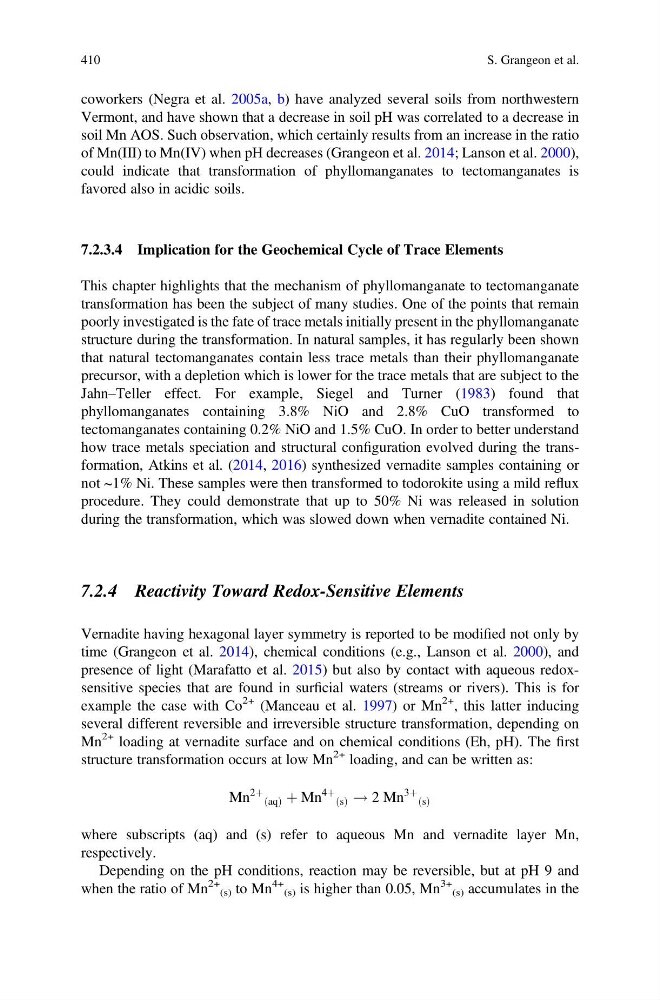
2+ loading, and can be written as:
Mn
2þ
aq
ð Þ þ Mn
4þ
s
ð Þ ! 2 Mn
3þ
s
ð Þ
where subscripts (aq) and (s) refer to aqueous Mn and vernadite layer Mn,
respectively.
Depending on the pH conditions, reaction may be reversible, but at pH 9 and
when the ratio of Mn
2+
(s) to Mn
4+
(s) is higher than 0.05, Mn
3+
(s) accumulates in the
410
S. Grangeon et al.
Vermont, and have shown that a decrease in soil pH was correlated to a decrease in
soil Mn AOS. Such observation, which certainly results from an increase in the ratio
of Mn(III) to Mn(IV) when pH decreases (Grangeon et al. 2014; Lanson et al. 2000),
could indicate that transformation of phyllomanganates to tectomanganates is
favored also in acidic soils.
7.2.3.4 Implication for the Geochemical Cycle of Trace Elements
This chapter highlights that the mechanism of phyllomanganate to tectomanganate
transformation has been the subject of many studies. One of the points that remain
poorly investigated is the fate of trace metals initially present in the phyllomanganate
structure during the transformation. In natural samples, it has regularly been shown
that natural tectomanganates contain less trace metals than their phyllomanganate
precursor, with a depletion which is lower for the trace metals that are subject to the
Jahn–Teller effect. For example, Siegel and Turner (1983) found that
phyllomanganates containing 3.8% NiO and 2.8% CuO transformed to
tectomanganates containing 0.2% NiO and 1.5% CuO. In order to better understand
how trace metals speciation and structural configuration evolved during the transformation, Atkins et al. (2014, 2016) synthesized vernadite samples containing or
not ~1% Ni. These samples were then transformed to todorokite using a mild reflux
procedure. They could demonstrate that up to 50% Ni was released in solution
during the transformation, which was slowed down when vernadite contained Ni.
7.2.4 Reactivity Toward Redox-Sensitive Elements
Vernadite having hexagonal layer symmetry is reported to be modified not only by
time (Grangeon et al. 2014), chemical conditions (e.g., Lanson et al. 2000), and
presence of light (Marafatto et al. 2015) but also by contact with aqueous redoxsensitive species that are found in surficial waters (streams or rivers). This is for
example the case with Co
2+ (Manceau et al. 1997) or Mn
2+ , this latter inducing
several different reversible and irreversible structure transformation, depending on
Mn
2+ loading at vernadite surface and on chemical conditions (Eh, pH). The first
structure transformation occurs at low Mn
2+ loading, and can be written as:
Mn
2þ
aq
ð Þ þ Mn
4þ
s
ð Þ ! 2 Mn
3þ
s
ð Þ
where subscripts (aq) and (s) refer to aqueous Mn and vernadite layer Mn,
respectively.
Depending on the pH conditions, reaction may be reversible, but at pH 9 and
when the ratio of Mn
2+
(s) to Mn
4+
(s) is higher than 0.05, Mn
3+
(s) accumulates in the
410
S. Grangeon et al.