

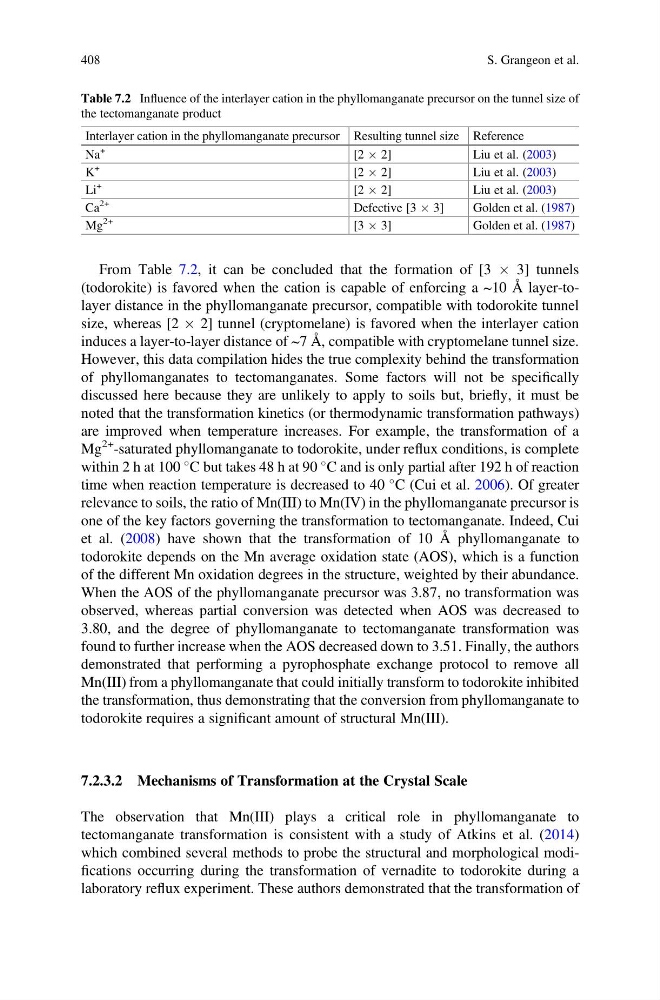
From Table 7.2, it can be concluded that the formation of [3 Â 3] tunnels
(todorokite) is favored when the cation is capable of enforcing a ~10 Å layer-tolayer distance in the phyllomanganate precursor, compatible with todorokite tunnel
size, whereas [2 Â 2] tunnel (cryptomelane) is favored when the interlayer cation
induces a layer-to-layer distance of ~7 Å, compatible with cryptomelane tunnel size.
However, this data compilation hides the true complexity behind the transformation
of phyllomanganates to tectomanganates. Some factors will not be specifically
discussed here because they are unlikely to apply to soils but, briefly, it must be
noted that the transformation kinetics (or thermodynamic transformation pathways)
are improved when temperature increases. For example, the transformation of a
Mg
2+ -saturated phyllomanganate to todorokite, under reflux conditions, is complete
within 2 h at 100
C but takes 48 h at 90
C and is only partial after 192 h of reaction
time when reaction temperature is decreased to 40
C (Cui et al. 2006). Of greater
relevance to soils, the ratio of Mn(III) to Mn(IV) in the phyllomanganate precursor is
one of the key factors governing the transformation to tectomanganate. Indeed, Cui
et al. (2008) have shown that the transformation of 10 Å phyllomanganate to
todorokite depends on the Mn average oxidation state (AOS), which is a function
of the different Mn oxidation degrees in the structure, weighted by their abundance.
When the AOS of the phyllomanganate precursor was 3.87, no transformation was
observed, whereas partial conversion was detected when AOS was decreased to
3.80, and the degree of phyllomanganate to tectomanganate transformation was
found to further increase when the AOS decreased down to 3.51. Finally, the authors
demonstrated that performing a pyrophosphate exchange protocol to remove all
Mn(III) from a phyllomanganate that could initially transform to todorokite inhibited
the transformation, thus demonstrating that the conversion from phyllomanganate to
todorokite requires a significant amount of structural Mn(III).
7.2.3.2 Mechanisms of Transformation at the Crystal Scale
The observation that Mn(III) plays a critical role in phyllomanganate to
tectomanganate transformation is consistent with a study of Atkins et al. (2014)
which combined several methods to probe the structural and morphological modifications occurring during the transformation of vernadite to todorokite during a
laboratory reflux experiment. These authors demonstrated that the transformation of
Table 7.2 Influence of the interlayer cation in the phyllomanganate precursor on the tunnel size of
the tectomanganate product
Interlayer cation in the phyllomanganate precursor Resulting tunnel size Reference
Na
+
[2 Â 2]
Liu et al. (2003)
K
+
[2 Â 2]
Liu et al. (2003)
Li
+
[2 Â 2]
Liu et al. (2003)
Ca
2+
Defective [3 Â 3]
Golden et al. (1987)
Mg
2+
[3 Â 3]
Golden et al. (1987)
408
S. Grangeon et al.
(todorokite) is favored when the cation is capable of enforcing a ~10 Å layer-tolayer distance in the phyllomanganate precursor, compatible with todorokite tunnel
size, whereas [2 Â 2] tunnel (cryptomelane) is favored when the interlayer cation
induces a layer-to-layer distance of ~7 Å, compatible with cryptomelane tunnel size.
However, this data compilation hides the true complexity behind the transformation
of phyllomanganates to tectomanganates. Some factors will not be specifically
discussed here because they are unlikely to apply to soils but, briefly, it must be
noted that the transformation kinetics (or thermodynamic transformation pathways)
are improved when temperature increases. For example, the transformation of a
Mg
2+ -saturated phyllomanganate to todorokite, under reflux conditions, is complete
within 2 h at 100
C but takes 48 h at 90
C and is only partial after 192 h of reaction
time when reaction temperature is decreased to 40
C (Cui et al. 2006). Of greater
relevance to soils, the ratio of Mn(III) to Mn(IV) in the phyllomanganate precursor is
one of the key factors governing the transformation to tectomanganate. Indeed, Cui
et al. (2008) have shown that the transformation of 10 Å phyllomanganate to
todorokite depends on the Mn average oxidation state (AOS), which is a function
of the different Mn oxidation degrees in the structure, weighted by their abundance.
When the AOS of the phyllomanganate precursor was 3.87, no transformation was
observed, whereas partial conversion was detected when AOS was decreased to
3.80, and the degree of phyllomanganate to tectomanganate transformation was
found to further increase when the AOS decreased down to 3.51. Finally, the authors
demonstrated that performing a pyrophosphate exchange protocol to remove all
Mn(III) from a phyllomanganate that could initially transform to todorokite inhibited
the transformation, thus demonstrating that the conversion from phyllomanganate to
todorokite requires a significant amount of structural Mn(III).
7.2.3.2 Mechanisms of Transformation at the Crystal Scale
The observation that Mn(III) plays a critical role in phyllomanganate to
tectomanganate transformation is consistent with a study of Atkins et al. (2014)
which combined several methods to probe the structural and morphological modifications occurring during the transformation of vernadite to todorokite during a
laboratory reflux experiment. These authors demonstrated that the transformation of
Table 7.2 Influence of the interlayer cation in the phyllomanganate precursor on the tunnel size of
the tectomanganate product
Interlayer cation in the phyllomanganate precursor Resulting tunnel size Reference
Na
+
[2 Â 2]
Liu et al. (2003)
K
+
[2 Â 2]
Liu et al. (2003)
Li
+
[2 Â 2]
Liu et al. (2003)
Ca
2+
Defective [3 Â 3]
Golden et al. (1987)
Mg
2+
[3 Â 3]
Golden et al. (1987)
408
S. Grangeon et al.