

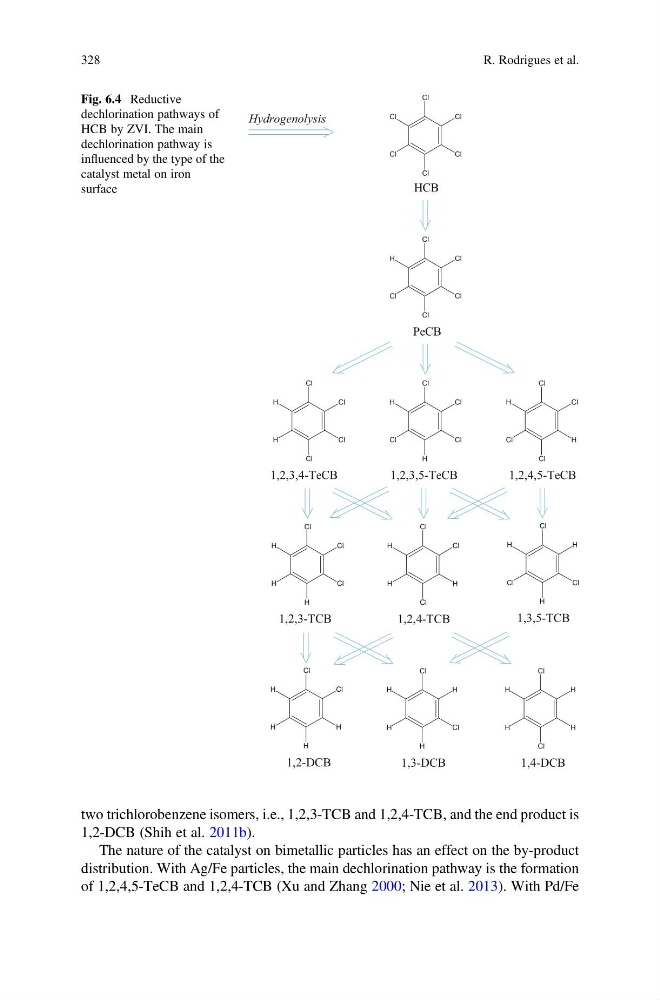
two trichlorobenzene isomers, i.e., 1,2,3-TCB and 1,2,4-TCB, and the end product is
1,2-DCB (Shih et al. 2011b).
The nature of the catalyst on bimetallic particles has an effect on the by-product
distribution. With Ag/Fe particles, the main dechlorination pathway is the formation
of 1,2,4,5-TeCB and 1,2,4-TCB (Xu and Zhang 2000; Nie et al. 2013). With Pd/Fe
Cl
Cl
Cl
Cl
Cl
Cl
Cl
Cl
Cl
Cl
Cl
H
Cl
H
Cl
Cl
Cl
H
H
Cl
Cl
Cl
Cl
H
H
H
H
Cl
Cl
H
Cl
Cl
H
Cl
Cl
H
HCB
PeCB
1,2,3,4-TeCB
1,2,3,5-TeCB
1,2,4,5-TeCB
H
H
Cl
Cl
Cl
H
1,2,3-TCB
H
Cl
H
Cl
Cl
H
1,2,4-TCB
Cl
H
Cl
H
Cl
H
1,3,5-TCB
Hydrogenolysis
H
H
Cl
H
Cl
H
1,3-DCB
H
Cl
H
H
Cl
H
1,4-DCB
1,2-DCB
Fig. 6.4 Reductive
dechlorination pathways of
HCB by ZVI. The main
dechlorination pathway is
influenced by the type of the
catalyst metal on iron
surface
328
R. Rodrigues et al.
1,2-DCB (Shih et al. 2011b).
The nature of the catalyst on bimetallic particles has an effect on the by-product
distribution. With Ag/Fe particles, the main dechlorination pathway is the formation
of 1,2,4,5-TeCB and 1,2,4-TCB (Xu and Zhang 2000; Nie et al. 2013). With Pd/Fe
Cl
Cl
Cl
Cl
Cl
Cl
Cl
Cl
Cl
Cl
Cl
H
Cl
H
Cl
Cl
Cl
H
H
Cl
Cl
Cl
Cl
H
H
H
H
Cl
Cl
H
Cl
Cl
H
Cl
Cl
H
HCB
PeCB
1,2,3,4-TeCB
1,2,3,5-TeCB
1,2,4,5-TeCB
H
H
Cl
Cl
Cl
H
1,2,3-TCB
H
Cl
H
Cl
Cl
H
1,2,4-TCB
Cl
H
Cl
H
Cl
H
1,3,5-TCB
Hydrogenolysis
H
H
Cl
H
Cl
H
1,3-DCB
H
Cl
H
H
Cl
H
1,4-DCB
1,2-DCB
Fig. 6.4 Reductive
dechlorination pathways of
HCB by ZVI. The main
dechlorination pathway is
influenced by the type of the
catalyst metal on iron
surface
328
R. Rodrigues et al.