

6.3.4.2 Degradation Pathways
Mechanistic studies regarding the chemical reduction by zero-valent metals have
shown a preferential tendency to β-elimination for compounds with α,β-pairs of
chlorine atoms (Arnold et al. 1999), while hydrogenolysis and α-elimination are two
competitive reactions for compounds with α-position chlorine atoms (Vogel et al.
1987; Fennelly and Roberts 1998; Song and Carraway 2005). For example, reductive β-elimination of chlorinated alkanes results in the formation of chlorinated
alkenes, and reductive α-elimination and hydrogenolysis results in the formation
of less chlorinated alkanes.
A summary of the general pathway of reduction of chlorinated ethanes and
ethylenes is shown in Fig. 6.3. Highly chlorinated ethanes preferentially react via
β-elimination rather than hydrogenolysis. The predominant chlorinated intermediate
of HCA is PCE (Lien and Zhang 2005), and trace amounts of PCA can be observed
with iron nanoparticles (Song and Carraway 2005). Different pathways are proposed
to explain the formation of the carbon–carbon double bond. Mechanistic studies via
computational or experimental electrochemistry have indicated that the dominant
reaction proceeds by two successive single-electron transfer steps, while an alternative pathway involves the formation of trichloromethylchlorocarbene,
pentachloroethyl anion, or pentachloroethyl radical as intermediates (Patterson
et al. 2001; Huang et al. 2012; Pizarro et al. 2018).
PCA reacts to form mainly TCE and traces of PCE, while 1,1,1,2-TeCA is mainly
transformed to 1,1-DCE, with small proportions of TCE obtained (Lien and Zhang
2005; Song and Carraway 2005). PCA can also react rapidly by dehydrochlorination
to form PCE (Roberts and Gschwend 1991).
The reductive elimination of 1,1,2,2-TeCA results in the formation of two isomers of DCE, cis-DCE and trans-DCE, in a ratio 4.5:1 for iron metal reactant. The
predominant formation of Z-isomer can be explained by the reactivity of the
intermediate formed in iron or iron oxide surface. Also, formation of TCE by
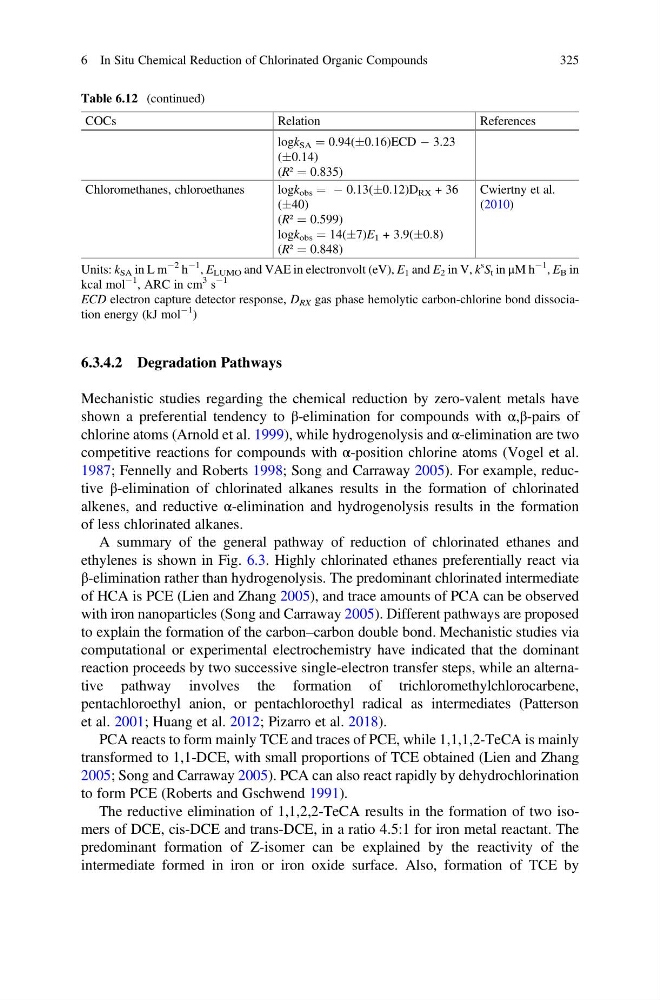
Table 6.12 (continued)
COCs
Relation
References
logk SA ¼ 0.94(Æ0.16)ECD À 3.23
(Æ0.14)
(R² ¼ 0.835)
Chloromethanes, chloroethanes
logk obs ¼ À 0.13(Æ0.12)D RX + 36
(Æ40)
(R² ¼ 0.599)
logk obs ¼ 14(Æ7)E 1 + 3.9(Æ0.8)
(R² ¼ 0.848)
Cwiertny et al.
(2010)
Units: k SA in L m
À2 h
À1
, E LUMO and VAE in electronvolt (eV), E 1 and E 2 in V, k
s S t in μM h
À1
, E B in
kcal mol
À1
, ARC in cm
3 s
À1
ECD electron capture detector response, D RX gas phase hemolytic carbon-chlorine bond dissociation energy (kJ mol
À1
)
6 In Situ Chemical Reduction of Chlorinated Organic Compounds
325
Mechanistic studies regarding the chemical reduction by zero-valent metals have
shown a preferential tendency to β-elimination for compounds with α,β-pairs of
chlorine atoms (Arnold et al. 1999), while hydrogenolysis and α-elimination are two
competitive reactions for compounds with α-position chlorine atoms (Vogel et al.
1987; Fennelly and Roberts 1998; Song and Carraway 2005). For example, reductive β-elimination of chlorinated alkanes results in the formation of chlorinated
alkenes, and reductive α-elimination and hydrogenolysis results in the formation
of less chlorinated alkanes.
A summary of the general pathway of reduction of chlorinated ethanes and
ethylenes is shown in Fig. 6.3. Highly chlorinated ethanes preferentially react via
β-elimination rather than hydrogenolysis. The predominant chlorinated intermediate
of HCA is PCE (Lien and Zhang 2005), and trace amounts of PCA can be observed
with iron nanoparticles (Song and Carraway 2005). Different pathways are proposed
to explain the formation of the carbon–carbon double bond. Mechanistic studies via
computational or experimental electrochemistry have indicated that the dominant
reaction proceeds by two successive single-electron transfer steps, while an alternative pathway involves the formation of trichloromethylchlorocarbene,
pentachloroethyl anion, or pentachloroethyl radical as intermediates (Patterson
et al. 2001; Huang et al. 2012; Pizarro et al. 2018).
PCA reacts to form mainly TCE and traces of PCE, while 1,1,1,2-TeCA is mainly
transformed to 1,1-DCE, with small proportions of TCE obtained (Lien and Zhang
2005; Song and Carraway 2005). PCA can also react rapidly by dehydrochlorination
to form PCE (Roberts and Gschwend 1991).
The reductive elimination of 1,1,2,2-TeCA results in the formation of two isomers of DCE, cis-DCE and trans-DCE, in a ratio 4.5:1 for iron metal reactant. The
predominant formation of Z-isomer can be explained by the reactivity of the
intermediate formed in iron or iron oxide surface. Also, formation of TCE by
Table 6.12 (continued)
COCs
Relation
References
logk SA ¼ 0.94(Æ0.16)ECD À 3.23
(Æ0.14)
(R² ¼ 0.835)
Chloromethanes, chloroethanes
logk obs ¼ À 0.13(Æ0.12)D RX + 36
(Æ40)
(R² ¼ 0.599)
logk obs ¼ 14(Æ7)E 1 + 3.9(Æ0.8)
(R² ¼ 0.848)
Cwiertny et al.
(2010)
Units: k SA in L m
À2 h
À1
, E LUMO and VAE in electronvolt (eV), E 1 and E 2 in V, k
s S t in μM h
À1
, E B in
kcal mol
À1
, ARC in cm
3 s
À1
ECD electron capture detector response, D RX gas phase hemolytic carbon-chlorine bond dissociation energy (kJ mol
À1
)
6 In Situ Chemical Reduction of Chlorinated Organic Compounds
325