

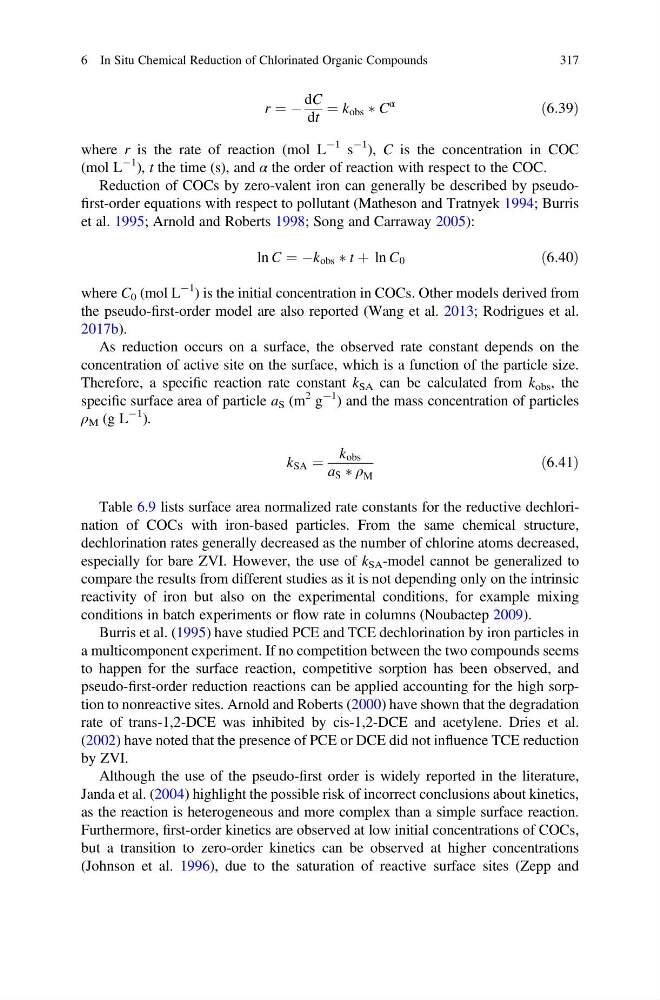
r ¼ À
dC
dt
¼ k obs à C
α
ð6:39Þ
where r is the rate of reaction (mol L
À1 s
À1 ), C is the concentration in COC
(mol L
À1 ), t the time (s), and α the order of reaction with respect to the COC.
Reduction of COCs by zero-valent iron can generally be described by pseudofirst-order equations with respect to pollutant (Matheson and Tratnyek 1994; Burris
et al. 1995; Arnold and Roberts 1998; Song and Carraway 2005):
ln C ¼ Àk obs à t þ ln C 0
ð6:40Þ
where C 0 (mol L
À1 ) is the initial concentration in COCs. Other models derived from
the pseudo-first-order model are also reported (Wang et al. 2013; Rodrigues et al.
2017b).
As reduction occurs on a surface, the observed rate constant depends on the
concentration of active site on the surface, which is a function of the particle size.
Therefore, a specific reaction rate constant k SA can be calculated from k obs , the
specific surface area of particle a S (m
2 g
À1 ) and the mass concentration of particles
ρ M (g L
À1 ).
k SA ¼
k obs
a S Ã ρ M
ð6:41Þ
Table 6.9 lists surface area normalized rate constants for the reductive dechlorination of COCs with iron-based particles. From the same chemical structure,
dechlorination rates generally decreased as the number of chlorine atoms decreased,
especially for bare ZVI. However, the use of k SA -model cannot be generalized to
compare the results from different studies as it is not depending only on the intrinsic
reactivity of iron but also on the experimental conditions, for example mixing
conditions in batch experiments or flow rate in columns (Noubactep 2009).
Burris et al. (1995) have studied PCE and TCE dechlorination by iron particles in
a multicomponent experiment. If no competition between the two compounds seems
to happen for the surface reaction, competitive sorption has been observed, and
pseudo-first-order reduction reactions can be applied accounting for the high sorption to nonreactive sites. Arnold and Roberts (2000) have shown that the degradation
rate of trans-1,2-DCE was inhibited by cis-1,2-DCE and acetylene. Dries et al.
(2002) have noted that the presence of PCE or DCE did not influence TCE reduction
by ZVI.
Although the use of the pseudo-first order is widely reported in the literature,
Janda et al. (2004) highlight the possible risk of incorrect conclusions about kinetics,
as the reaction is heterogeneous and more complex than a simple surface reaction.
Furthermore, first-order kinetics are observed at low initial concentrations of COCs,
but a transition to zero-order kinetics can be observed at higher concentrations
(Johnson et al. 1996), due to the saturation of reactive surface sites (Zepp and
6 In Situ Chemical Reduction of Chlorinated Organic Compounds
317
dC
dt
¼ k obs à C
α
ð6:39Þ
where r is the rate of reaction (mol L
À1 s
À1 ), C is the concentration in COC
(mol L
À1 ), t the time (s), and α the order of reaction with respect to the COC.
Reduction of COCs by zero-valent iron can generally be described by pseudofirst-order equations with respect to pollutant (Matheson and Tratnyek 1994; Burris
et al. 1995; Arnold and Roberts 1998; Song and Carraway 2005):
ln C ¼ Àk obs à t þ ln C 0
ð6:40Þ
where C 0 (mol L
À1 ) is the initial concentration in COCs. Other models derived from
the pseudo-first-order model are also reported (Wang et al. 2013; Rodrigues et al.
2017b).
As reduction occurs on a surface, the observed rate constant depends on the
concentration of active site on the surface, which is a function of the particle size.
Therefore, a specific reaction rate constant k SA can be calculated from k obs , the
specific surface area of particle a S (m
2 g
À1 ) and the mass concentration of particles
ρ M (g L
À1 ).
k SA ¼
k obs
a S Ã ρ M
ð6:41Þ
Table 6.9 lists surface area normalized rate constants for the reductive dechlorination of COCs with iron-based particles. From the same chemical structure,
dechlorination rates generally decreased as the number of chlorine atoms decreased,
especially for bare ZVI. However, the use of k SA -model cannot be generalized to
compare the results from different studies as it is not depending only on the intrinsic
reactivity of iron but also on the experimental conditions, for example mixing
conditions in batch experiments or flow rate in columns (Noubactep 2009).
Burris et al. (1995) have studied PCE and TCE dechlorination by iron particles in
a multicomponent experiment. If no competition between the two compounds seems
to happen for the surface reaction, competitive sorption has been observed, and
pseudo-first-order reduction reactions can be applied accounting for the high sorption to nonreactive sites. Arnold and Roberts (2000) have shown that the degradation
rate of trans-1,2-DCE was inhibited by cis-1,2-DCE and acetylene. Dries et al.
(2002) have noted that the presence of PCE or DCE did not influence TCE reduction
by ZVI.
Although the use of the pseudo-first order is widely reported in the literature,
Janda et al. (2004) highlight the possible risk of incorrect conclusions about kinetics,
as the reaction is heterogeneous and more complex than a simple surface reaction.
Furthermore, first-order kinetics are observed at low initial concentrations of COCs,
but a transition to zero-order kinetics can be observed at higher concentrations
(Johnson et al. 1996), due to the saturation of reactive surface sites (Zepp and
6 In Situ Chemical Reduction of Chlorinated Organic Compounds
317