

More studies are still required to investigate the transformations in real environmental conditions with appropriate iron doses (Lowry and Casman 2009; Zhao et al.
2016; Lefevre et al. 2016; Lei et al. 2018), in combination with life cycle analysis
(Lemming et al. 2012; Suchomel et al. 2014).
6.3.3 Stoichiometric Requirement
Stoichiometric reductant demand (SRD) is defined as the mass (or mole) of a
reductant theoretically required to obtain a complete dechlorination of a mass
(or mole) of COCs, i.e., the formation of non-chlorinated hydrocarbons and free
chloride ions. This concept is adapted from the stoichiometric oxidant demand
(SOD), widely reported in the literature (Brown 2010; Lemaire et al. 2013ab;
Ranc et al. 2016). Its determination implies the knowledge of half-reactions for
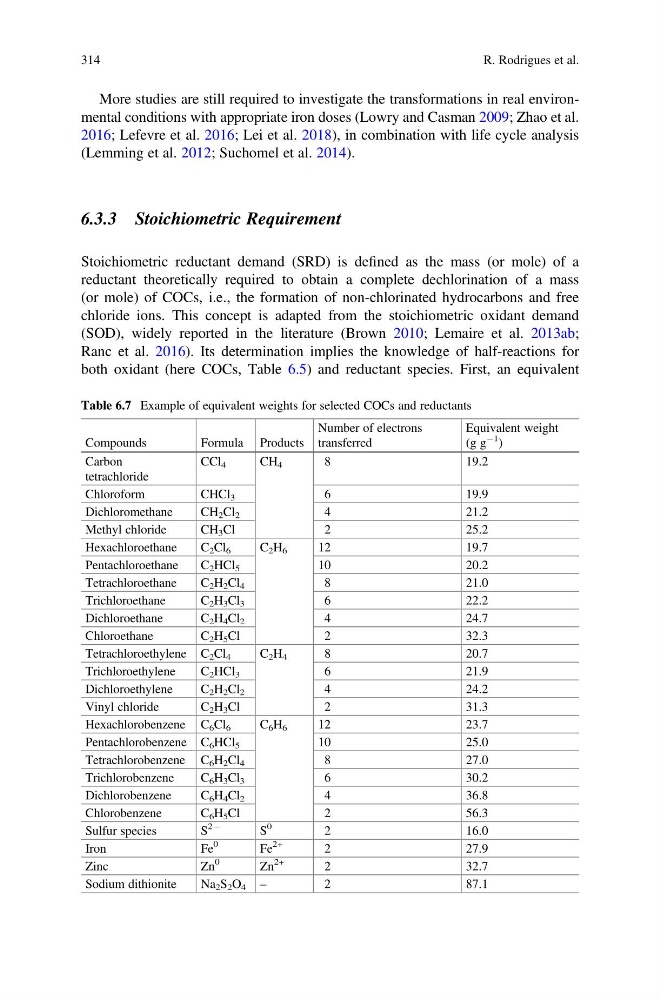
both oxidant (here COCs, Table 6.5) and reductant species. First, an equivalent
Table 6.7 Example of equivalent weights for selected COCs and reductants
Compounds
Formula Products
Number of electrons
transferred
Equivalent weight
(g g
À1
)
Carbon
tetrachloride
CCl 4
CH 4
8
19.2
Chloroform
CHCl 3
6
19.9
Dichloromethane
CH 2 Cl 2
4
21.2
Methyl chloride
CH 3 Cl
2
25.2
Hexachloroethane
C 2 Cl 6
C 2 H 6
12
19.7
Pentachloroethane
C 2 HCl 5
10
20.2
Tetrachloroethane
C 2 H 2 Cl 4
8
21.0
Trichloroethane
C 2 H 3 Cl 3
6
22.2
Dichloroethane
C 2 H 4 Cl 2
4
24.7
Chloroethane
C 2 H 5 Cl
2
32.3
Tetrachloroethylene C 2 Cl 4
C 2 H 4
8
20.7
Trichloroethylene
C 2 HCl 3
6
21.9
Dichloroethylene
C 2 H 2 Cl 2
4
24.2
Vinyl chloride
C 2 H 3 Cl
2
31.3
Hexachlorobenzene C 6 Cl 6
C 6 H 6
12
23.7
Pentachlorobenzene C 6 HCl 5
10
25.0
Tetrachlorobenzene C 6 H 2 Cl 4
8
27.0
Trichlorobenzene
C 6 H 3 Cl 3
6
30.2
Dichlorobenzene
C 6 H 4 Cl 2
4
36.8
Chlorobenzene
C 6 H 5 Cl
2
56.3
Sulfur species
S
2À
S
0
2
16.0
Iron
Fe
0
Fe
2+
2
27.9
Zinc
Zn
0
Zn
2+
2
32.7
Sodium dithionite
Na 2 S 2 O 4 –
2
87.1
314
R. Rodrigues et al.
2016; Lefevre et al. 2016; Lei et al. 2018), in combination with life cycle analysis
(Lemming et al. 2012; Suchomel et al. 2014).
6.3.3 Stoichiometric Requirement
Stoichiometric reductant demand (SRD) is defined as the mass (or mole) of a
reductant theoretically required to obtain a complete dechlorination of a mass
(or mole) of COCs, i.e., the formation of non-chlorinated hydrocarbons and free
chloride ions. This concept is adapted from the stoichiometric oxidant demand
(SOD), widely reported in the literature (Brown 2010; Lemaire et al. 2013ab;
Ranc et al. 2016). Its determination implies the knowledge of half-reactions for
both oxidant (here COCs, Table 6.5) and reductant species. First, an equivalent
Table 6.7 Example of equivalent weights for selected COCs and reductants
Compounds
Formula Products
Number of electrons
transferred
Equivalent weight
(g g
À1
)
Carbon
tetrachloride
CCl 4
CH 4
8
19.2
Chloroform
CHCl 3
6
19.9
Dichloromethane
CH 2 Cl 2
4
21.2
Methyl chloride
CH 3 Cl
2
25.2
Hexachloroethane
C 2 Cl 6
C 2 H 6
12
19.7
Pentachloroethane
C 2 HCl 5
10
20.2
Tetrachloroethane
C 2 H 2 Cl 4
8
21.0
Trichloroethane
C 2 H 3 Cl 3
6
22.2
Dichloroethane
C 2 H 4 Cl 2
4
24.7
Chloroethane
C 2 H 5 Cl
2
32.3
Tetrachloroethylene C 2 Cl 4
C 2 H 4
8
20.7
Trichloroethylene
C 2 HCl 3
6
21.9
Dichloroethylene
C 2 H 2 Cl 2
4
24.2
Vinyl chloride
C 2 H 3 Cl
2
31.3
Hexachlorobenzene C 6 Cl 6
C 6 H 6
12
23.7
Pentachlorobenzene C 6 HCl 5
10
25.0
Tetrachlorobenzene C 6 H 2 Cl 4
8
27.0
Trichlorobenzene
C 6 H 3 Cl 3
6
30.2
Dichlorobenzene
C 6 H 4 Cl 2
4
36.8
Chlorobenzene
C 6 H 5 Cl
2
56.3
Sulfur species
S
2À
S
0
2
16.0
Iron
Fe
0
Fe
2+
2
27.9
Zinc
Zn
0
Zn
2+
2
32.7
Sodium dithionite
Na 2 S 2 O 4 –
2
87.1
314
R. Rodrigues et al.