

specific surface area but also the chemical composition and presence of impurities on
the surface, such as carbon, oxygen, sulfur, or boron content (Lin and Lo 2005;
Velimirovic et al. 2013a, 2017).
Standardized experiments have shown that the specific reaction rate constant
(k SA ) for COCs degradation with mZVI particles are in the same order of magnitude
than those obtained with nZVI particles, while iron corrosion occurs slowly
(Velimirovic et al. 2013b, 2014). Indeed, it is noted that galvanic corrosion exists
between Fe
0 (anode) and iron corrosion products (cathode), as they exhibit more
noble potentials (Wilhelm 1988; Zhang 2011). Consequently, the ratio between
cathodic and anodic sites is less important for microscale than for nanoscale particles, resulting in lower local current densities and the increase in their reactive
lifetime. In addition, higher oxidant yields are obtained with mZVI particles (Lee
et al. 2014; Ma et al. 2016).
A limitation to the use of nZVI and mZVI particles is respectively the aggregation
and the sedimentation phenomena, resulting in a rapid decrease in specific surface
area, reactivity, and mobility (Phenrat et al. 2007; Hotze et al. 2010). The use of
ultrasonic irradiation (20 kHz) during the synthesis of Ni/Fe nanoparticles can avoid
agglomeration and improve nanoparticle disparity (Zhao et al. 2014). Also, to
mitigate aggregation/sedimentation, surface modification was investigated such as
to provide electrostatic and/or steric forces that counter interparticle magnetic
attractive forces and thereby increase the stability (Wiesner and Bottero 2007;
Phenrat et al. 2008). Surface modification includes the use of a stabilizer during
the synthesis of the particles or after the synthesis by simply dispersing the particles
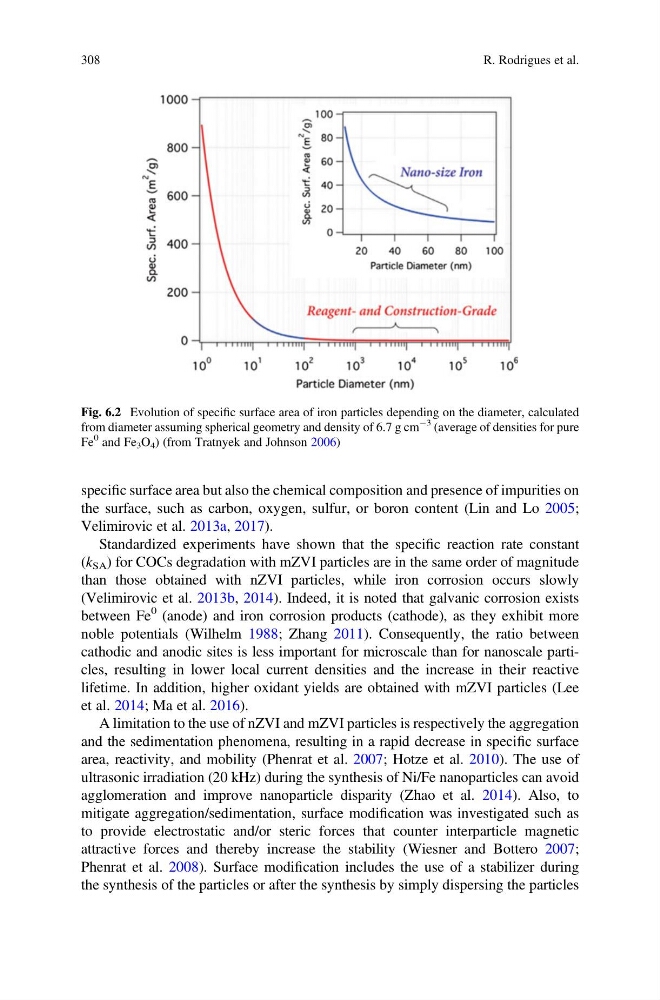
Fig. 6.2 Evolution of specific surface area of iron particles depending on the diameter, calculated
from diameter assuming spherical geometry and density of 6.7 g cm
À3 (average of densities for pure
Fe
0 and Fe 3 O 4 ) (from Tratnyek and Johnson 2006)
308
R. Rodrigues et al.
the surface, such as carbon, oxygen, sulfur, or boron content (Lin and Lo 2005;
Velimirovic et al. 2013a, 2017).
Standardized experiments have shown that the specific reaction rate constant
(k SA ) for COCs degradation with mZVI particles are in the same order of magnitude
than those obtained with nZVI particles, while iron corrosion occurs slowly
(Velimirovic et al. 2013b, 2014). Indeed, it is noted that galvanic corrosion exists
between Fe
0 (anode) and iron corrosion products (cathode), as they exhibit more
noble potentials (Wilhelm 1988; Zhang 2011). Consequently, the ratio between
cathodic and anodic sites is less important for microscale than for nanoscale particles, resulting in lower local current densities and the increase in their reactive
lifetime. In addition, higher oxidant yields are obtained with mZVI particles (Lee
et al. 2014; Ma et al. 2016).
A limitation to the use of nZVI and mZVI particles is respectively the aggregation
and the sedimentation phenomena, resulting in a rapid decrease in specific surface
area, reactivity, and mobility (Phenrat et al. 2007; Hotze et al. 2010). The use of
ultrasonic irradiation (20 kHz) during the synthesis of Ni/Fe nanoparticles can avoid
agglomeration and improve nanoparticle disparity (Zhao et al. 2014). Also, to
mitigate aggregation/sedimentation, surface modification was investigated such as
to provide electrostatic and/or steric forces that counter interparticle magnetic
attractive forces and thereby increase the stability (Wiesner and Bottero 2007;
Phenrat et al. 2008). Surface modification includes the use of a stabilizer during
the synthesis of the particles or after the synthesis by simply dispersing the particles
Fig. 6.2 Evolution of specific surface area of iron particles depending on the diameter, calculated
from diameter assuming spherical geometry and density of 6.7 g cm
À3 (average of densities for pure
Fe
0 and Fe 3 O 4 ) (from Tratnyek and Johnson 2006)
308
R. Rodrigues et al.