

importance as they govern iron oxidation kinetics and degradation processes (Kumar
et al. 2014a).
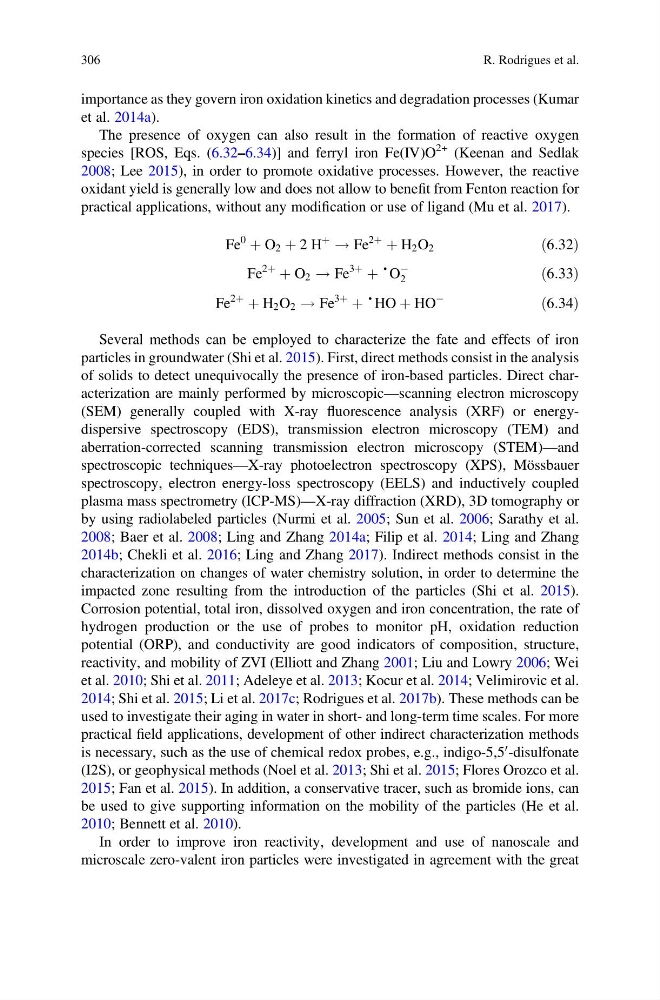
The presence of oxygen can also result in the formation of reactive oxygen
species [ROS, Eqs. (6.32–6.34)] and ferryl iron Fe(IV)O
2+ (Keenan and Sedlak
2008; Lee 2015), in order to promote oxidative processes. However, the reactive
oxidant yield is generally low and does not allow to benefit from Fenton reaction for
practical applications, without any modification or use of ligand (Mu et al. 2017).
Fe
0
þ O 2 þ 2 H
þ
! Fe
2þ
þ H 2 O 2
ð6:32Þ
Fe
2þ
þ O 2 ! Fe
3þ
þ
• O
À
2
ð6:33Þ
Fe
2þ
þ H 2 O 2 ! Fe
3þ
þ
• HO þ HO
À
ð6:34Þ
Several methods can be employed to characterize the fate and effects of iron
particles in groundwater (Shi et al. 2015). First, direct methods consist in the analysis
of solids to detect unequivocally the presence of iron-based particles. Direct characterization are mainly performed by microscopic—scanning electron microscopy
(SEM) generally coupled with X-ray fluorescence analysis (XRF) or energydispersive spectroscopy (EDS), transmission electron microscopy (TEM) and
aberration-corrected scanning transmission electron microscopy (STEM)—and
spectroscopic techniques—X-ray photoelectron spectroscopy (XPS), Mössbauer
spectroscopy, electron energy-loss spectroscopy (EELS) and inductively coupled
plasma mass spectrometry (ICP-MS)—X-ray diffraction (XRD), 3D tomography or
by using radiolabeled particles (Nurmi et al. 2005; Sun et al. 2006; Sarathy et al.
2008; Baer et al. 2008; Ling and Zhang 2014a; Filip et al. 2014; Ling and Zhang
2014b; Chekli et al. 2016; Ling and Zhang 2017). Indirect methods consist in the
characterization on changes of water chemistry solution, in order to determine the
impacted zone resulting from the introduction of the particles (Shi et al. 2015).
Corrosion potential, total iron, dissolved oxygen and iron concentration, the rate of
hydrogen production or the use of probes to monitor pH, oxidation reduction
potential (ORP), and conductivity are good indicators of composition, structure,
reactivity, and mobility of ZVI (Elliott and Zhang 2001; Liu and Lowry 2006; Wei
et al. 2010; Shi et al. 2011; Adeleye et al. 2013; Kocur et al. 2014; Velimirovic et al.
2014; Shi et al. 2015; Li et al. 2017c; Rodrigues et al. 2017b). These methods can be
used to investigate their aging in water in short- and long-term time scales. For more
practical field applications, development of other indirect characterization methods
is necessary, such as the use of chemical redox probes, e.g., indigo-5,5
0 -disulfonate
(I2S), or geophysical methods (Noel et al. 2013; Shi et al. 2015; Flores Orozco et al.
2015; Fan et al. 2015). In addition, a conservative tracer, such as bromide ions, can
be used to give supporting information on the mobility of the particles (He et al.
2010; Bennett et al. 2010).
In order to improve iron reactivity, development and use of nanoscale and
microscale zero-valent iron particles were investigated in agreement with the great
306
R. Rodrigues et al.
et al. 2014a).
The presence of oxygen can also result in the formation of reactive oxygen
species [ROS, Eqs. (6.32–6.34)] and ferryl iron Fe(IV)O
2+ (Keenan and Sedlak
2008; Lee 2015), in order to promote oxidative processes. However, the reactive
oxidant yield is generally low and does not allow to benefit from Fenton reaction for
practical applications, without any modification or use of ligand (Mu et al. 2017).
Fe
0
þ O 2 þ 2 H
þ
! Fe
2þ
þ H 2 O 2
ð6:32Þ
Fe
2þ
þ O 2 ! Fe
3þ
þ
• O
À
2
ð6:33Þ
Fe
2þ
þ H 2 O 2 ! Fe
3þ
þ
• HO þ HO
À
ð6:34Þ
Several methods can be employed to characterize the fate and effects of iron
particles in groundwater (Shi et al. 2015). First, direct methods consist in the analysis
of solids to detect unequivocally the presence of iron-based particles. Direct characterization are mainly performed by microscopic—scanning electron microscopy
(SEM) generally coupled with X-ray fluorescence analysis (XRF) or energydispersive spectroscopy (EDS), transmission electron microscopy (TEM) and
aberration-corrected scanning transmission electron microscopy (STEM)—and
spectroscopic techniques—X-ray photoelectron spectroscopy (XPS), Mössbauer
spectroscopy, electron energy-loss spectroscopy (EELS) and inductively coupled
plasma mass spectrometry (ICP-MS)—X-ray diffraction (XRD), 3D tomography or
by using radiolabeled particles (Nurmi et al. 2005; Sun et al. 2006; Sarathy et al.
2008; Baer et al. 2008; Ling and Zhang 2014a; Filip et al. 2014; Ling and Zhang
2014b; Chekli et al. 2016; Ling and Zhang 2017). Indirect methods consist in the
characterization on changes of water chemistry solution, in order to determine the
impacted zone resulting from the introduction of the particles (Shi et al. 2015).
Corrosion potential, total iron, dissolved oxygen and iron concentration, the rate of
hydrogen production or the use of probes to monitor pH, oxidation reduction
potential (ORP), and conductivity are good indicators of composition, structure,
reactivity, and mobility of ZVI (Elliott and Zhang 2001; Liu and Lowry 2006; Wei
et al. 2010; Shi et al. 2011; Adeleye et al. 2013; Kocur et al. 2014; Velimirovic et al.
2014; Shi et al. 2015; Li et al. 2017c; Rodrigues et al. 2017b). These methods can be
used to investigate their aging in water in short- and long-term time scales. For more
practical field applications, development of other indirect characterization methods
is necessary, such as the use of chemical redox probes, e.g., indigo-5,5
0 -disulfonate
(I2S), or geophysical methods (Noel et al. 2013; Shi et al. 2015; Flores Orozco et al.
2015; Fan et al. 2015). In addition, a conservative tracer, such as bromide ions, can
be used to give supporting information on the mobility of the particles (He et al.
2010; Bennett et al. 2010).
In order to improve iron reactivity, development and use of nanoscale and
microscale zero-valent iron particles were investigated in agreement with the great
306
R. Rodrigues et al.