

Direct reduction at iron surface:
Fe
0
þ RCl þ H
þ
! Fe
2þ
þ RH þ Cl
À
ð6:28Þ
Iron corrosion:
Fe
0
þ 2 H 2 O ! Fe
2þ
þ H 2 g
ð Þ þ 2 HO
À
ð6:29Þ
Reduction by ferrous iron:
2 Fe
2þ
þ RCl þ H
þ
! 2 Fe
3þ
þ RH þ Cl
À
ð6:30Þ
Reduction by hydrogen:
RCl þ H 2 g
ð Þ !
catalyst RH þ Cl
À
þ H
þ
ð6:31Þ
Due to their rapid oxidation, iron particles have a core–shell structure, with an
iron core surrounded by a thin mixed-valent iron oxide shell (Li et al. 2006a; Martin
et al. 2008; Yan et al. 2010a; Ling et al. 2017). This shell is where all remediation
processes, such as adsorption, coprecipitation, and chemical reduction, occur
(Noubactep 2012). The interfacial mineral composition of this shell is quite complex
and include mainly—from the inner sphere to the outer sphere—FeO (wüstite),
Fe 3 O 4 (magnetite), Fe 2 O 3 (hematite α-Fe 2 O 3 and maghemite γ-Fe 2 O 3 ), and
FeOOH (goethite α-FeOOH, lepidocrocite γ-FeOOH and feroxyhyte δ-FeOOH)
(Uegami et al. 2002; Wang et al. 2009a; Yan et al. 2013; Kumar et al. 2014a; Mu
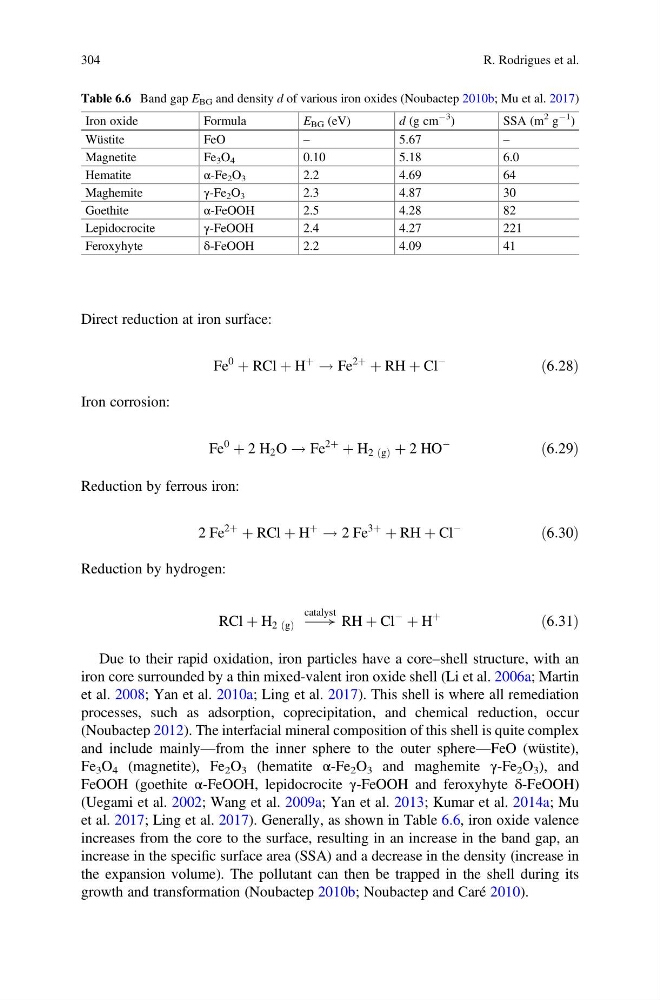
et al. 2017; Ling et al. 2017). Generally, as shown in Table 6.6, iron oxide valence
increases from the core to the surface, resulting in an increase in the band gap, an
increase in the specific surface area (SSA) and a decrease in the density (increase in
the expansion volume). The pollutant can then be trapped in the shell during its
growth and transformation (Noubactep 2010b; Noubactep and Caré 2010).
Table 6.6 Band gap E BG and density d of various iron oxides (Noubactep 2010b; Mu et al. 2017)
Iron oxide
Formula
E BG (eV)
d (g cm
À3
)
SSA (m
2 g
À1
)
Wüstite
FeO
–
5.67
–
Magnetite
Fe 3 O 4
0.10
5.18
6.0
Hematite
α-Fe 2 O 3
2.2
4.69
64
Maghemite
γ-Fe 2 O 3
2.3
4.87
30
Goethite
α-FeOOH
2.5
4.28
82
Lepidocrocite
γ-FeOOH
2.4
4.27
221
Feroxyhyte
δ-FeOOH
2.2
4.09
41
304
R. Rodrigues et al.
Fe
0
þ RCl þ H
þ
! Fe
2þ
þ RH þ Cl
À
ð6:28Þ
Iron corrosion:
Fe
0
þ 2 H 2 O ! Fe
2þ
þ H 2 g
ð Þ þ 2 HO
À
ð6:29Þ
Reduction by ferrous iron:
2 Fe
2þ
þ RCl þ H
þ
! 2 Fe
3þ
þ RH þ Cl
À
ð6:30Þ
Reduction by hydrogen:
RCl þ H 2 g
ð Þ !
catalyst RH þ Cl
À
þ H
þ
ð6:31Þ
Due to their rapid oxidation, iron particles have a core–shell structure, with an
iron core surrounded by a thin mixed-valent iron oxide shell (Li et al. 2006a; Martin
et al. 2008; Yan et al. 2010a; Ling et al. 2017). This shell is where all remediation
processes, such as adsorption, coprecipitation, and chemical reduction, occur
(Noubactep 2012). The interfacial mineral composition of this shell is quite complex
and include mainly—from the inner sphere to the outer sphere—FeO (wüstite),
Fe 3 O 4 (magnetite), Fe 2 O 3 (hematite α-Fe 2 O 3 and maghemite γ-Fe 2 O 3 ), and
FeOOH (goethite α-FeOOH, lepidocrocite γ-FeOOH and feroxyhyte δ-FeOOH)
(Uegami et al. 2002; Wang et al. 2009a; Yan et al. 2013; Kumar et al. 2014a; Mu
et al. 2017; Ling et al. 2017). Generally, as shown in Table 6.6, iron oxide valence
increases from the core to the surface, resulting in an increase in the band gap, an
increase in the specific surface area (SSA) and a decrease in the density (increase in
the expansion volume). The pollutant can then be trapped in the shell during its
growth and transformation (Noubactep 2010b; Noubactep and Caré 2010).
Table 6.6 Band gap E BG and density d of various iron oxides (Noubactep 2010b; Mu et al. 2017)
Iron oxide
Formula
E BG (eV)
d (g cm
À3
)
SSA (m
2 g
À1
)
Wüstite
FeO
–
5.67
–
Magnetite
Fe 3 O 4
0.10
5.18
6.0
Hematite
α-Fe 2 O 3
2.2
4.69
64
Maghemite
γ-Fe 2 O 3
2.3
4.87
30
Goethite
α-FeOOH
2.5
4.28
82
Lepidocrocite
γ-FeOOH
2.4
4.27
221
Feroxyhyte
δ-FeOOH
2.2
4.09
41
304
R. Rodrigues et al.