

chemical structure and environmental conditions. Reduction is more susceptible to
occur for compounds with a high number of chlorine atoms, as carbon atoms are
more electron deficient (Brown 2010).
COCs can undergo four oxidative degradation pathways—α-hydroxylation,
halosyl oxidation, epoxidation, and biohalogenation—or three reductive degradation
pathways—hydrogenolysis, dichloroelimination, and coupling reactions between
two identical COCs—depending on the nature of the reactant and the structure of
the pollutant (Vogel et al. 1987). In agreement to the objective of this chapter, only
reductive pathways are discussed in details.
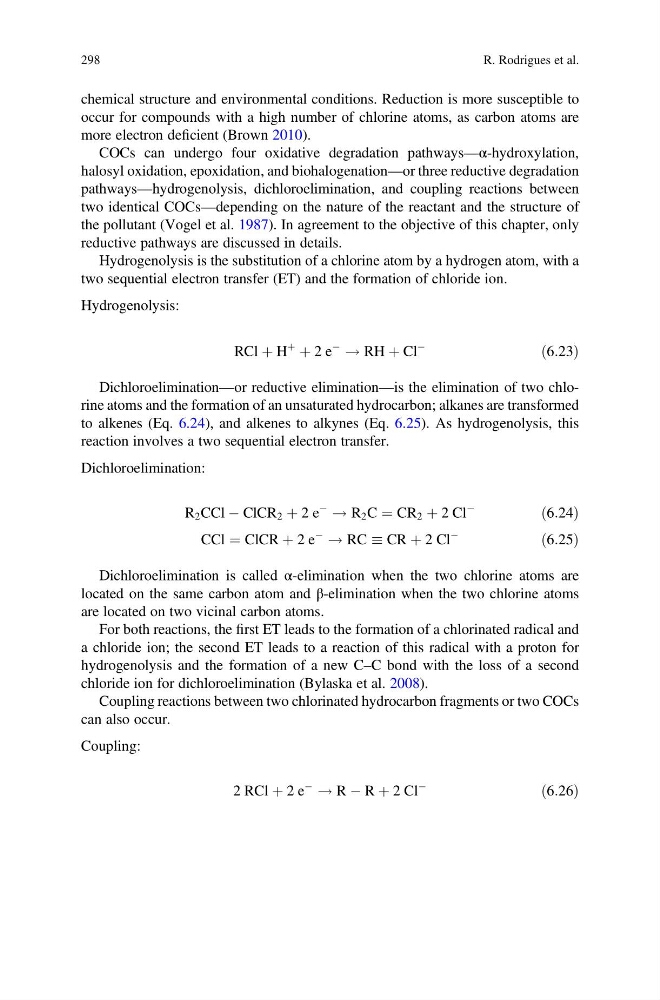
Hydrogenolysis is the substitution of a chlorine atom by a hydrogen atom, with a
two sequential electron transfer (ET) and the formation of chloride ion.
Hydrogenolysis:
RCl þ H
þ
þ 2 e
À
! RH þ Cl
À
ð6:23Þ
Dichloroelimination—or reductive elimination—is the elimination of two chlorine atoms and the formation of an unsaturated hydrocarbon; alkanes are transformed
to alkenes (Eq. 6.24), and alkenes to alkynes (Eq. 6.25). As hydrogenolysis, this
reaction involves a two sequential electron transfer.
Dichloroelimination:
R 2 CCl À ClCR 2 þ 2 e
À
! R 2 C ¼ CR 2 þ 2 Cl
À
ð6:24Þ
CCl ¼ ClCR þ 2 e
À
! RC CR þ 2 Cl
À
ð6:25Þ
Dichloroelimination is called α-elimination when the two chlorine atoms are
located on the same carbon atom and β-elimination when the two chlorine atoms
are located on two vicinal carbon atoms.
For both reactions, the first ET leads to the formation of a chlorinated radical and
a chloride ion; the second ET leads to a reaction of this radical with a proton for
hydrogenolysis and the formation of a new C–C bond with the loss of a second
chloride ion for dichloroelimination (Bylaska et al. 2008).
Coupling reactions between two chlorinated hydrocarbon fragments or two COCs
can also occur.
Coupling:
2 RCl þ 2 e
À
! R À R þ 2 Cl
À
ð6:26Þ
298
R. Rodrigues et al.
occur for compounds with a high number of chlorine atoms, as carbon atoms are
more electron deficient (Brown 2010).
COCs can undergo four oxidative degradation pathways—α-hydroxylation,
halosyl oxidation, epoxidation, and biohalogenation—or three reductive degradation
pathways—hydrogenolysis, dichloroelimination, and coupling reactions between
two identical COCs—depending on the nature of the reactant and the structure of
the pollutant (Vogel et al. 1987). In agreement to the objective of this chapter, only
reductive pathways are discussed in details.
Hydrogenolysis is the substitution of a chlorine atom by a hydrogen atom, with a
two sequential electron transfer (ET) and the formation of chloride ion.
Hydrogenolysis:
RCl þ H
þ
þ 2 e
À
! RH þ Cl
À
ð6:23Þ
Dichloroelimination—or reductive elimination—is the elimination of two chlorine atoms and the formation of an unsaturated hydrocarbon; alkanes are transformed
to alkenes (Eq. 6.24), and alkenes to alkynes (Eq. 6.25). As hydrogenolysis, this
reaction involves a two sequential electron transfer.
Dichloroelimination:
R 2 CCl À ClCR 2 þ 2 e
À
! R 2 C ¼ CR 2 þ 2 Cl
À
ð6:24Þ
CCl ¼ ClCR þ 2 e
À
! RC CR þ 2 Cl
À
ð6:25Þ
Dichloroelimination is called α-elimination when the two chlorine atoms are
located on the same carbon atom and β-elimination when the two chlorine atoms
are located on two vicinal carbon atoms.
For both reactions, the first ET leads to the formation of a chlorinated radical and
a chloride ion; the second ET leads to a reaction of this radical with a proton for
hydrogenolysis and the formation of a new C–C bond with the loss of a second
chloride ion for dichloroelimination (Bylaska et al. 2008).
Coupling reactions between two chlorinated hydrocarbon fragments or two COCs
can also occur.
Coupling:
2 RCl þ 2 e
À
! R À R þ 2 Cl
À
ð6:26Þ
298
R. Rodrigues et al.