

6.2.3.5 Sorption
Sorption is related to the partitioning of a substance from one phase onto or into
another phase. For COCs, it represents mainly their partitioning from the aqueous
solution onto (e.g., adsorption) or into (e.g., absorption) a solid phase (Stumm et al.
1992). Both absorption and adsorption processes have to be considered (Allen-King
et al. 2002). The relative concentration of COCs in the water and solid phases is
generally described using Eq. (6.15):
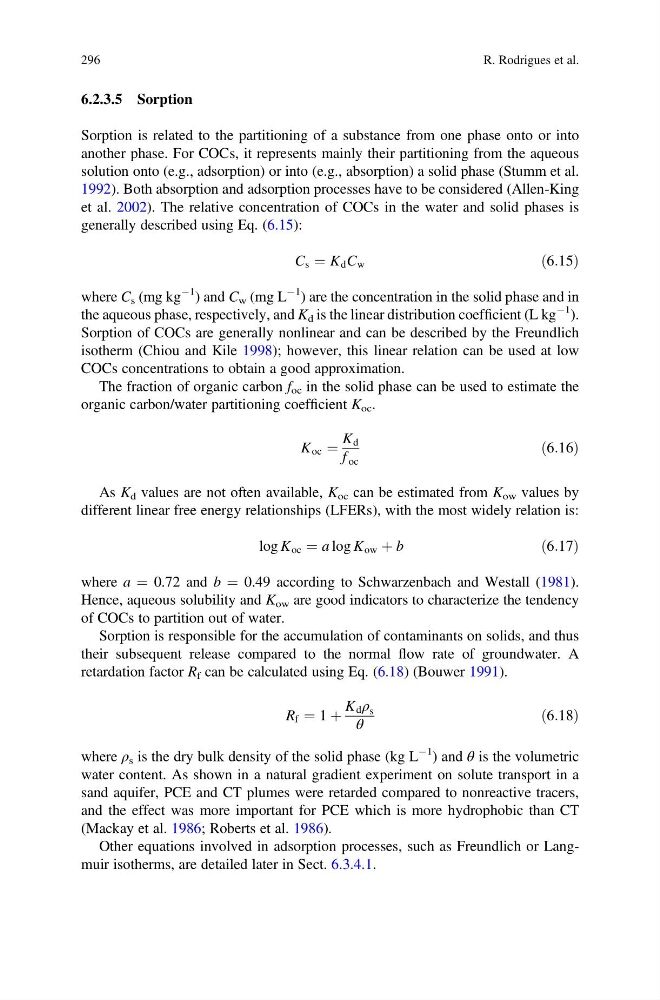
C s ¼ K d C w
ð6:15Þ
where C s (mg kg
À1 ) and C w (mg L
À1 ) are the concentration in the solid phase and in
the aqueous phase, respectively, and K d is the linear distribution coefficient (L kg
À1 ).
Sorption of COCs are generally nonlinear and can be described by the Freundlich
isotherm (Chiou and Kile 1998); however, this linear relation can be used at low
COCs concentrations to obtain a good approximation.
The fraction of organic carbon f oc in the solid phase can be used to estimate the
organic carbon/water partitioning coefficient K oc .
K oc ¼
K d
f oc
ð6:16Þ
As K d values are not often available, K oc can be estimated from K ow values by
different linear free energy relationships (LFERs), with the most widely relation is:
log K oc ¼ a log K ow þ b
ð6:17Þ
where a ¼ 0.72 and b ¼ 0.49 according to Schwarzenbach and Westall (1981).
Hence, aqueous solubility and K ow are good indicators to characterize the tendency
of COCs to partition out of water.
Sorption is responsible for the accumulation of contaminants on solids, and thus
their subsequent release compared to the normal flow rate of groundwater. A
retardation factor R f can be calculated using Eq. (6.18) (Bouwer 1991).
R f ¼ 1 þ
K d ρ s
θ
ð6:18Þ
where ρ s is the dry bulk density of the solid phase (kg L
À1 ) and θ is the volumetric
water content. As shown in a natural gradient experiment on solute transport in a
sand aquifer, PCE and CT plumes were retarded compared to nonreactive tracers,
and the effect was more important for PCE which is more hydrophobic than CT
(Mackay et al. 1986; Roberts et al. 1986).
Other equations involved in adsorption processes, such as Freundlich or Langmuir isotherms, are detailed later in Sect. 6.3.4.1.
296
R. Rodrigues et al.
Sorption is related to the partitioning of a substance from one phase onto or into
another phase. For COCs, it represents mainly their partitioning from the aqueous
solution onto (e.g., adsorption) or into (e.g., absorption) a solid phase (Stumm et al.
1992). Both absorption and adsorption processes have to be considered (Allen-King
et al. 2002). The relative concentration of COCs in the water and solid phases is
generally described using Eq. (6.15):
C s ¼ K d C w
ð6:15Þ
where C s (mg kg
À1 ) and C w (mg L
À1 ) are the concentration in the solid phase and in
the aqueous phase, respectively, and K d is the linear distribution coefficient (L kg
À1 ).
Sorption of COCs are generally nonlinear and can be described by the Freundlich
isotherm (Chiou and Kile 1998); however, this linear relation can be used at low
COCs concentrations to obtain a good approximation.
The fraction of organic carbon f oc in the solid phase can be used to estimate the
organic carbon/water partitioning coefficient K oc .
K oc ¼
K d
f oc
ð6:16Þ
As K d values are not often available, K oc can be estimated from K ow values by
different linear free energy relationships (LFERs), with the most widely relation is:
log K oc ¼ a log K ow þ b
ð6:17Þ
where a ¼ 0.72 and b ¼ 0.49 according to Schwarzenbach and Westall (1981).
Hence, aqueous solubility and K ow are good indicators to characterize the tendency
of COCs to partition out of water.
Sorption is responsible for the accumulation of contaminants on solids, and thus
their subsequent release compared to the normal flow rate of groundwater. A
retardation factor R f can be calculated using Eq. (6.18) (Bouwer 1991).
R f ¼ 1 þ
K d ρ s
θ
ð6:18Þ
where ρ s is the dry bulk density of the solid phase (kg L
À1 ) and θ is the volumetric
water content. As shown in a natural gradient experiment on solute transport in a
sand aquifer, PCE and CT plumes were retarded compared to nonreactive tracers,
and the effect was more important for PCE which is more hydrophobic than CT
(Mackay et al. 1986; Roberts et al. 1986).
Other equations involved in adsorption processes, such as Freundlich or Langmuir isotherms, are detailed later in Sect. 6.3.4.1.
296
R. Rodrigues et al.