

Assays for monitoring of TPH bioremediation efficiency
• Contaminant
concentration
measurement
• Metabolite
generation
screening
(quantitative
changes in TPH
fractions)
• Quantification
of bioavailable
fraction
concentration
during time
• Enzymatic activity
measurement:
- monooxygenase
- urease
- lipase
- dehydrogenase
- phosphatase
- Hydrolase
- proteases
-
β-glucosidase
- Arylsulfatase
• Profiling techniques
- PLFA analysis
Fingerprinting methods:
• qPCRDGGE/TTGE
• T-RFLP
Functional genes
abundance measurements:
• qPCR of 16S
rRNA
- nahAc
- alkB
- xylE
• Bacterial/fungal
density:
- CFU
- MPN
• Microbial biomass
- qPCR
• Community level
physiological
profiling
- Biolog®
microplates
• Microtox
®
• Ames test
• Germination
tests
• Growth
inhibition
and
reproductive
capability
• Reproduction
tests
• Acute
tests e.g.
avoidance
Bioassays
Chemical
Genetic
Biochemical
Microbial/molecular
Phytoassays
Invertebrate
assays
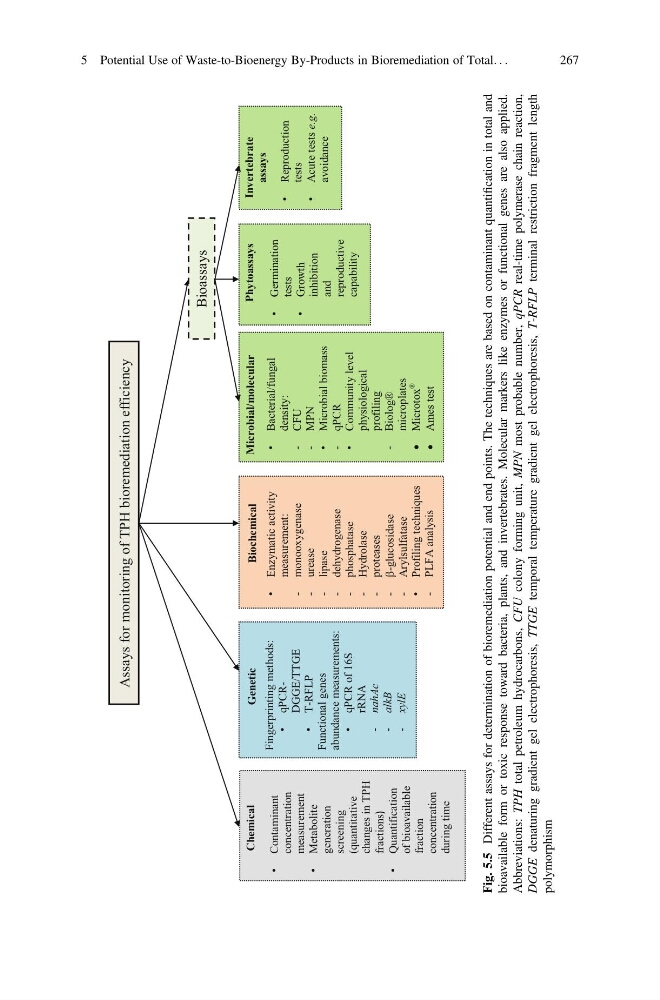
Fig. 5.5
Different assays for determination of bioremediation potential and end points. The techniques are based on contaminant quantification in total and
bioavailable form or toxic response toward bacteria, plants, and invertebrates. Molecular markers like enzymes or functional genes are also applied.
Abbreviations: TPH
total petroleum hydrocarbons, CFU
colony forming unit, MPN
most probable number, qPCR
real-time polymerase chain reaction,
DGGE
denaturing gradient gel electrophoresis, TTGE
temporal temperature gradient gel electrophoresis, T-RFLP
terminal restriction fragment length
polymorphism
5 Potential Use of Waste-to-Bioenergy By-Products in Bioremediation of Total. . .
267
• Contaminant
concentration
measurement
• Metabolite
generation
screening
(quantitative
changes in TPH
fractions)
• Quantification
of bioavailable
fraction
concentration
during time
• Enzymatic activity
measurement:
- monooxygenase
- urease
- lipase
- dehydrogenase
- phosphatase
- Hydrolase
- proteases
-
β-glucosidase
- Arylsulfatase
• Profiling techniques
- PLFA analysis
Fingerprinting methods:
• qPCRDGGE/TTGE
• T-RFLP
Functional genes
abundance measurements:
• qPCR of 16S
rRNA
- nahAc
- alkB
- xylE
• Bacterial/fungal
density:
- CFU
- MPN
• Microbial biomass
- qPCR
• Community level
physiological
profiling
- Biolog®
microplates
• Microtox
®
• Ames test
• Germination
tests
• Growth
inhibition
and
reproductive
capability
• Reproduction
tests
• Acute
tests e.g.
avoidance
Bioassays
Chemical
Genetic
Biochemical
Microbial/molecular
Phytoassays
Invertebrate
assays
Fig. 5.5
Different assays for determination of bioremediation potential and end points. The techniques are based on contaminant quantification in total and
bioavailable form or toxic response toward bacteria, plants, and invertebrates. Molecular markers like enzymes or functional genes are also applied.
Abbreviations: TPH
total petroleum hydrocarbons, CFU
colony forming unit, MPN
most probable number, qPCR
real-time polymerase chain reaction,
DGGE
denaturing gradient gel electrophoresis, TTGE
temporal temperature gradient gel electrophoresis, T-RFLP
terminal restriction fragment length
polymorphism
5 Potential Use of Waste-to-Bioenergy By-Products in Bioremediation of Total. . .
267