

degradation of biomass occurs and for temperatures between 35 and 40
C diversification of microbial communities is usually observed (Bustamante et al. 2013).
During composting, the inactivation of pathogenic organisms may be achieved if
temperature rises above 50
C and stays still for a prolonged duration such as three
consecutive days (Vinnerås et al. 2010; Isobaev et al. 2012). In the study of
Bustamante et al. (2013) composting of digestate resulted in creation of sanitary
safe compost. In the mentioned studies during the first week of digestate composting,
temperature raised above 50
C up to 55
C and for two following weeks stabilized
at 50
C (Bustamante et al. 2013). Thermophilic phase may last up to 60 days of
composting. Efficiency of pathogens inactivation is directly correlated with temperature raise (Vinnerås et al. 2010). Provided that the residual contaminants
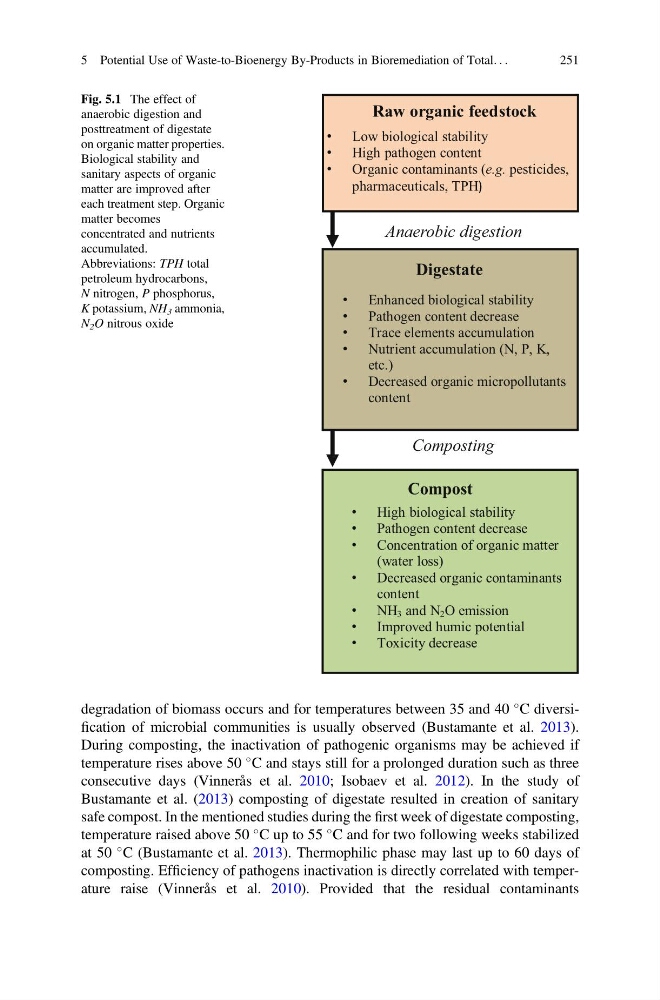
Anaerobic digestion
Raw organic feedstock
Digestate
Compost
Composting
• Low biological stability
• High pathogen content
• Organic contaminants (e.g. pesticides,
pharmaceuticals, TPH)
• Enhanced biological stability
• Pathogen content decrease
• Trace elements accumulation
• Nutrient accumulation (N, P, K,
etc.)
• Decreased organic micropollutants
content
• High biological stability
• Pathogen content decrease
• Concentration of organic matter
(water loss)
• Decreased organic contaminants
content
• NH 3 and N 2 O emission
• Improved humic potential
• Toxicity decrease
Fig. 5.1 The effect of
anaerobic digestion and
posttreatment of digestate
on organic matter properties.
Biological stability and
sanitary aspects of organic
matter are improved after
each treatment step. Organic
matter becomes
concentrated and nutrients
accumulated.
Abbreviations: TPH total
petroleum hydrocarbons,
N nitrogen, P phosphorus,
K potassium, NH 3 ammonia,
N 2 O nitrous oxide
5 Potential Use of Waste-to-Bioenergy By-Products in Bioremediation of Total. . .
251
C diversification of microbial communities is usually observed (Bustamante et al. 2013).
During composting, the inactivation of pathogenic organisms may be achieved if
temperature rises above 50
C and stays still for a prolonged duration such as three
consecutive days (Vinnerås et al. 2010; Isobaev et al. 2012). In the study of
Bustamante et al. (2013) composting of digestate resulted in creation of sanitary
safe compost. In the mentioned studies during the first week of digestate composting,
temperature raised above 50
C up to 55
C and for two following weeks stabilized
at 50
C (Bustamante et al. 2013). Thermophilic phase may last up to 60 days of
composting. Efficiency of pathogens inactivation is directly correlated with temperature raise (Vinnerås et al. 2010). Provided that the residual contaminants
Anaerobic digestion
Raw organic feedstock
Digestate
Compost
Composting
• Low biological stability
• High pathogen content
• Organic contaminants (e.g. pesticides,
pharmaceuticals, TPH)
• Enhanced biological stability
• Pathogen content decrease
• Trace elements accumulation
• Nutrient accumulation (N, P, K,
etc.)
• Decreased organic micropollutants
content
• High biological stability
• Pathogen content decrease
• Concentration of organic matter
(water loss)
• Decreased organic contaminants
content
• NH 3 and N 2 O emission
• Improved humic potential
• Toxicity decrease
Fig. 5.1 The effect of
anaerobic digestion and
posttreatment of digestate
on organic matter properties.
Biological stability and
sanitary aspects of organic
matter are improved after
each treatment step. Organic
matter becomes
concentrated and nutrients
accumulated.
Abbreviations: TPH total
petroleum hydrocarbons,
N nitrogen, P phosphorus,
K potassium, NH 3 ammonia,
N 2 O nitrous oxide
5 Potential Use of Waste-to-Bioenergy By-Products in Bioremediation of Total. . .
251