

composed of hundreds of diverse hydrocarbons (Atlas and Hazen 2011). The main
fractions can be further divided into more specific partitions such as petroleum gas,
naphtha, gasoline, kerosene oil, diesel fuel, paraffin wax, or asphalt.
Some of the physicochemical properties of hydrocarbons from different groups
are presented in Table 5.2. Diffusivity is the magnitude of the molar flux through a
surface per unit concentration gradient. Specific gravity is the ratio of the mass of a
substance to the mass of a reference substance for the same given volume. Water
solubility impacts partially the mobility of contaminants in soil and water bodies.
Vapor pressure value affects mobility into gas phase (i.e., air) and persistence of the
compounds. Henry’s law constant (H ) indicates the tendency of a compound to
evaporate from aqueous phase and is determined by vapor pressure and solubility. If
the H value is higher than 10
À3 atm m
3 mol
À1 , the compound tends to volatilize from
aqueous phase; values lower than 10
À3 atm m
3 mol
À1 may support occurrence of
different processes like sorption to soil particles (Heath et al. 1993). Hydrocarbons
with high volatility value may evaporate from soil before biodegradation takes place.
The octanol/water partition coefficient, expressed as K ow or P used in log 10 form,
describes the hydrophobic or hydrophilic preference and also may help to predict
affinity for water column. K oc is the organic carbon sorption coefficient which
directly indicates sorption to soil organic matter (SOM). The higher is K oc value,
the higher sorption will be observed. Half-life (T 1/2 ) of chemical compounds represents the time required for 50% concentration loss, assuming the first order of
degradation kinetics.
Several studies on hydrocarbons bioremediation reported that n-alkanes and
aromatic compounds are more biodegradable than iso-alkanes and cycloalkanes
(Salanitro 2001; Mao et al. 2009). However, biodegradation efficiency which
means the extent to which contaminants are biodegraded, of individual compounds
depends on conditions present on site or applied treatment approach. For example,
high oxygen supply may support degradation of aromatic hydrocarbons up to three
rings. It was observed that in well-aerated soils, the degradation of these aromatics
was faster in comparison to respective alkanes (Fedorak and Westlake 1981; Mao
et al. 2009). Different decomposition time between hydrocarbons groups is also
related to bioavailability (Salanitro 2001). Water soluble hydrocarbons are more
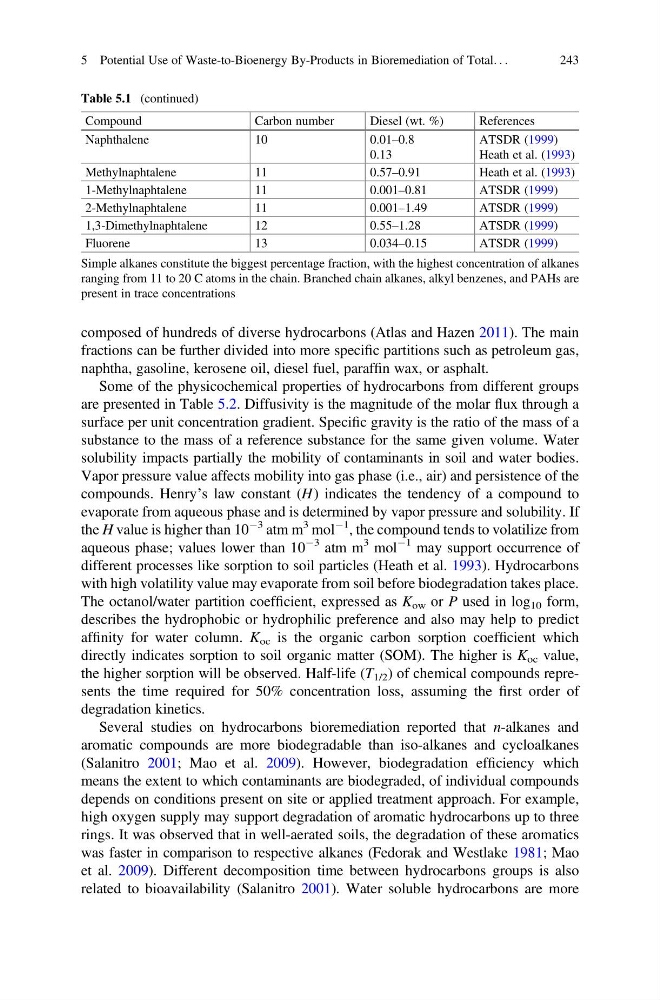
Table 5.1 (continued)
Compound
Carbon number
Diesel (wt. %)
References
Naphthalene
10
0.01–0.8
0.13
ATSDR (1999)
Heath et al. (1993)
Methylnaphtalene
11
0.57–0.91
Heath et al. (1993)
1-Methylnaphtalene
11
0.001–0.81
ATSDR (1999)
2-Methylnaphtalene
11
0.001–1.49
ATSDR (1999)
1,3-Dimethylnaphtalene
12
0.55–1.28
ATSDR (1999)
Fluorene
13
0.034–0.15
ATSDR (1999)
Simple alkanes constitute the biggest percentage fraction, with the highest concentration of alkanes
ranging from 11 to 20 C atoms in the chain. Branched chain alkanes, alkyl benzenes, and PAHs are
present in trace concentrations
5 Potential Use of Waste-to-Bioenergy By-Products in Bioremediation of Total. . .
243
fractions can be further divided into more specific partitions such as petroleum gas,
naphtha, gasoline, kerosene oil, diesel fuel, paraffin wax, or asphalt.
Some of the physicochemical properties of hydrocarbons from different groups
are presented in Table 5.2. Diffusivity is the magnitude of the molar flux through a
surface per unit concentration gradient. Specific gravity is the ratio of the mass of a
substance to the mass of a reference substance for the same given volume. Water
solubility impacts partially the mobility of contaminants in soil and water bodies.
Vapor pressure value affects mobility into gas phase (i.e., air) and persistence of the
compounds. Henry’s law constant (H ) indicates the tendency of a compound to
evaporate from aqueous phase and is determined by vapor pressure and solubility. If
the H value is higher than 10
À3 atm m
3 mol
À1 , the compound tends to volatilize from
aqueous phase; values lower than 10
À3 atm m
3 mol
À1 may support occurrence of
different processes like sorption to soil particles (Heath et al. 1993). Hydrocarbons
with high volatility value may evaporate from soil before biodegradation takes place.
The octanol/water partition coefficient, expressed as K ow or P used in log 10 form,
describes the hydrophobic or hydrophilic preference and also may help to predict
affinity for water column. K oc is the organic carbon sorption coefficient which
directly indicates sorption to soil organic matter (SOM). The higher is K oc value,
the higher sorption will be observed. Half-life (T 1/2 ) of chemical compounds represents the time required for 50% concentration loss, assuming the first order of
degradation kinetics.
Several studies on hydrocarbons bioremediation reported that n-alkanes and
aromatic compounds are more biodegradable than iso-alkanes and cycloalkanes
(Salanitro 2001; Mao et al. 2009). However, biodegradation efficiency which
means the extent to which contaminants are biodegraded, of individual compounds
depends on conditions present on site or applied treatment approach. For example,
high oxygen supply may support degradation of aromatic hydrocarbons up to three
rings. It was observed that in well-aerated soils, the degradation of these aromatics
was faster in comparison to respective alkanes (Fedorak and Westlake 1981; Mao
et al. 2009). Different decomposition time between hydrocarbons groups is also
related to bioavailability (Salanitro 2001). Water soluble hydrocarbons are more
Table 5.1 (continued)
Compound
Carbon number
Diesel (wt. %)
References
Naphthalene
10
0.01–0.8
0.13
ATSDR (1999)
Heath et al. (1993)
Methylnaphtalene
11
0.57–0.91
Heath et al. (1993)
1-Methylnaphtalene
11
0.001–0.81
ATSDR (1999)
2-Methylnaphtalene
11
0.001–1.49
ATSDR (1999)
1,3-Dimethylnaphtalene
12
0.55–1.28
ATSDR (1999)
Fluorene
13
0.034–0.15
ATSDR (1999)
Simple alkanes constitute the biggest percentage fraction, with the highest concentration of alkanes
ranging from 11 to 20 C atoms in the chain. Branched chain alkanes, alkyl benzenes, and PAHs are
present in trace concentrations
5 Potential Use of Waste-to-Bioenergy By-Products in Bioremediation of Total. . .
243