

4.3 Results of Oxidation in Batch
Numerous batch experiments were performed in order to test the different oxidants
and to define the best concentrations and reaction times. The results showed that
1 day was largely sufficient for Fenton and ozone treatment, while persulfate
required more than a week to reach a complete efficiency. One of the key questions
is the role of the presence of Natural Organic Demand (NOD), outlined by several
authors (Siegrist et al. 2011). In this study, the same type of experiments was
performed but using high concentrations of oxidants as it is often done in the field.
Figure 4.2 shows that in a natural soil the oxidation is often more efficient than in
pure silica sand, and thus contradicts the classical concept of decrease of efficiency
in presence of NOD. This may arise from some activation processes.
During these experiments, the role of the oxidant dose on the removal of
contaminants that are not easily degradable like menthol and decane was also
addressed. Figure 4.3 clearly shows that even at concentrations higher than the
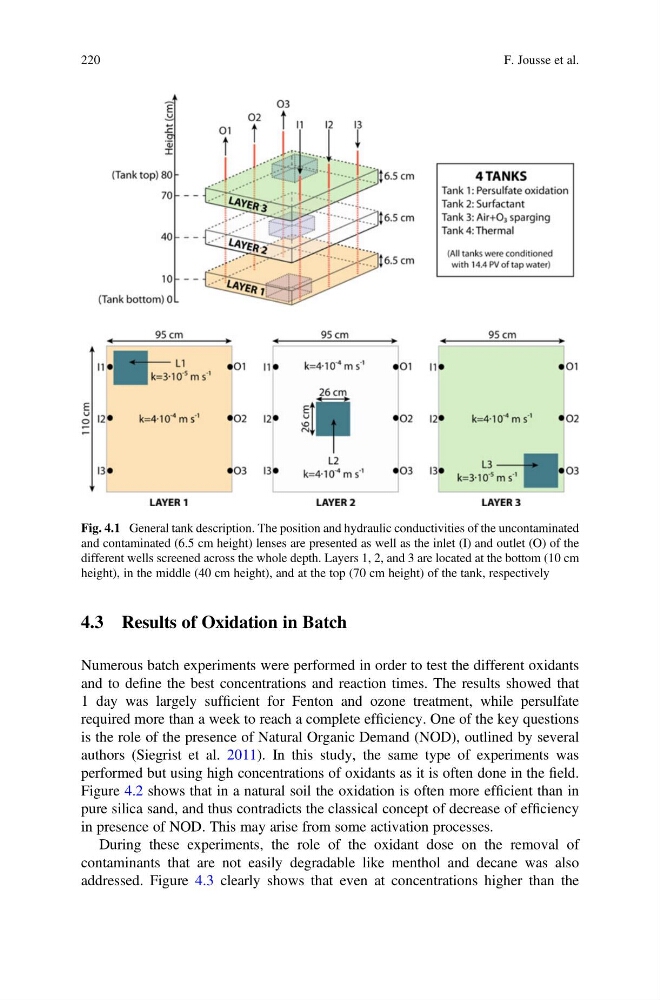
Fig. 4.1 General tank description. The position and hydraulic conductivities of the uncontaminated
and contaminated (6.5 cm height) lenses are presented as well as the inlet (I) and outlet (O) of the
different wells screened across the whole depth. Layers 1, 2, and 3 are located at the bottom (10 cm
height), in the middle (40 cm height), and at the top (70 cm height) of the tank, respectively
220
F. Jousse et al.
Numerous batch experiments were performed in order to test the different oxidants
and to define the best concentrations and reaction times. The results showed that
1 day was largely sufficient for Fenton and ozone treatment, while persulfate
required more than a week to reach a complete efficiency. One of the key questions
is the role of the presence of Natural Organic Demand (NOD), outlined by several
authors (Siegrist et al. 2011). In this study, the same type of experiments was
performed but using high concentrations of oxidants as it is often done in the field.
Figure 4.2 shows that in a natural soil the oxidation is often more efficient than in
pure silica sand, and thus contradicts the classical concept of decrease of efficiency
in presence of NOD. This may arise from some activation processes.
During these experiments, the role of the oxidant dose on the removal of
contaminants that are not easily degradable like menthol and decane was also
addressed. Figure 4.3 clearly shows that even at concentrations higher than the
Fig. 4.1 General tank description. The position and hydraulic conductivities of the uncontaminated
and contaminated (6.5 cm height) lenses are presented as well as the inlet (I) and outlet (O) of the
different wells screened across the whole depth. Layers 1, 2, and 3 are located at the bottom (10 cm
height), in the middle (40 cm height), and at the top (70 cm height) of the tank, respectively
220
F. Jousse et al.