

was to differentiate easily the behavior of linear and cyclic compounds. These
batches were realized using either calibrated fine silica sand (MI32, Sibelco, France)
or a natural uncontaminated silty-sand soil with 1.5% content of organic matter.
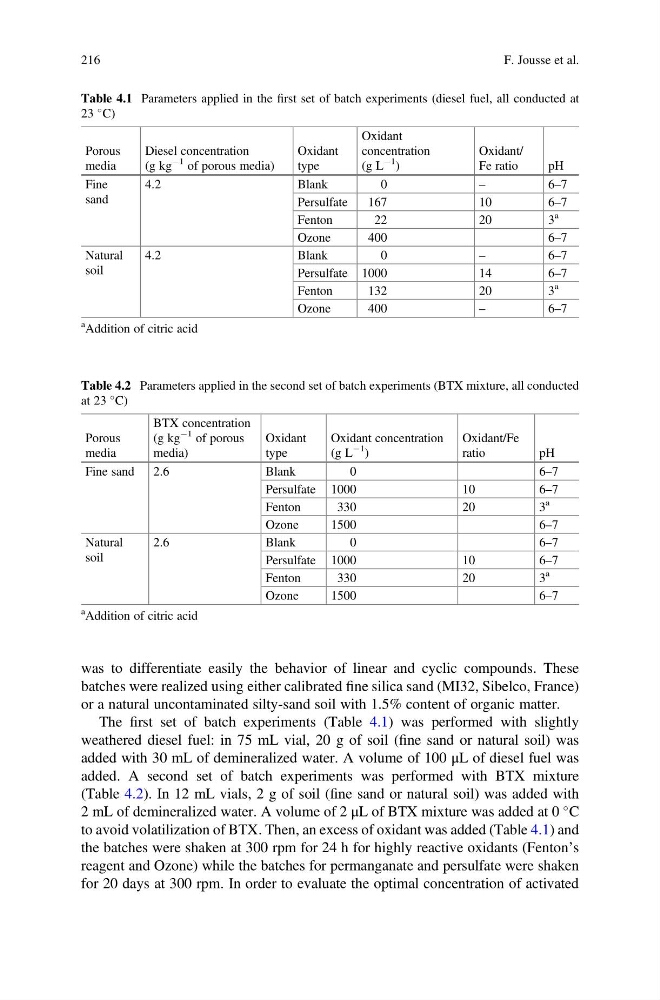
The first set of batch experiments (Table 4.1) was performed with slightly
weathered diesel fuel: in 75 mL vial, 20 g of soil (fine sand or natural soil) was
added with 30 mL of demineralized water. A volume of 100 μL of diesel fuel was
added. A second set of batch experiments was performed with BTX mixture
(Table 4.2). In 12 mL vials, 2 g of soil (fine sand or natural soil) was added with
2 mL of demineralized water. A volume of 2 μL of BTX mixture was added at 0
C
to avoid volatilization of BTX. Then, an excess of oxidant was added (Table 4.1) and
the batches were shaken at 300 rpm for 24 h for highly reactive oxidants (Fenton’s
reagent and Ozone) while the batches for permanganate and persulfate were shaken
for 20 days at 300 rpm. In order to evaluate the optimal concentration of activated
Table 4.1 Parameters applied in the first set of batch experiments (diesel fuel, all conducted at
23
C)
Porous
media
Diesel concentration
(g kg
À1 of porous media)
Oxidant
type
Oxidant
concentration
(g L
À1
)
Oxidant/
Fe ratio
pH
Fine
sand
4.2
Blank
0
–
6–7
Persulfate
167
10
6–7
Fenton
22
20
3
a
Ozone
400
6–7
Natural
soil
4.2
Blank
0
–
6–7
Persulfate 1000
14
6–7
Fenton
132
20
3
a
Ozone
400
–
6–7
a Addition of citric acid
Table 4.2 Parameters applied in the second set of batch experiments (BTX mixture, all conducted
at 23
C)
Porous
media
BTX concentration
(g kg
À1 of porous
media)
Oxidant
type
Oxidant concentration
(g L
À1
)
Oxidant/Fe
ratio
pH
Fine sand 2.6
Blank
0
6–7
Persulfate 1000
10
6–7
Fenton
330
20
3
a
Ozone
1500
6–7
Natural
soil
2.6
Blank
0
6–7
Persulfate 1000
10
6–7
Fenton
330
20
3
a
Ozone
1500
6–7
a Addition of citric acid
216
F. Jousse et al.
batches were realized using either calibrated fine silica sand (MI32, Sibelco, France)
or a natural uncontaminated silty-sand soil with 1.5% content of organic matter.
The first set of batch experiments (Table 4.1) was performed with slightly
weathered diesel fuel: in 75 mL vial, 20 g of soil (fine sand or natural soil) was
added with 30 mL of demineralized water. A volume of 100 μL of diesel fuel was
added. A second set of batch experiments was performed with BTX mixture
(Table 4.2). In 12 mL vials, 2 g of soil (fine sand or natural soil) was added with
2 mL of demineralized water. A volume of 2 μL of BTX mixture was added at 0
C
to avoid volatilization of BTX. Then, an excess of oxidant was added (Table 4.1) and
the batches were shaken at 300 rpm for 24 h for highly reactive oxidants (Fenton’s
reagent and Ozone) while the batches for permanganate and persulfate were shaken
for 20 days at 300 rpm. In order to evaluate the optimal concentration of activated
Table 4.1 Parameters applied in the first set of batch experiments (diesel fuel, all conducted at
23
C)
Porous
media
Diesel concentration
(g kg
À1 of porous media)
Oxidant
type
Oxidant
concentration
(g L
À1
)
Oxidant/
Fe ratio
pH
Fine
sand
4.2
Blank
0
–
6–7
Persulfate
167
10
6–7
Fenton
22
20
3
a
Ozone
400
6–7
Natural
soil
4.2
Blank
0
–
6–7
Persulfate 1000
14
6–7
Fenton
132
20
3
a
Ozone
400
–
6–7
a Addition of citric acid
Table 4.2 Parameters applied in the second set of batch experiments (BTX mixture, all conducted
at 23
C)
Porous
media
BTX concentration
(g kg
À1 of porous
media)
Oxidant
type
Oxidant concentration
(g L
À1
)
Oxidant/Fe
ratio
pH
Fine sand 2.6
Blank
0
6–7
Persulfate 1000
10
6–7
Fenton
330
20
3
a
Ozone
1500
6–7
Natural
soil
2.6
Blank
0
6–7
Persulfate 1000
10
6–7
Fenton
330
20
3
a
Ozone
1500
6–7
a Addition of citric acid
216
F. Jousse et al.