

hydrocarbons such as nonane and BTEX (benzene, toluene, ethylbenzene, and
xylenes). Their partial pressure (P i ) varies exponentially vs. temperature (T )
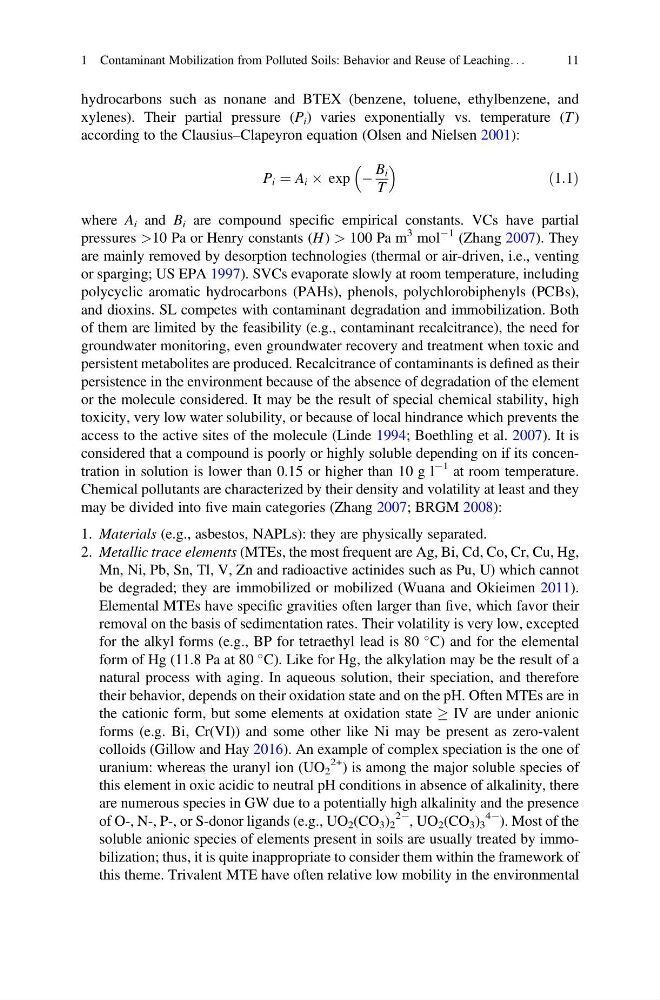
according to the Clausius–Clapeyron equation (Olsen and Nielsen 2001):
P i ¼ A i  exp À
B i
T
ð1:1Þ
where A i and B i are compound specific empirical constants. VCs have partial
pressures >10 Pa or Henry constants (H ) > 100 Pa m
3 mol
À1 (Zhang 2007). They
are mainly removed by desorption technologies (thermal or air-driven, i.e., venting
or sparging; US EPA 1997). SVCs evaporate slowly at room temperature, including
polycyclic aromatic hydrocarbons (PAHs), phenols, polychlorobiphenyls (PCBs),
and dioxins. SL competes with contaminant degradation and immobilization. Both
of them are limited by the feasibility (e.g., contaminant recalcitrance), the need for
groundwater monitoring, even groundwater recovery and treatment when toxic and
persistent metabolites are produced. Recalcitrance of contaminants is defined as their
persistence in the environment because of the absence of degradation of the element
or the molecule considered. It may be the result of special chemical stability, high
toxicity, very low water solubility, or because of local hindrance which prevents the
access to the active sites of the molecule (Linde 1994; Boethling et al. 2007). It is
considered that a compound is poorly or highly soluble depending on if its concentration in solution is lower than 0.15 or higher than 10 g l
À1 at room temperature.
Chemical pollutants are characterized by their density and volatility at least and they
may be divided into five main categories (Zhang 2007; BRGM 2008):
1. Materials (e.g., asbestos, NAPLs): they are physically separated.
2. Metallic trace elements (MTEs, the most frequent are Ag, Bi, Cd, Co, Cr, Cu, Hg,
Mn, Ni, Pb, Sn, Tl, V, Zn and radioactive actinides such as Pu, U) which cannot
be degraded; they are immobilized or mobilized (Wuana and Okieimen 2011).
Elemental MTEs have specific gravities often larger than five, which favor their
removal on the basis of sedimentation rates. Their volatility is very low, excepted
for the alkyl forms (e.g., BP for tetraethyl lead is 80
C) and for the elemental
form of Hg (11.8 Pa at 80
C). Like for Hg, the alkylation may be the result of a
natural process with aging. In aqueous solution, their speciation, and therefore
their behavior, depends on their oxidation state and on the pH. Often MTEs are in
the cationic form, but some elements at oxidation state ! IV are under anionic
forms (e.g. Bi, Cr(VI)) and some other like Ni may be present as zero-valent
colloids (Gillow and Hay 2016). An example of complex speciation is the one of
uranium: whereas the uranyl ion (UO 2
2+ ) is among the major soluble species of
this element in oxic acidic to neutral pH conditions in absence of alkalinity, there
are numerous species in GW due to a potentially high alkalinity and the presence
of O-, N-, P-, or S-donor ligands (e.g., UO 2 (CO 3 ) 2
2À
, UO 2 (CO 3 ) 3
4À ). Most of the
soluble anionic species of elements present in soils are usually treated by immobilization; thus, it is quite inappropriate to consider them within the framework of
this theme. Trivalent MTE have often relative low mobility in the environmental
1 Contaminant Mobilization from Polluted Soils: Behavior and Reuse of Leaching. . .
11
xylenes). Their partial pressure (P i ) varies exponentially vs. temperature (T )
according to the Clausius–Clapeyron equation (Olsen and Nielsen 2001):
P i ¼ A i  exp À
B i
T
ð1:1Þ
where A i and B i are compound specific empirical constants. VCs have partial
pressures >10 Pa or Henry constants (H ) > 100 Pa m
3 mol
À1 (Zhang 2007). They
are mainly removed by desorption technologies (thermal or air-driven, i.e., venting
or sparging; US EPA 1997). SVCs evaporate slowly at room temperature, including
polycyclic aromatic hydrocarbons (PAHs), phenols, polychlorobiphenyls (PCBs),
and dioxins. SL competes with contaminant degradation and immobilization. Both
of them are limited by the feasibility (e.g., contaminant recalcitrance), the need for
groundwater monitoring, even groundwater recovery and treatment when toxic and
persistent metabolites are produced. Recalcitrance of contaminants is defined as their
persistence in the environment because of the absence of degradation of the element
or the molecule considered. It may be the result of special chemical stability, high
toxicity, very low water solubility, or because of local hindrance which prevents the
access to the active sites of the molecule (Linde 1994; Boethling et al. 2007). It is
considered that a compound is poorly or highly soluble depending on if its concentration in solution is lower than 0.15 or higher than 10 g l
À1 at room temperature.
Chemical pollutants are characterized by their density and volatility at least and they
may be divided into five main categories (Zhang 2007; BRGM 2008):
1. Materials (e.g., asbestos, NAPLs): they are physically separated.
2. Metallic trace elements (MTEs, the most frequent are Ag, Bi, Cd, Co, Cr, Cu, Hg,
Mn, Ni, Pb, Sn, Tl, V, Zn and radioactive actinides such as Pu, U) which cannot
be degraded; they are immobilized or mobilized (Wuana and Okieimen 2011).
Elemental MTEs have specific gravities often larger than five, which favor their
removal on the basis of sedimentation rates. Their volatility is very low, excepted
for the alkyl forms (e.g., BP for tetraethyl lead is 80
C) and for the elemental
form of Hg (11.8 Pa at 80
C). Like for Hg, the alkylation may be the result of a
natural process with aging. In aqueous solution, their speciation, and therefore
their behavior, depends on their oxidation state and on the pH. Often MTEs are in
the cationic form, but some elements at oxidation state ! IV are under anionic
forms (e.g. Bi, Cr(VI)) and some other like Ni may be present as zero-valent
colloids (Gillow and Hay 2016). An example of complex speciation is the one of
uranium: whereas the uranyl ion (UO 2
2+ ) is among the major soluble species of
this element in oxic acidic to neutral pH conditions in absence of alkalinity, there
are numerous species in GW due to a potentially high alkalinity and the presence
of O-, N-, P-, or S-donor ligands (e.g., UO 2 (CO 3 ) 2
2À
, UO 2 (CO 3 ) 3
4À ). Most of the
soluble anionic species of elements present in soils are usually treated by immobilization; thus, it is quite inappropriate to consider them within the framework of
this theme. Trivalent MTE have often relative low mobility in the environmental
1 Contaminant Mobilization from Polluted Soils: Behavior and Reuse of Leaching. . .
11