

3.7 Conclusions and Recommendations
In Situ Thermal Treatments (ISTT) may be used in many circumstances. Increasing
the temperature modifies the behavior of organic pollutants by (1) increasing their
vapor pressure, aqueous solubility, Henry’s Law constant, the rate of their (bio)
chemical reactions and (2) decreasing their organic carbon partitioning, liquid
density, liquid viscosity, and interfacial tension. ISTT may solve remediation issues
that cannot otherwise be solved effectively or adequately with any other technique.
These techniques can mainly be implemented to treat concentrated pollution
sources in both saturated and unsaturated zones, as well as in contexts with both
low and high soil heterogeneity. The available thermal techniques allow different
temperature plateaus to be reached: steam-enhanced extraction (170
C), thermal
conductive heating or in situ thermal desorption (750–800
C), electrical resistance
heating (100
C) and radio frequency heating (100–400
C). In the saturated zone
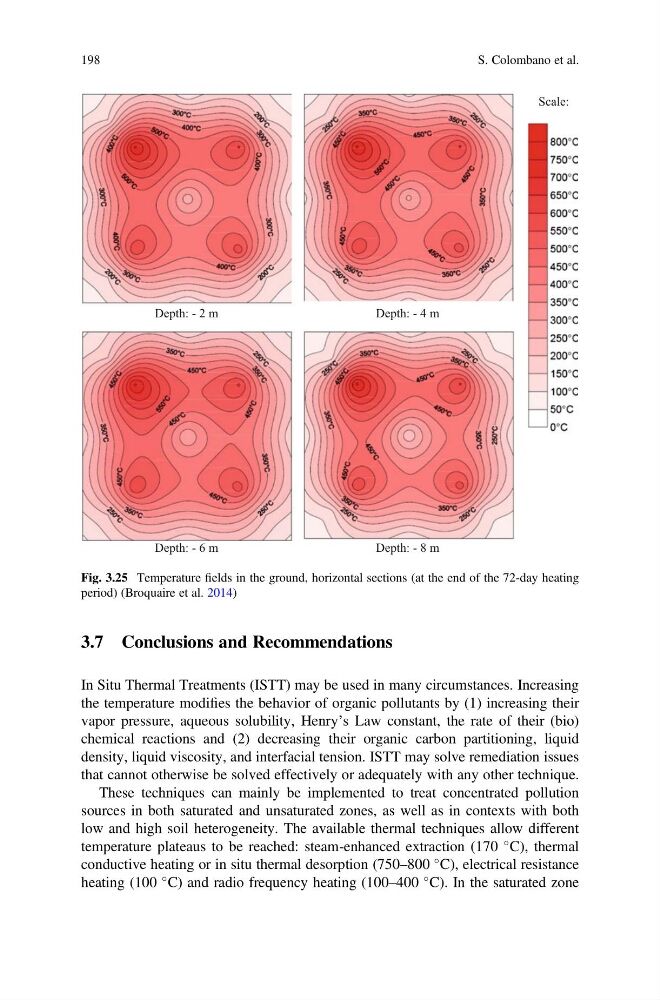
Scale:
Depth: - 2 m
Depth: - 4 m
Depth: - 6 m
Depth: - 8 m
Fig. 3.25 Temperature fields in the ground, horizontal sections (at the end of the 72-day heating
period) (Broquaire et al. 2014)
198
S. Colombano et al.
In Situ Thermal Treatments (ISTT) may be used in many circumstances. Increasing
the temperature modifies the behavior of organic pollutants by (1) increasing their
vapor pressure, aqueous solubility, Henry’s Law constant, the rate of their (bio)
chemical reactions and (2) decreasing their organic carbon partitioning, liquid
density, liquid viscosity, and interfacial tension. ISTT may solve remediation issues
that cannot otherwise be solved effectively or adequately with any other technique.
These techniques can mainly be implemented to treat concentrated pollution
sources in both saturated and unsaturated zones, as well as in contexts with both
low and high soil heterogeneity. The available thermal techniques allow different
temperature plateaus to be reached: steam-enhanced extraction (170
C), thermal
conductive heating or in situ thermal desorption (750–800
C), electrical resistance
heating (100
C) and radio frequency heating (100–400
C). In the saturated zone
Scale:
Depth: - 2 m
Depth: - 4 m
Depth: - 6 m
Depth: - 8 m
Fig. 3.25 Temperature fields in the ground, horizontal sections (at the end of the 72-day heating
period) (Broquaire et al. 2014)
198
S. Colombano et al.