

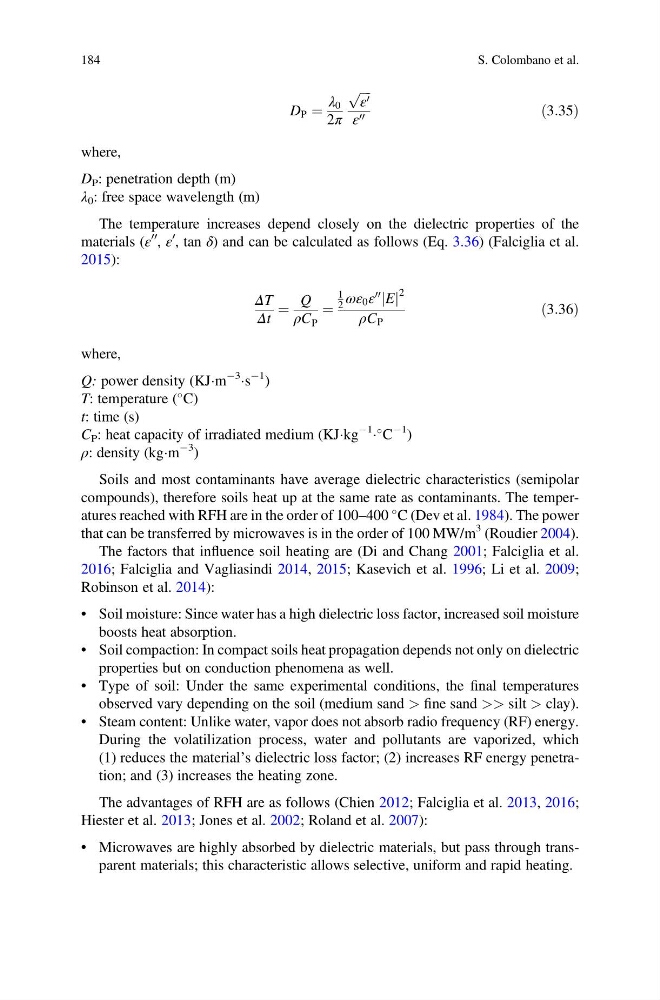
D P ¼
λ 0
2π
ffiffiffi ffi
ε 0
p
ε 00
ð3:35Þ
where,
D P : penetration depth (m)
λ 0 : free space wavelength (m)
The temperature increases depend closely on the dielectric properties of the
materials (ε
00 , ε
0 , tan δ) and can be calculated as follows (Eq. 3.36) (Falciglia et al.
2015):
ΔT
Δt
¼
Q
ρC P
¼
1
2 ωε 0 ε
00 E
j j
2
ρC P
ð3:36Þ
where,
Q: power density (KJÁm
À3 Ás
À1 )
T: temperature (
C)
t: time (s)
C P : heat capacity of irradiated medium (KJÁkg
À1
Á
C
À1 )
ρ: density (kgÁm
À3
)
Soils and most contaminants have average dielectric characteristics (semipolar
compounds), therefore soils heat up at the same rate as contaminants. The temperatures reached with RFH are in the order of 100–400
C (Dev et al. 1984). The power
that can be transferred by microwaves is in the order of 100 MW/m
3 (Roudier 2004).
The factors that influence soil heating are (Di and Chang 2001; Falciglia et al.
2016; Falciglia and Vagliasindi 2014, 2015; Kasevich et al. 1996; Li et al. 2009;
Robinson et al. 2014):
• Soil moisture: Since water has a high dielectric loss factor, increased soil moisture
boosts heat absorption.
• Soil compaction: In compact soils heat propagation depends not only on dielectric
properties but on conduction phenomena as well.
• Type of soil: Under the same experimental conditions, the final temperatures
observed vary depending on the soil (medium sand > fine sand >> silt > clay).
• Steam content: Unlike water, vapor does not absorb radio frequency (RF) energy.
During the volatilization process, water and pollutants are vaporized, which
(1) reduces the material’s dielectric loss factor; (2) increases RF energy penetration; and (3) increases the heating zone.
The advantages of RFH are as follows (Chien 2012; Falciglia et al. 2013, 2016;
Hiester et al. 2013; Jones et al. 2002; Roland et al. 2007):
• Microwaves are highly absorbed by dielectric materials, but pass through transparent materials; this characteristic allows selective, uniform and rapid heating.
184
S. Colombano et al.
λ 0
2π
ffiffiffi ffi
ε 0
p
ε 00
ð3:35Þ
where,
D P : penetration depth (m)
λ 0 : free space wavelength (m)
The temperature increases depend closely on the dielectric properties of the
materials (ε
00 , ε
0 , tan δ) and can be calculated as follows (Eq. 3.36) (Falciglia et al.
2015):
ΔT
Δt
¼
Q
ρC P
¼
1
2 ωε 0 ε
00 E
j j
2
ρC P
ð3:36Þ
where,
Q: power density (KJÁm
À3 Ás
À1 )
T: temperature (
C)
t: time (s)
C P : heat capacity of irradiated medium (KJÁkg
À1
Á
C
À1 )
ρ: density (kgÁm
À3
)
Soils and most contaminants have average dielectric characteristics (semipolar
compounds), therefore soils heat up at the same rate as contaminants. The temperatures reached with RFH are in the order of 100–400
C (Dev et al. 1984). The power
that can be transferred by microwaves is in the order of 100 MW/m
3 (Roudier 2004).
The factors that influence soil heating are (Di and Chang 2001; Falciglia et al.
2016; Falciglia and Vagliasindi 2014, 2015; Kasevich et al. 1996; Li et al. 2009;
Robinson et al. 2014):
• Soil moisture: Since water has a high dielectric loss factor, increased soil moisture
boosts heat absorption.
• Soil compaction: In compact soils heat propagation depends not only on dielectric
properties but on conduction phenomena as well.
• Type of soil: Under the same experimental conditions, the final temperatures
observed vary depending on the soil (medium sand > fine sand >> silt > clay).
• Steam content: Unlike water, vapor does not absorb radio frequency (RF) energy.
During the volatilization process, water and pollutants are vaporized, which
(1) reduces the material’s dielectric loss factor; (2) increases RF energy penetration; and (3) increases the heating zone.
The advantages of RFH are as follows (Chien 2012; Falciglia et al. 2013, 2016;
Hiester et al. 2013; Jones et al. 2002; Roland et al. 2007):
• Microwaves are highly absorbed by dielectric materials, but pass through transparent materials; this characteristic allows selective, uniform and rapid heating.
184
S. Colombano et al.