

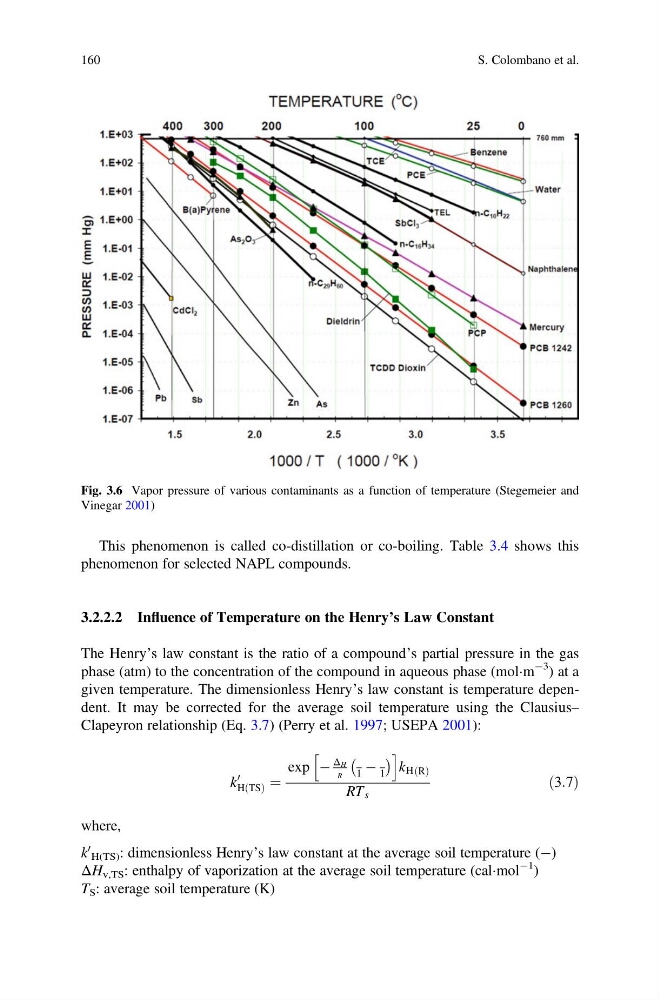
This phenomenon is called co-distillation or co-boiling. Table 3.4 shows this
phenomenon for selected NAPL compounds.
3.2.2.2 Influence of Temperature on the Henry’s Law Constant
The Henry’s law constant is the ratio of a compound’s partial pressure in the gas
phase (atm) to the concentration of the compound in aqueous phase (molÁm
À3 ) at a
given temperature. The dimensionless Henry’s law constant is temperature dependent. It may be corrected for the average soil temperature using the Clausius–
Clapeyron relationship (Eq. 3.7) (Perry et al. 1997; USEPA 2001):
k
0
H TS
ð Þ ¼
exp À
Δ H
R
1 À 1
À
Á
h
i
k H R
ð Þ
RT s
ð3:7Þ
where,
k
0
H(TS) : dimensionless Henry’s law constant at the average soil temperature (À)
ΔH v,TS : enthalpy of vaporization at the average soil temperature (calÁmol
À1 )
T S : average soil temperature (K)
Fig. 3.6 Vapor pressure of various contaminants as a function of temperature (Stegemeier and
Vinegar 2001)
160
S. Colombano et al.
phenomenon for selected NAPL compounds.
3.2.2.2 Influence of Temperature on the Henry’s Law Constant
The Henry’s law constant is the ratio of a compound’s partial pressure in the gas
phase (atm) to the concentration of the compound in aqueous phase (molÁm
À3 ) at a
given temperature. The dimensionless Henry’s law constant is temperature dependent. It may be corrected for the average soil temperature using the Clausius–
Clapeyron relationship (Eq. 3.7) (Perry et al. 1997; USEPA 2001):
k
0
H TS
ð Þ ¼
exp À
Δ H
R
1 À 1
À
Á
h
i
k H R
ð Þ
RT s
ð3:7Þ
where,
k
0
H(TS) : dimensionless Henry’s law constant at the average soil temperature (À)
ΔH v,TS : enthalpy of vaporization at the average soil temperature (calÁmol
À1 )
T S : average soil temperature (K)
Fig. 3.6 Vapor pressure of various contaminants as a function of temperature (Stegemeier and
Vinegar 2001)
160
S. Colombano et al.