

Table 3.1 Potential applicability of various source depletion technologies in two contrasting
hydro-geological situations (USEPA 2003)
Hydraulically accessible (permeable
zones hydraulically connected to wells)
Hydraulically inaccessible
(low-permeability zones or permeable
zones not hydraulically connected to
wells)
DNAPL in
pools: large
mass
a
DNAPL distributed as
residual with small
mass
b
DNAPL of
substantial
mass
DNAPL distributed as
residual with small
mass
b
Co-solvent
P
E
U
U
Electrical
heating
E–P
E
E
P
Oxidation
P
E
U–P
P
Steam
injection
E
E
P
P
Surfactants
P
E
U
U
Waterflooding P
U
U
U
Chemical
reduction
U–P
P
U –P
P
Biological
U
P–E
P
P
E: Expected to be a suitable technology based on field and/or laboratory data and scientific
knowledge
P: Possibly a suitable technology based on current scientific knowledge
U: Unlikely to be a suitable technology (i.e., impractical or not effective in a reasonable time frame)
based on scientific knowledge
When two designations are shown the panel members had differing opinions
a Defined as being free phase and possibly mobile
b
Defined as relatively small residual/distributed pool, discontinuous, not connected, and diffuse
mass
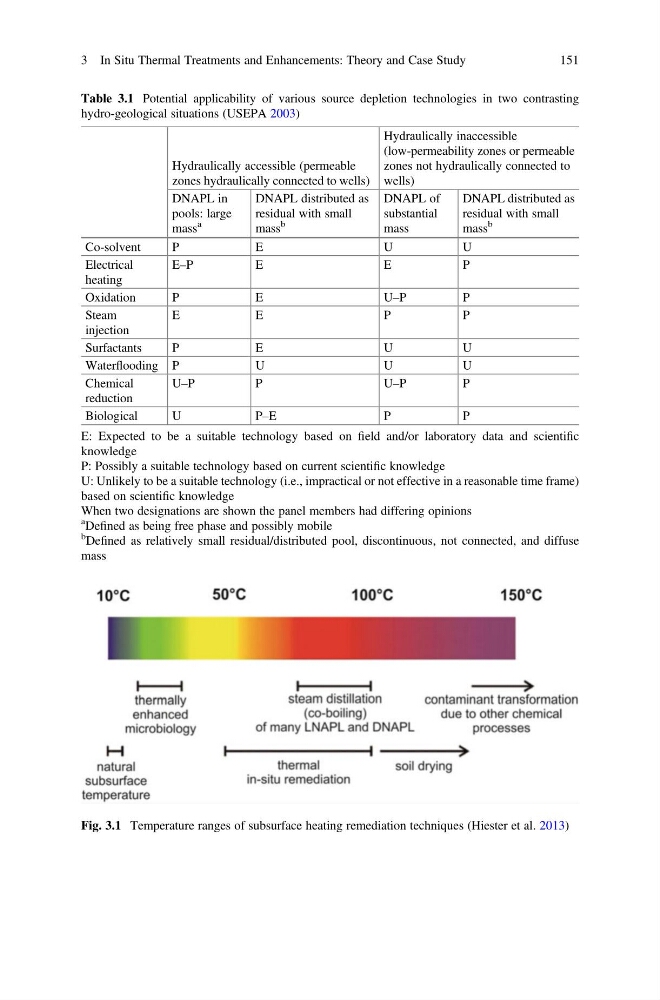
Fig. 3.1 Temperature ranges of subsurface heating remediation techniques (Hiester et al. 2013)
3 In Situ Thermal Treatments and Enhancements: Theory and Case Study
151
hydro-geological situations (USEPA 2003)
Hydraulically accessible (permeable
zones hydraulically connected to wells)
Hydraulically inaccessible
(low-permeability zones or permeable
zones not hydraulically connected to
wells)
DNAPL in
pools: large
mass
a
DNAPL distributed as
residual with small
mass
b
DNAPL of
substantial
mass
DNAPL distributed as
residual with small
mass
b
Co-solvent
P
E
U
U
Electrical
heating
E–P
E
E
P
Oxidation
P
E
U–P
P
Steam
injection
E
E
P
P
Surfactants
P
E
U
U
Waterflooding P
U
U
U
Chemical
reduction
U–P
P
U –P
P
Biological
U
P–E
P
P
E: Expected to be a suitable technology based on field and/or laboratory data and scientific
knowledge
P: Possibly a suitable technology based on current scientific knowledge
U: Unlikely to be a suitable technology (i.e., impractical or not effective in a reasonable time frame)
based on scientific knowledge
When two designations are shown the panel members had differing opinions
a Defined as being free phase and possibly mobile
b
Defined as relatively small residual/distributed pool, discontinuous, not connected, and diffuse
mass
Fig. 3.1 Temperature ranges of subsurface heating remediation techniques (Hiester et al. 2013)
3 In Situ Thermal Treatments and Enhancements: Theory and Case Study
151