

fluctuations in the water table level. Vapor extraction/groundwater extraction was
also ruled out due to the number of wells needed.
Remediation processes were designed using a software program from the American Petroleum Institute (Models for Design of Free-Product Recovery Systems for
Petroleum Hydrocarbon Liquids) (Charbeneau 2007). The goal was to compare the
different treatment techniques (i.e., pumping/skimming, and trench) in terms of
purification yields, treatment duration, and flow rates.
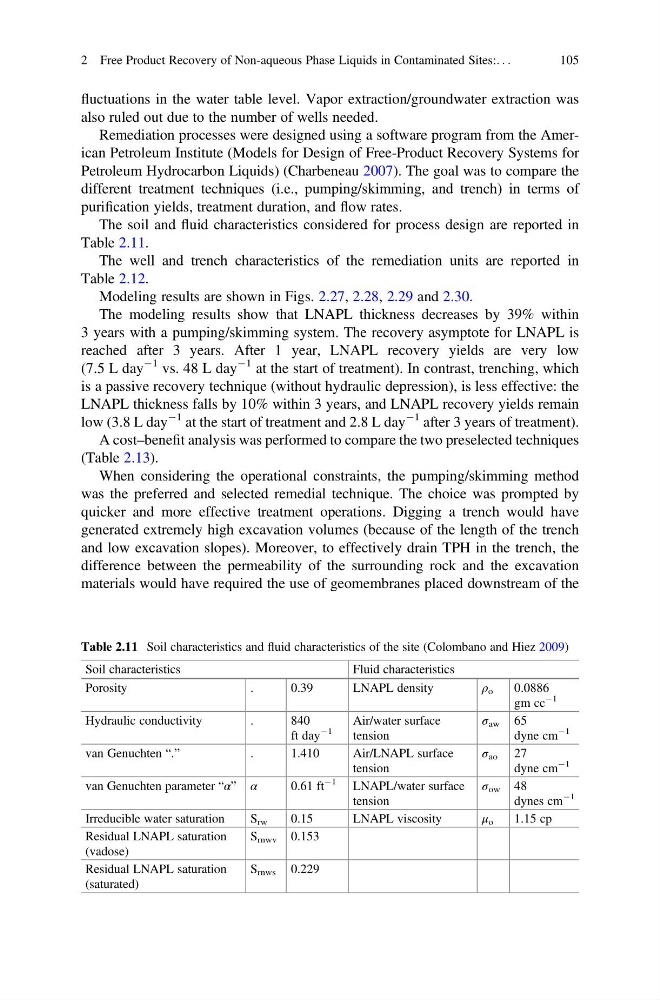
The soil and fluid characteristics considered for process design are reported in
Table 2.11.
The well and trench characteristics of the remediation units are reported in
Table 2.12.
Modeling results are shown in Figs. 2.27, 2.28, 2.29 and 2.30.
The modeling results show that LNAPL thickness decreases by 39% within
3 years with a pumping/skimming system. The recovery asymptote for LNAPL is
reached after 3 years. After 1 year, LNAPL recovery yields are very low
(7.5 L day
À1 vs. 48 L day
À1 at the start of treatment). In contrast, trenching, which
is a passive recovery technique (without hydraulic depression), is less effective: the
LNAPL thickness falls by 10% within 3 years, and LNAPL recovery yields remain
low (3.8 L day
À1 at the start of treatment and 2.8 L day
À1 after 3 years of treatment).
A cost–benefit analysis was performed to compare the two preselected techniques
(Table 2.13).
When considering the operational constraints, the pumping/skimming method
was the preferred and selected remedial technique. The choice was prompted by
quicker and more effective treatment operations. Digging a trench would have
generated extremely high excavation volumes (because of the length of the trench
and low excavation slopes). Moreover, to effectively drain TPH in the trench, the
difference between the permeability of the surrounding rock and the excavation
materials would have required the use of geomembranes placed downstream of the
Table 2.11 Soil characteristics and fluid characteristics of the site (Colombano and Hiez 2009)
Soil characteristics
Fluid characteristics
Porosity
.
0.39
LNAPL density
ρ o
0.0886
gm cc
À1
Hydraulic conductivity
.
840
ft day
À1
Air/water surface
tension
σ aw 65
dyne cm
À1
van Genuchten “.”
.
1.410
Air/LNAPL surface
tension
σ ao 27
dyne cm
À1
van Genuchten parameter “α” α
0.61 ft
À1
LNAPL/water surface
tension
σ ow 48
dynes cm
À1
Irreducible water saturation
S rw
0.15
LNAPL viscosity
μ o
1.15 cp
Residual LNAPL saturation
(vadose)
S rnwv 0.153
Residual LNAPL saturation
(saturated)
S rnws 0.229
2 Free Product Recovery of Non-aqueous Phase Liquids in Contaminated Sites:. . .
105
also ruled out due to the number of wells needed.
Remediation processes were designed using a software program from the American Petroleum Institute (Models for Design of Free-Product Recovery Systems for
Petroleum Hydrocarbon Liquids) (Charbeneau 2007). The goal was to compare the
different treatment techniques (i.e., pumping/skimming, and trench) in terms of
purification yields, treatment duration, and flow rates.
The soil and fluid characteristics considered for process design are reported in
Table 2.11.
The well and trench characteristics of the remediation units are reported in
Table 2.12.
Modeling results are shown in Figs. 2.27, 2.28, 2.29 and 2.30.
The modeling results show that LNAPL thickness decreases by 39% within
3 years with a pumping/skimming system. The recovery asymptote for LNAPL is
reached after 3 years. After 1 year, LNAPL recovery yields are very low
(7.5 L day
À1 vs. 48 L day
À1 at the start of treatment). In contrast, trenching, which
is a passive recovery technique (without hydraulic depression), is less effective: the
LNAPL thickness falls by 10% within 3 years, and LNAPL recovery yields remain
low (3.8 L day
À1 at the start of treatment and 2.8 L day
À1 after 3 years of treatment).
A cost–benefit analysis was performed to compare the two preselected techniques
(Table 2.13).
When considering the operational constraints, the pumping/skimming method
was the preferred and selected remedial technique. The choice was prompted by
quicker and more effective treatment operations. Digging a trench would have
generated extremely high excavation volumes (because of the length of the trench
and low excavation slopes). Moreover, to effectively drain TPH in the trench, the
difference between the permeability of the surrounding rock and the excavation
materials would have required the use of geomembranes placed downstream of the
Table 2.11 Soil characteristics and fluid characteristics of the site (Colombano and Hiez 2009)
Soil characteristics
Fluid characteristics
Porosity
.
0.39
LNAPL density
ρ o
0.0886
gm cc
À1
Hydraulic conductivity
.
840
ft day
À1
Air/water surface
tension
σ aw 65
dyne cm
À1
van Genuchten “.”
.
1.410
Air/LNAPL surface
tension
σ ao 27
dyne cm
À1
van Genuchten parameter “α” α
0.61 ft
À1
LNAPL/water surface
tension
σ ow 48
dynes cm
À1
Irreducible water saturation
S rw
0.15
LNAPL viscosity
μ o
1.15 cp
Residual LNAPL saturation
(vadose)
S rnwv 0.153
Residual LNAPL saturation
(saturated)
S rnws 0.229
2 Free Product Recovery of Non-aqueous Phase Liquids in Contaminated Sites:. . .
105