

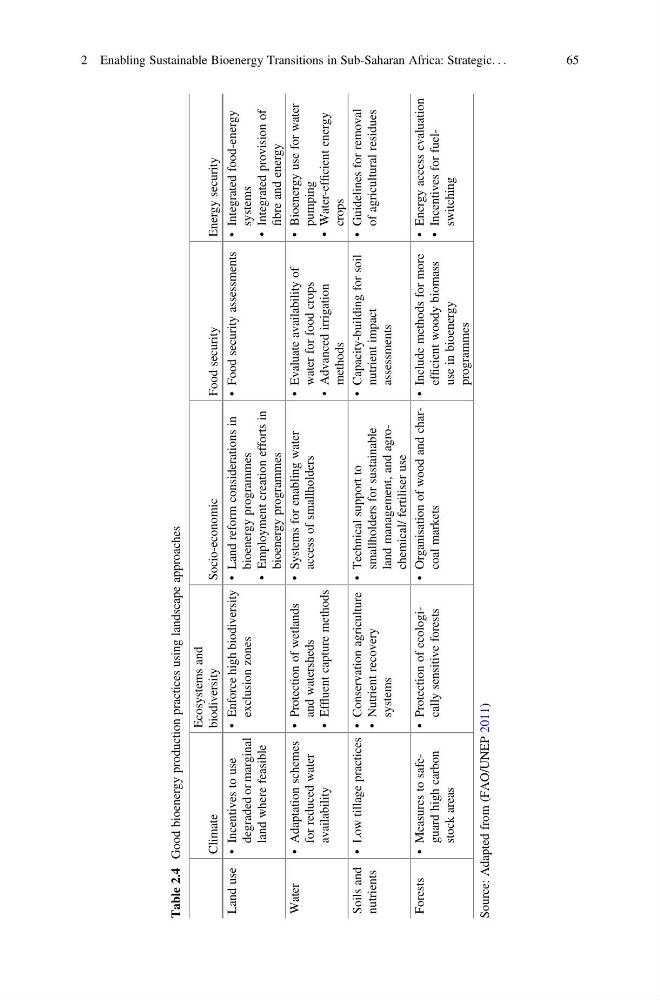
Table 2.4
Good bioenergy production practices using landscape approaches
Climate
Ecosystems and
biodiversity
Socio-economic
Food security
Energy security
Land use
• Incentives to use
degraded or marginal
land where feasible
• Enforce high biodiversity
exclusion zones
• Land reform considerations in
bioenergy programmes
• Employment creation efforts in
bioenergy programmes
• Food security assessments
• Integrated food-energy
systems
• Integrated provision of
fibre and energy
Water
• Adaptation schemes
for reduced water
availability
• Protection of wetlands
and watersheds
• Effluent capture methods
• Systems for enabling water
access of smallholders
• Evaluate availability of
water for food crops
• Advanced irrigation
methods
• Bioenergy use for water
pumping
• Water-efficient energy
crops
Soils and
nutrients
• Low tillage practices
• Conservation agriculture
• Nutrient recovery
systems
• Technical support to
smallholders for sustainable
land management, and agrochemical/ fertiliser use
• Capacity-building for soil
nutrient impact
assessments
• Guidelines for removal
of agricultural residues
Forests
• Measures to safeguard high carbon
stock areas
• Protection of ecologically sensitive forests
• Organisation of wood and charcoal markets
• Include methods for more
efficient woody biomass
use in bioenergy
programmes
• Energy access evaluation
• Incentives for fuelswitching
Source: Adapted from (FAO/UNEP 2011)
2 Enabling Sustainable Bioenergy Transitions in Sub-Saharan Africa: Strategic. . .
65
Good bioenergy production practices using landscape approaches
Climate
Ecosystems and
biodiversity
Socio-economic
Food security
Energy security
Land use
• Incentives to use
degraded or marginal
land where feasible
• Enforce high biodiversity
exclusion zones
• Land reform considerations in
bioenergy programmes
• Employment creation efforts in
bioenergy programmes
• Food security assessments
• Integrated food-energy
systems
• Integrated provision of
fibre and energy
Water
• Adaptation schemes
for reduced water
availability
• Protection of wetlands
and watersheds
• Effluent capture methods
• Systems for enabling water
access of smallholders
• Evaluate availability of
water for food crops
• Advanced irrigation
methods
• Bioenergy use for water
pumping
• Water-efficient energy
crops
Soils and
nutrients
• Low tillage practices
• Conservation agriculture
• Nutrient recovery
systems
• Technical support to
smallholders for sustainable
land management, and agrochemical/ fertiliser use
• Capacity-building for soil
nutrient impact
assessments
• Guidelines for removal
of agricultural residues
Forests
• Measures to safeguard high carbon
stock areas
• Protection of ecologically sensitive forests
• Organisation of wood and charcoal markets
• Include methods for more
efficient woody biomass
use in bioenergy
programmes
• Energy access evaluation
• Incentives for fuelswitching
Source: Adapted from (FAO/UNEP 2011)
2 Enabling Sustainable Bioenergy Transitions in Sub-Saharan Africa: Strategic. . .
65