

10.4 Discussion
10.4.1 Understanding Human–Nature Relationships
in Humid Tropical Forests
Our study finds that the communities in the study area have strong nature-human
relationships in that forest knowledge and the local perceptions of nature are not
isolated from their conception of the world (Sect. 10.3.1). Instead, they are linked to
both the human and spiritual worlds through multiple avenues (see Table 10.1, Sect.
10.3.1). Enhancing human well-being and ensuring livelihoods is central to these
relationships, as these conceptions of human well-being and livelihoods are not just
something abstract, but are shared life objectives within groups, or between community members. This effort to achieve livelihoods and well-being is strongly linked
to the effective mobilization of local knowledge systems for the identification,
classification and utilization of natural resources (Chazdon et al. 2009; Mala et al.
2008a).
Moreover, the social definition of forest is based on the uses and practices (often
associated with the existence of forests and natural resources), and not on fixed
parameters prevalent in technical definitions (see Table 10.2). This finding reflects
studies in other similar forest socio-ecological systems in West Kalimantan (Colfer
and Byron 2001) and southern Cameroon (Dounias and Hladik 1996; Oyono 2002;
Mala and Oyono 2004). All of the above suggest the existence of a social definition
of forests in many of the areas where local communities depend substantially on
them for their livelihoods.
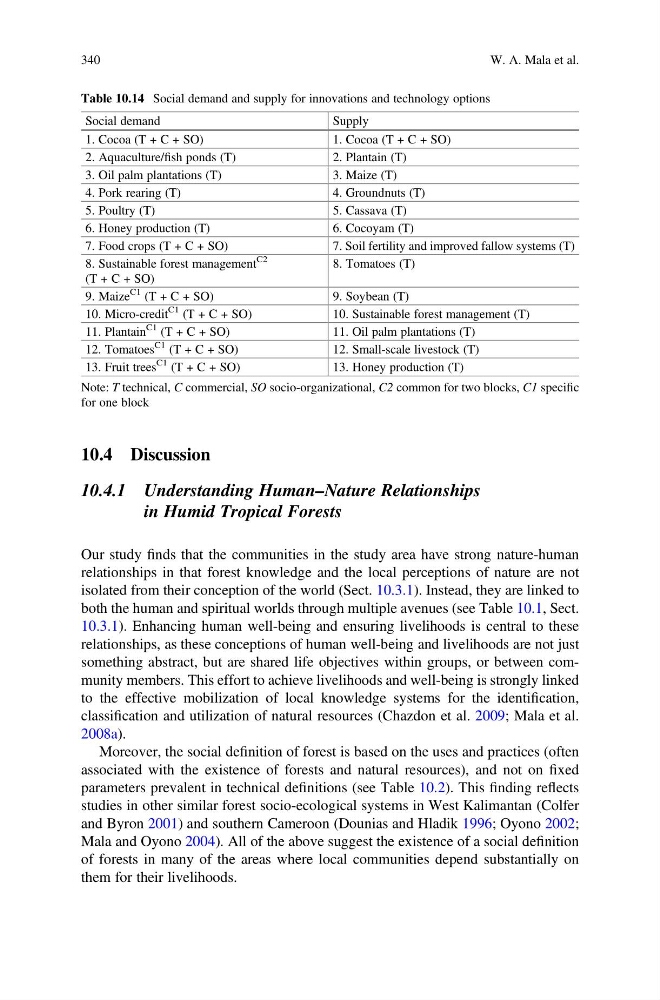
Table 10.14 Social demand and supply for innovations and technology options
Social demand
Supply
1. Cocoa (T + C + SO)
1. Cocoa (T + C + SO)
2. Aquaculture/fish ponds (T)
2. Plantain (T)
3. Oil palm plantations (T)
3. Maize (T)
4. Pork rearing (T)
4. Groundnuts (T)
5. Poultry (T)
5. Cassava (T)
6. Honey production (T)
6. Cocoyam (T)
7. Food crops (T + C + SO)
7. Soil fertility and improved fallow systems (T)
8. Sustainable forest management
C2
(T + C + SO)
8. Tomatoes (T)
9. Maize
C1 (T + C + SO)
9. Soybean (T)
10. Micro-credit
C1 (T + C + SO)
10. Sustainable forest management (T)
11. Plantain
C1 (T + C + SO)
11. Oil palm plantations (T)
12. Tomatoes
C1 (T + C + SO)
12. Small-scale livestock (T)
13. Fruit trees
C1 (T + C + SO)
13. Honey production (T)
Note: T technical, C commercial, SO socio-organizational, C2 common for two blocks, C1 specific
for one block
340
W. A. Mala et al.
10.4.1 Understanding Human–Nature Relationships
in Humid Tropical Forests
Our study finds that the communities in the study area have strong nature-human
relationships in that forest knowledge and the local perceptions of nature are not
isolated from their conception of the world (Sect. 10.3.1). Instead, they are linked to
both the human and spiritual worlds through multiple avenues (see Table 10.1, Sect.
10.3.1). Enhancing human well-being and ensuring livelihoods is central to these
relationships, as these conceptions of human well-being and livelihoods are not just
something abstract, but are shared life objectives within groups, or between community members. This effort to achieve livelihoods and well-being is strongly linked
to the effective mobilization of local knowledge systems for the identification,
classification and utilization of natural resources (Chazdon et al. 2009; Mala et al.
2008a).
Moreover, the social definition of forest is based on the uses and practices (often
associated with the existence of forests and natural resources), and not on fixed
parameters prevalent in technical definitions (see Table 10.2). This finding reflects
studies in other similar forest socio-ecological systems in West Kalimantan (Colfer
and Byron 2001) and southern Cameroon (Dounias and Hladik 1996; Oyono 2002;
Mala and Oyono 2004). All of the above suggest the existence of a social definition
of forests in many of the areas where local communities depend substantially on
them for their livelihoods.
Table 10.14 Social demand and supply for innovations and technology options
Social demand
Supply
1. Cocoa (T + C + SO)
1. Cocoa (T + C + SO)
2. Aquaculture/fish ponds (T)
2. Plantain (T)
3. Oil palm plantations (T)
3. Maize (T)
4. Pork rearing (T)
4. Groundnuts (T)
5. Poultry (T)
5. Cassava (T)
6. Honey production (T)
6. Cocoyam (T)
7. Food crops (T + C + SO)
7. Soil fertility and improved fallow systems (T)
8. Sustainable forest management
C2
(T + C + SO)
8. Tomatoes (T)
9. Maize
C1 (T + C + SO)
9. Soybean (T)
10. Micro-credit
C1 (T + C + SO)
10. Sustainable forest management (T)
11. Plantain
C1 (T + C + SO)
11. Oil palm plantations (T)
12. Tomatoes
C1 (T + C + SO)
12. Small-scale livestock (T)
13. Fruit trees
C1 (T + C + SO)
13. Honey production (T)
Note: T technical, C commercial, SO socio-organizational, C2 common for two blocks, C1 specific
for one block
340
W. A. Mala et al.