

species include non-timber fruit species (e.g. P. americana, Mangifera indica,
E. guineensis, D. edulis, Trichoscypha acuminate, Irvingia gabonensis), as well as
valuable timber species (e.g. Disthemonathus benthamianus, Lophira alata,
Pterocarpus soyauxii, Milicia excelsa, T. superba, T. scleroxylon).
2
10.3.4 Desirable Plant Characteristics for Household
Consumption and Selling
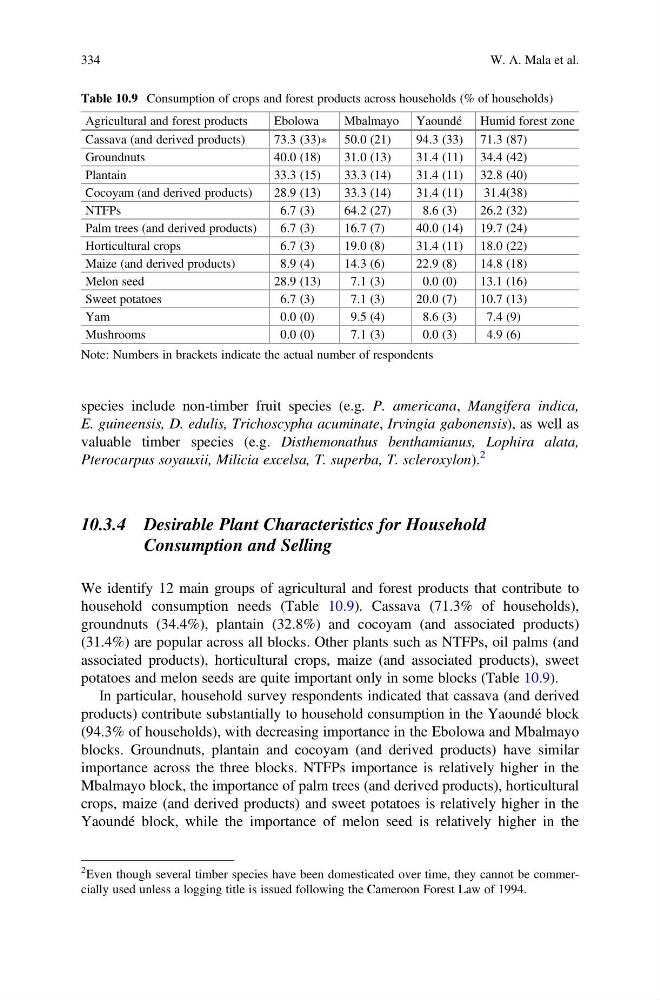
We identify 12 main groups of agricultural and forest products that contribute to
household consumption needs (Table 10.9). Cassava (71.3% of households),
groundnuts (34.4%), plantain (32.8%) and cocoyam (and associated products)
(31.4%) are popular across all blocks. Other plants such as NTFPs, oil palms (and
associated products), horticultural crops, maize (and associated products), sweet
potatoes and melon seeds are quite important only in some blocks (Table 10.9).
In particular, household survey respondents indicated that cassava (and derived
products) contribute substantially to household consumption in the Yaoundé block
(94.3% of households), with decreasing importance in the Ebolowa and Mbalmayo
blocks. Groundnuts, plantain and cocoyam (and derived products) have similar
importance across the three blocks. NTFPs importance is relatively higher in the
Mbalmayo block, the importance of palm trees (and derived products), horticultural
crops, maize (and derived products) and sweet potatoes is relatively higher in the
Yaoundé block, while the importance of melon seed is relatively higher in the
Table 10.9 Consumption of crops and forest products across households (% of households)
Agricultural and forest products
Ebolowa
Mbalmayo Yaoundé Humid forest zone
Cassava (and derived products)
73.3 (33)Ã 50.0 (21)
94.3 (33) 71.3 (87)
Groundnuts
40.0 (18)
31.0 (13)
31.4 (11) 34.4 (42)
Plantain
33.3 (15)
33.3 (14)
31.4 (11) 32.8 (40)
Cocoyam (and derived products)
28.9 (13)
33.3 (14)
31.4 (11)
31.4(38)
NTFPs
6.7 (3)
64.2 (27)
8.6 (3)
26.2 (32)
Palm trees (and derived products)
6.7 (3)
16.7 (7)
40.0 (14) 19.7 (24)
Horticultural crops
6.7 (3)
19.0 (8)
31.4 (11) 18.0 (22)
Maize (and derived products)
8.9 (4)
14.3 (6)
22.9 (8)
14.8 (18)
Melon seed
28.9 (13)
7.1 (3)
0.0 (0)
13.1 (16)
Sweet potatoes
6.7 (3)
7.1 (3)
20.0 (7)
10.7 (13)
Yam
0.0 (0)
9.5 (4)
8.6 (3)
7.4 (9)
Mushrooms
0.0 (0)
7.1 (3)
0.0 (3)
4.9 (6)
Note: Numbers in brackets indicate the actual number of respondents
2 Even though several timber species have been domesticated over time, they cannot be commercially used unless a logging title is issued following the Cameroon Forest Law of 1994.
334
W. A. Mala et al.
E. guineensis, D. edulis, Trichoscypha acuminate, Irvingia gabonensis), as well as
valuable timber species (e.g. Disthemonathus benthamianus, Lophira alata,
Pterocarpus soyauxii, Milicia excelsa, T. superba, T. scleroxylon).
2
10.3.4 Desirable Plant Characteristics for Household
Consumption and Selling
We identify 12 main groups of agricultural and forest products that contribute to
household consumption needs (Table 10.9). Cassava (71.3% of households),
groundnuts (34.4%), plantain (32.8%) and cocoyam (and associated products)
(31.4%) are popular across all blocks. Other plants such as NTFPs, oil palms (and
associated products), horticultural crops, maize (and associated products), sweet
potatoes and melon seeds are quite important only in some blocks (Table 10.9).
In particular, household survey respondents indicated that cassava (and derived
products) contribute substantially to household consumption in the Yaoundé block
(94.3% of households), with decreasing importance in the Ebolowa and Mbalmayo
blocks. Groundnuts, plantain and cocoyam (and derived products) have similar
importance across the three blocks. NTFPs importance is relatively higher in the
Mbalmayo block, the importance of palm trees (and derived products), horticultural
crops, maize (and derived products) and sweet potatoes is relatively higher in the
Yaoundé block, while the importance of melon seed is relatively higher in the
Table 10.9 Consumption of crops and forest products across households (% of households)
Agricultural and forest products
Ebolowa
Mbalmayo Yaoundé Humid forest zone
Cassava (and derived products)
73.3 (33)Ã 50.0 (21)
94.3 (33) 71.3 (87)
Groundnuts
40.0 (18)
31.0 (13)
31.4 (11) 34.4 (42)
Plantain
33.3 (15)
33.3 (14)
31.4 (11) 32.8 (40)
Cocoyam (and derived products)
28.9 (13)
33.3 (14)
31.4 (11)
31.4(38)
NTFPs
6.7 (3)
64.2 (27)
8.6 (3)
26.2 (32)
Palm trees (and derived products)
6.7 (3)
16.7 (7)
40.0 (14) 19.7 (24)
Horticultural crops
6.7 (3)
19.0 (8)
31.4 (11) 18.0 (22)
Maize (and derived products)
8.9 (4)
14.3 (6)
22.9 (8)
14.8 (18)
Melon seed
28.9 (13)
7.1 (3)
0.0 (0)
13.1 (16)
Sweet potatoes
6.7 (3)
7.1 (3)
20.0 (7)
10.7 (13)
Yam
0.0 (0)
9.5 (4)
8.6 (3)
7.4 (9)
Mushrooms
0.0 (0)
7.1 (3)
0.0 (3)
4.9 (6)
Note: Numbers in brackets indicate the actual number of respondents
2 Even though several timber species have been domesticated over time, they cannot be commercially used unless a logging title is issued following the Cameroon Forest Law of 1994.
334
W. A. Mala et al.