

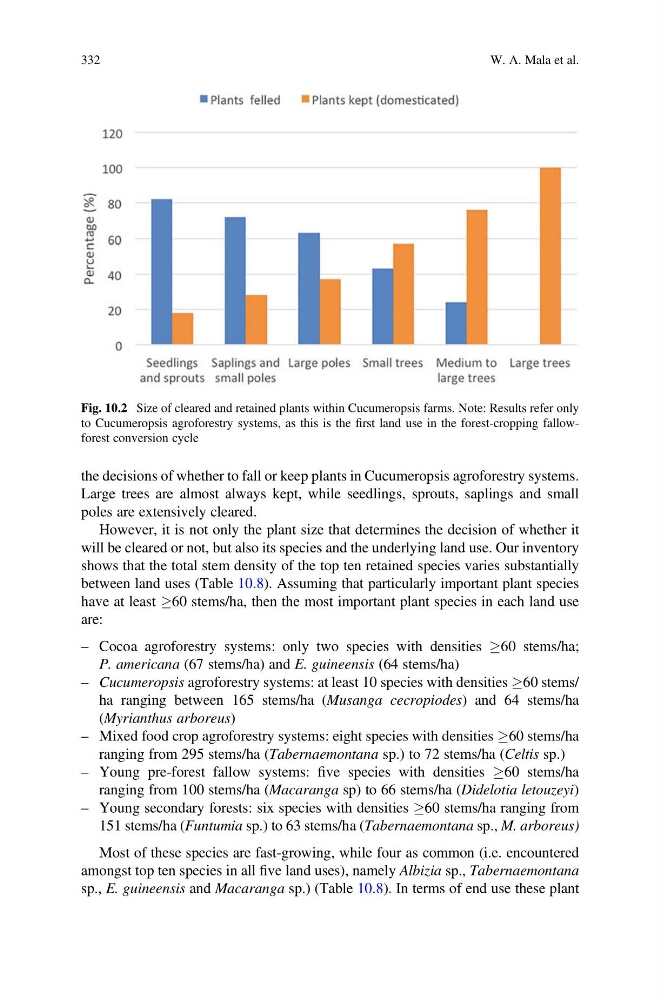
the decisions of whether to fall or keep plants in Cucumeropsis agroforestry systems.
Large trees are almost always kept, while seedlings, sprouts, saplings and small
poles are extensively cleared.
However, it is not only the plant size that determines the decision of whether it
will be cleared or not, but also its species and the underlying land use. Our inventory
shows that the total stem density of the top ten retained species varies substantially
between land uses (Table 10.8). Assuming that particularly important plant species
have at least !60 stems/ha, then the most important plant species in each land use
are:
– Cocoa agroforestry systems: only two species with densities !60 stems/ha;
P. americana (67 stems/ha) and E. guineensis (64 stems/ha)
– Cucumeropsis agroforestry systems: at least 10 species with densities !60 stems/
ha ranging between 165 stems/ha (Musanga cecropiodes) and 64 stems/ha
(Myrianthus arboreus)
– Mixed food crop agroforestry systems: eight species with densities !60 stems/ha
ranging from 295 stems/ha (Tabernaemontana sp.) to 72 stems/ha (Celtis sp.)
– Young pre-forest fallow systems: five species with densities !60 stems/ha
ranging from 100 stems/ha (Macaranga sp) to 66 stems/ha (Didelotia letouzeyi)
– Young secondary forests: six species with densities !60 stems/ha ranging from
151 stems/ha (Funtumia sp.) to 63 stems/ha (Tabernaemontana sp., M. arboreus)
Most of these species are fast-growing, while four as common (i.e. encountered
amongst top ten species in all five land uses), namely Albizia sp., Tabernaemontana
sp., E. guineensis and Macaranga sp.) (Table 10.8). In terms of end use these plant
Fig. 10.2 Size of cleared and retained plants within Cucumeropsis farms. Note: Results refer only
to Cucumeropsis agroforestry systems, as this is the first land use in the forest-cropping fallowforest conversion cycle
332
W. A. Mala et al.
Large trees are almost always kept, while seedlings, sprouts, saplings and small
poles are extensively cleared.
However, it is not only the plant size that determines the decision of whether it
will be cleared or not, but also its species and the underlying land use. Our inventory
shows that the total stem density of the top ten retained species varies substantially
between land uses (Table 10.8). Assuming that particularly important plant species
have at least !60 stems/ha, then the most important plant species in each land use
are:
– Cocoa agroforestry systems: only two species with densities !60 stems/ha;
P. americana (67 stems/ha) and E. guineensis (64 stems/ha)
– Cucumeropsis agroforestry systems: at least 10 species with densities !60 stems/
ha ranging between 165 stems/ha (Musanga cecropiodes) and 64 stems/ha
(Myrianthus arboreus)
– Mixed food crop agroforestry systems: eight species with densities !60 stems/ha
ranging from 295 stems/ha (Tabernaemontana sp.) to 72 stems/ha (Celtis sp.)
– Young pre-forest fallow systems: five species with densities !60 stems/ha
ranging from 100 stems/ha (Macaranga sp) to 66 stems/ha (Didelotia letouzeyi)
– Young secondary forests: six species with densities !60 stems/ha ranging from
151 stems/ha (Funtumia sp.) to 63 stems/ha (Tabernaemontana sp., M. arboreus)
Most of these species are fast-growing, while four as common (i.e. encountered
amongst top ten species in all five land uses), namely Albizia sp., Tabernaemontana
sp., E. guineensis and Macaranga sp.) (Table 10.8). In terms of end use these plant
Fig. 10.2 Size of cleared and retained plants within Cucumeropsis farms. Note: Results refer only
to Cucumeropsis agroforestry systems, as this is the first land use in the forest-cropping fallowforest conversion cycle
332
W. A. Mala et al.