

8.3.2.3 Research Funding and Collaborative Research
There is little documentation describing how industry funds innovation-related
research in Ghana. Industry had, in 2016, the second largest contribution to GDP
(24.2%) after the services sector (56.9%) (GSS 2017). Growth in the industrial sector
has fluctuated over the past decade in response to various events. For example, in
2008, industry’s contribution increased due to large infrastructural developments,
while it declined in 2009 due to unreliable power supply and increasing fuel prices
(Table 8.6). The increasing contribution from 2011 onwards can be credited to the
extraction of crude oil that started in 2010 and increased the mining/quarrying
sub-sector inputs from about 2% to over 8% since 2011. Capital availability has
been the biggest challenge to industrial growth over the past four decades. This is
both in terms of access to capital and the high cost of borrowing due to interest rates,
which sometimes exceeded 42% during that period. The declining value of the
Ghanaian currency
7 has also limited the amount of foreign direct investment
(FDIs) in Ghanaian industries.
UG has successfully collaborated with many domestic industries, mainly through
the transfer of applied science and technology know-how that was introduced into
their manufacturing processes (e.g. Box 8.2). Additional research areas have been
recommended in order to forge a stronger collaboration between the UG and the
industry immediately and in the short- and long term (Table 8.7).
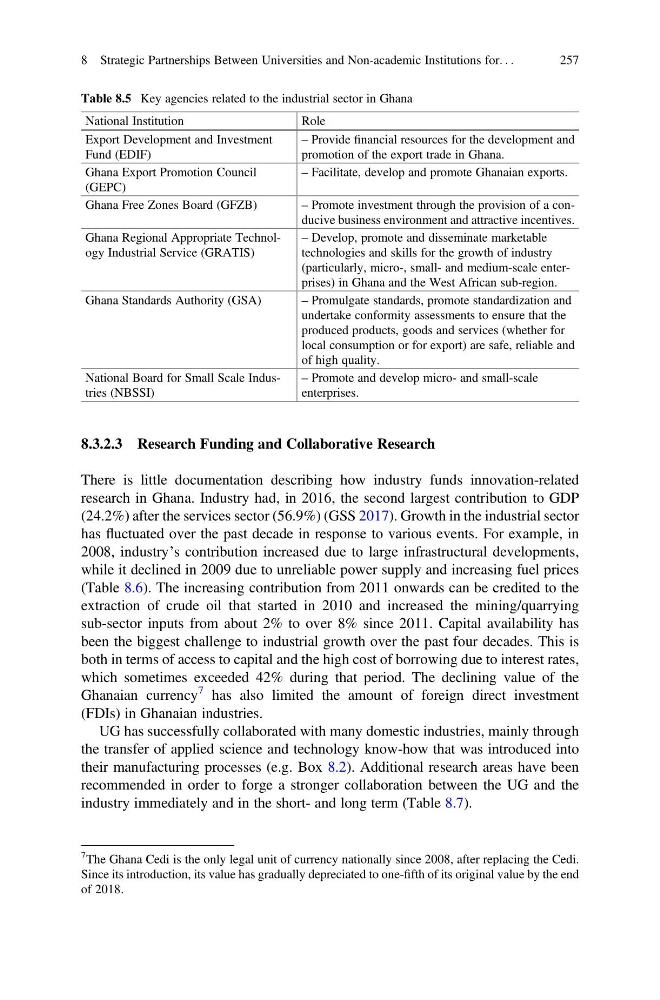
Table 8.5 Key agencies related to the industrial sector in Ghana
National Institution
Role
Export Development and Investment
Fund (EDIF)
– Provide financial resources for the development and
promotion of the export trade in Ghana.
Ghana Export Promotion Council
(GEPC)
– Facilitate, develop and promote Ghanaian exports.
Ghana Free Zones Board (GFZB)
– Promote investment through the provision of a conducive business environment and attractive incentives.
Ghana Regional Appropriate Technology Industrial Service (GRATIS)
– Develop, promote and disseminate marketable
technologies and skills for the growth of industry
(particularly, micro-, small- and medium-scale enterprises) in Ghana and the West African sub-region.
Ghana Standards Authority (GSA)
– Promulgate standards, promote standardization and
undertake conformity assessments to ensure that the
produced products, goods and services (whether for
local consumption or for export) are safe, reliable and
of high quality.
National Board for Small Scale Industries (NBSSI)
– Promote and develop micro- and small-scale
enterprises.
7 The Ghana Cedi is the only legal unit of currency nationally since 2008, after replacing the Cedi.
Since its introduction, its value has gradually depreciated to one-fifth of its original value by the end
of 2018.
8 Strategic Partnerships Between Universities and Non-academic Institutions for. . .
257
There is little documentation describing how industry funds innovation-related
research in Ghana. Industry had, in 2016, the second largest contribution to GDP
(24.2%) after the services sector (56.9%) (GSS 2017). Growth in the industrial sector
has fluctuated over the past decade in response to various events. For example, in
2008, industry’s contribution increased due to large infrastructural developments,
while it declined in 2009 due to unreliable power supply and increasing fuel prices
(Table 8.6). The increasing contribution from 2011 onwards can be credited to the
extraction of crude oil that started in 2010 and increased the mining/quarrying
sub-sector inputs from about 2% to over 8% since 2011. Capital availability has
been the biggest challenge to industrial growth over the past four decades. This is
both in terms of access to capital and the high cost of borrowing due to interest rates,
which sometimes exceeded 42% during that period. The declining value of the
Ghanaian currency
7 has also limited the amount of foreign direct investment
(FDIs) in Ghanaian industries.
UG has successfully collaborated with many domestic industries, mainly through
the transfer of applied science and technology know-how that was introduced into
their manufacturing processes (e.g. Box 8.2). Additional research areas have been
recommended in order to forge a stronger collaboration between the UG and the
industry immediately and in the short- and long term (Table 8.7).
Table 8.5 Key agencies related to the industrial sector in Ghana
National Institution
Role
Export Development and Investment
Fund (EDIF)
– Provide financial resources for the development and
promotion of the export trade in Ghana.
Ghana Export Promotion Council
(GEPC)
– Facilitate, develop and promote Ghanaian exports.
Ghana Free Zones Board (GFZB)
– Promote investment through the provision of a conducive business environment and attractive incentives.
Ghana Regional Appropriate Technology Industrial Service (GRATIS)
– Develop, promote and disseminate marketable
technologies and skills for the growth of industry
(particularly, micro-, small- and medium-scale enterprises) in Ghana and the West African sub-region.
Ghana Standards Authority (GSA)
– Promulgate standards, promote standardization and
undertake conformity assessments to ensure that the
produced products, goods and services (whether for
local consumption or for export) are safe, reliable and
of high quality.
National Board for Small Scale Industries (NBSSI)
– Promote and develop micro- and small-scale
enterprises.
7 The Ghana Cedi is the only legal unit of currency nationally since 2008, after replacing the Cedi.
Since its introduction, its value has gradually depreciated to one-fifth of its original value by the end
of 2018.
8 Strategic Partnerships Between Universities and Non-academic Institutions for. . .
257