

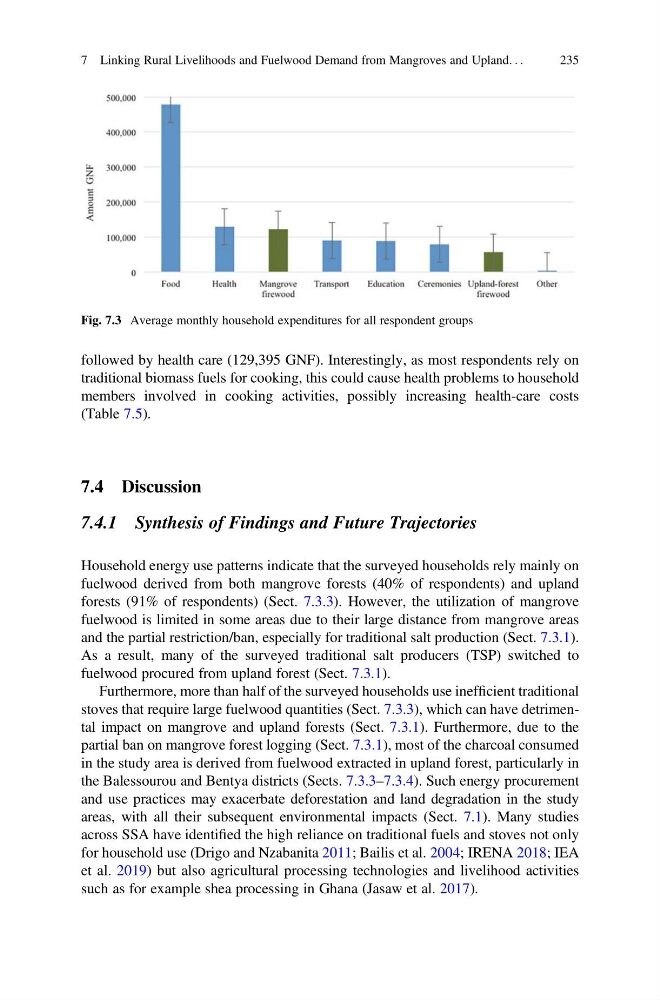
followed by health care (129,395 GNF). Interestingly, as most respondents rely on
traditional biomass fuels for cooking, this could cause health problems to household
members involved in cooking activities, possibly increasing health-care costs
(Table 7.5).
7.4 Discussion
7.4.1 Synthesis of Findings and Future Trajectories
Household energy use patterns indicate that the surveyed households rely mainly on
fuelwood derived from both mangrove forests (40% of respondents) and upland
forests (91% of respondents) (Sect. 7.3.3). However, the utilization of mangrove
fuelwood is limited in some areas due to their large distance from mangrove areas
and the partial restriction/ban, especially for traditional salt production (Sect. 7.3.1).
As a result, many of the surveyed traditional salt producers (TSP) switched to
fuelwood procured from upland forest (Sect. 7.3.1).
Furthermore, more than half of the surveyed households use inefficient traditional
stoves that require large fuelwood quantities (Sect. 7.3.3), which can have detrimental impact on mangrove and upland forests (Sect. 7.3.1). Furthermore, due to the
partial ban on mangrove forest logging (Sect. 7.3.1), most of the charcoal consumed
in the study area is derived from fuelwood extracted in upland forest, particularly in
the Balessourou and Bentya districts (Sects. 7.3.3–7.3.4). Such energy procurement
and use practices may exacerbate deforestation and land degradation in the study
areas, with all their subsequent environmental impacts (Sect. 7.1). Many studies
across SSA have identified the high reliance on traditional fuels and stoves not only
for household use (Drigo and Nzabanita 2011; Bailis et al. 2004; IRENA 2018; IEA
et al. 2019) but also agricultural processing technologies and livelihood activities
such as for example shea processing in Ghana (Jasaw et al. 2017).
Fig. 7.3 Average monthly household expenditures for all respondent groups
7 Linking Rural Livelihoods and Fuelwood Demand from Mangroves and Upland. . .
235
traditional biomass fuels for cooking, this could cause health problems to household
members involved in cooking activities, possibly increasing health-care costs
(Table 7.5).
7.4 Discussion
7.4.1 Synthesis of Findings and Future Trajectories
Household energy use patterns indicate that the surveyed households rely mainly on
fuelwood derived from both mangrove forests (40% of respondents) and upland
forests (91% of respondents) (Sect. 7.3.3). However, the utilization of mangrove
fuelwood is limited in some areas due to their large distance from mangrove areas
and the partial restriction/ban, especially for traditional salt production (Sect. 7.3.1).
As a result, many of the surveyed traditional salt producers (TSP) switched to
fuelwood procured from upland forest (Sect. 7.3.1).
Furthermore, more than half of the surveyed households use inefficient traditional
stoves that require large fuelwood quantities (Sect. 7.3.3), which can have detrimental impact on mangrove and upland forests (Sect. 7.3.1). Furthermore, due to the
partial ban on mangrove forest logging (Sect. 7.3.1), most of the charcoal consumed
in the study area is derived from fuelwood extracted in upland forest, particularly in
the Balessourou and Bentya districts (Sects. 7.3.3–7.3.4). Such energy procurement
and use practices may exacerbate deforestation and land degradation in the study
areas, with all their subsequent environmental impacts (Sect. 7.1). Many studies
across SSA have identified the high reliance on traditional fuels and stoves not only
for household use (Drigo and Nzabanita 2011; Bailis et al. 2004; IRENA 2018; IEA
et al. 2019) but also agricultural processing technologies and livelihood activities
such as for example shea processing in Ghana (Jasaw et al. 2017).
Fig. 7.3 Average monthly household expenditures for all respondent groups
7 Linking Rural Livelihoods and Fuelwood Demand from Mangroves and Upland. . .
235