

bushfires, which are commonly used by locals to access vital ecosystem services
such as bushmeat, fodder, firewood and charcoal (see also Chap. 10 Vol. 1). This
contributes to the overexploitation and further decline of some of the already scarce
plant and animal species (Boafo et al. 2014). It is worth mentioning that when such
events occur, the external assistance from national and international disaster management agencies is the primary adaptive strategy (NADMO 2011).
6.2.3 Data Collection
For Step 3 (see Sect. 6.2.1), we performed preliminary fieldwork during the rainy
period when floods are expected (8–25 August 2013), and during the long dry season
(12–27 April 2014). These preliminary fieldworks involved direct observation,
transect walks, farmland visits and informal interviews with opinion leaders and
local households to understand the main characteristics of the communities, the
hazards and disasters they experience and how they cope with them. Participants
included local community members, agriculture extension officers and disaster
management agencies from the Tolon and Wa West District Assemblies.
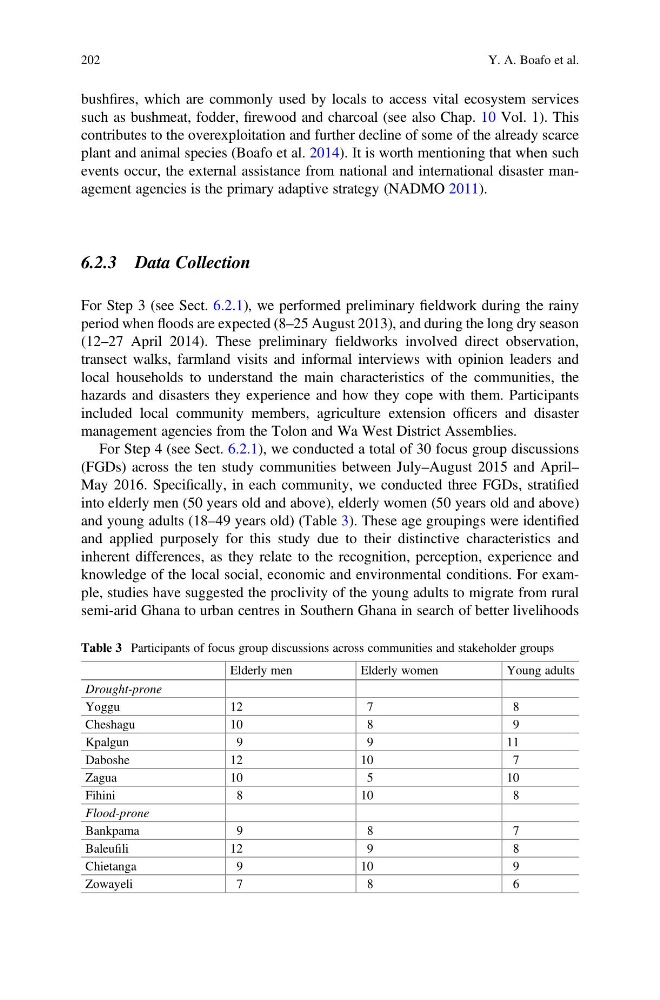
For Step 4 (see Sect. 6.2.1), we conducted a total of 30 focus group discussions
(FGDs) across the ten study communities between July–August 2015 and April–
May 2016. Specifically, in each community, we conducted three FGDs, stratified
into elderly men (50 years old and above), elderly women (50 years old and above)
and young adults (18–49 years old) (Table 3). These age groupings were identified
and applied purposely for this study due to their distinctive characteristics and
inherent differences, as they relate to the recognition, perception, experience and
knowledge of the local social, economic and environmental conditions. For example, studies have suggested the proclivity of the young adults to migrate from rural
semi-arid Ghana to urban centres in Southern Ghana in search of better livelihoods
Table 3 Participants of focus group discussions across communities and stakeholder groups
Elderly men
Elderly women
Young adults
Drought-prone
Yoggu
12
7
8
Cheshagu
10
8
9
Kpalgun
9
9
11
Daboshe
12
10
7
Zagua
10
5
10
Fihini
8
10
8
Flood-prone
Bankpama
9
8
7
Baleufili
12
9
8
Chietanga
9
10
9
Zowayeli
7
8
6
202
Y. A. Boafo et al.
such as bushmeat, fodder, firewood and charcoal (see also Chap. 10 Vol. 1). This
contributes to the overexploitation and further decline of some of the already scarce
plant and animal species (Boafo et al. 2014). It is worth mentioning that when such
events occur, the external assistance from national and international disaster management agencies is the primary adaptive strategy (NADMO 2011).
6.2.3 Data Collection
For Step 3 (see Sect. 6.2.1), we performed preliminary fieldwork during the rainy
period when floods are expected (8–25 August 2013), and during the long dry season
(12–27 April 2014). These preliminary fieldworks involved direct observation,
transect walks, farmland visits and informal interviews with opinion leaders and
local households to understand the main characteristics of the communities, the
hazards and disasters they experience and how they cope with them. Participants
included local community members, agriculture extension officers and disaster
management agencies from the Tolon and Wa West District Assemblies.
For Step 4 (see Sect. 6.2.1), we conducted a total of 30 focus group discussions
(FGDs) across the ten study communities between July–August 2015 and April–
May 2016. Specifically, in each community, we conducted three FGDs, stratified
into elderly men (50 years old and above), elderly women (50 years old and above)
and young adults (18–49 years old) (Table 3). These age groupings were identified
and applied purposely for this study due to their distinctive characteristics and
inherent differences, as they relate to the recognition, perception, experience and
knowledge of the local social, economic and environmental conditions. For example, studies have suggested the proclivity of the young adults to migrate from rural
semi-arid Ghana to urban centres in Southern Ghana in search of better livelihoods
Table 3 Participants of focus group discussions across communities and stakeholder groups
Elderly men
Elderly women
Young adults
Drought-prone
Yoggu
12
7
8
Cheshagu
10
8
9
Kpalgun
9
9
11
Daboshe
12
10
7
Zagua
10
5
10
Fihini
8
10
8
Flood-prone
Bankpama
9
8
7
Baleufili
12
9
8
Chietanga
9
10
9
Zowayeli
7
8
6
202
Y. A. Boafo et al.