

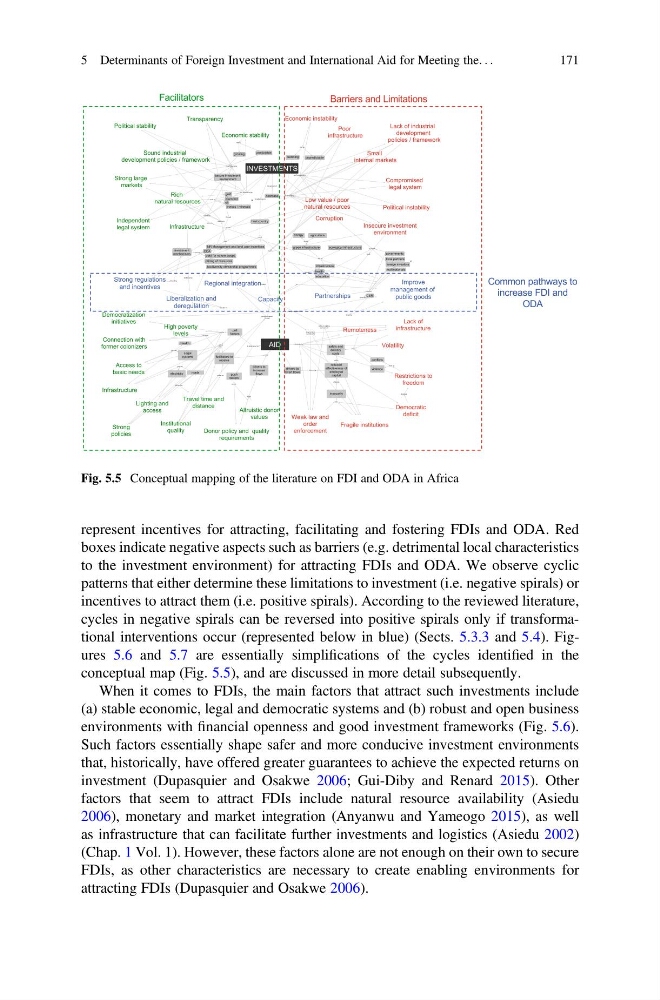
represent incentives for attracting, facilitating and fostering FDIs and ODA. Red
boxes indicate negative aspects such as barriers (e.g. detrimental local characteristics
to the investment environment) for attracting FDIs and ODA. We observe cyclic
patterns that either determine these limitations to investment (i.e. negative spirals) or
incentives to attract them (i.e. positive spirals). According to the reviewed literature,
cycles in negative spirals can be reversed into positive spirals only if transformational interventions occur (represented below in blue) (Sects. 5.3.3 and 5.4). Figures 5.6 and 5.7 are essentially simplifications of the cycles identified in the
conceptual map (Fig. 5.5), and are discussed in more detail subsequently.
When it comes to FDIs, the main factors that attract such investments include
(a) stable economic, legal and democratic systems and (b) robust and open business
environments with financial openness and good investment frameworks (Fig. 5.6).
Such factors essentially shape safer and more conducive investment environments
that, historically, have offered greater guarantees to achieve the expected returns on
investment (Dupasquier and Osakwe 2006; Gui-Diby and Renard 2015). Other
factors that seem to attract FDIs include natural resource availability (Asiedu
2006), monetary and market integration (Anyanwu and Yameogo 2015), as well
as infrastructure that can facilitate further investments and logistics (Asiedu 2002)
(Chap. 1 Vol. 1). However, these factors alone are not enough on their own to secure
FDIs, as other characteristics are necessary to create enabling environments for
attracting FDIs (Dupasquier and Osakwe 2006).
Fig. 5.5 Conceptual mapping of the literature on FDI and ODA in Africa
5 Determinants of Foreign Investment and International Aid for Meeting the. . .
171
boxes indicate negative aspects such as barriers (e.g. detrimental local characteristics
to the investment environment) for attracting FDIs and ODA. We observe cyclic
patterns that either determine these limitations to investment (i.e. negative spirals) or
incentives to attract them (i.e. positive spirals). According to the reviewed literature,
cycles in negative spirals can be reversed into positive spirals only if transformational interventions occur (represented below in blue) (Sects. 5.3.3 and 5.4). Figures 5.6 and 5.7 are essentially simplifications of the cycles identified in the
conceptual map (Fig. 5.5), and are discussed in more detail subsequently.
When it comes to FDIs, the main factors that attract such investments include
(a) stable economic, legal and democratic systems and (b) robust and open business
environments with financial openness and good investment frameworks (Fig. 5.6).
Such factors essentially shape safer and more conducive investment environments
that, historically, have offered greater guarantees to achieve the expected returns on
investment (Dupasquier and Osakwe 2006; Gui-Diby and Renard 2015). Other
factors that seem to attract FDIs include natural resource availability (Asiedu
2006), monetary and market integration (Anyanwu and Yameogo 2015), as well
as infrastructure that can facilitate further investments and logistics (Asiedu 2002)
(Chap. 1 Vol. 1). However, these factors alone are not enough on their own to secure
FDIs, as other characteristics are necessary to create enabling environments for
attracting FDIs (Dupasquier and Osakwe 2006).
Fig. 5.5 Conceptual mapping of the literature on FDI and ODA in Africa
5 Determinants of Foreign Investment and International Aid for Meeting the. . .
171