

practice fulfil both the national regulation and the requirements set by the EU RED
or SCL schemes. Similarly, sometimes the EU regulation has made it difficult for
Member-States to apply sustainability criteria. More specifically, the certification
through private voluntary initiatives requires the harmonisation of public and private
regulation, and the trust between the actors involved at the different levels. In such
contexts, programs with non-corporate governing bodies and/or involving NGOs
can provide greater independence from business interests, increasing legitimacy and
therefore trust (Zezza 2013).
It is worth mentioning that many of the SCL schemes provide only suggestions or
require ‘good practices’, but only a few explicitly provide ‘certification’ to the
adopting companies. For instance, compliance to ISO standards is voluntary, and
certification is possible but not obligatory. In this sense, ISO does not perform
certification per se, and therefore a company/organisation cannot be certified by
ISO itself. Instead, non-mandatory external certification is performed by independent bodies (mostly private) to verify the compliance with ISO standards. An
alternative to third-party certification is ‘second-party’ verification performed by
the customers of the organisation or a self-declaration of conformity with the
standard (ISO 2011). SCL shemes with mandatory requirements often require the
adherence to relevant national or international regulations, such as the ILO standards. However, many of these SCL schemes are not always well aligned with key
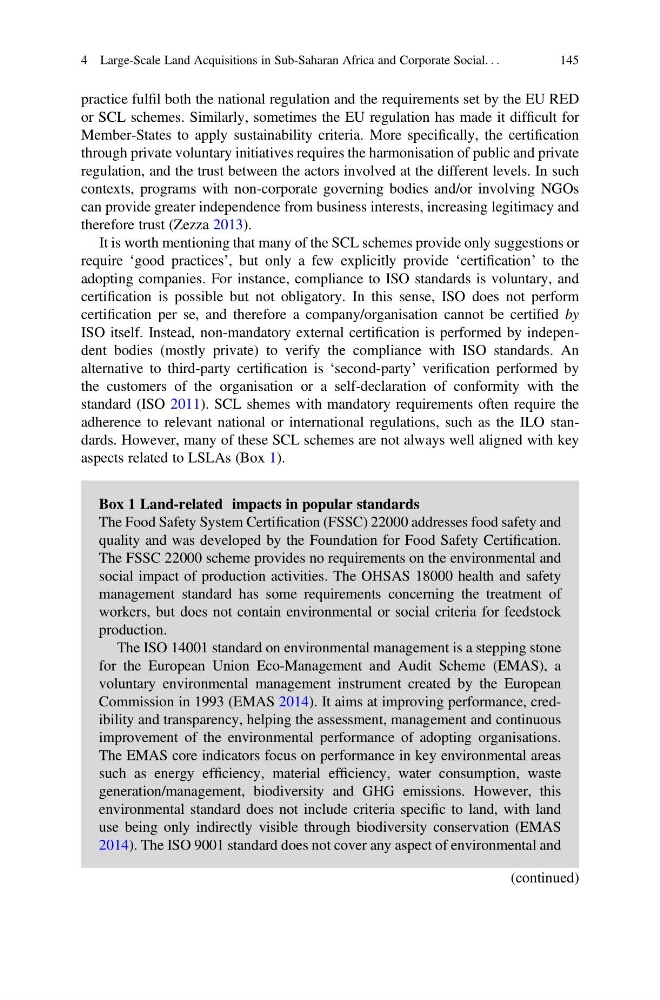
aspects related to LSLAs (Box 1).
Box 1 Land-related impacts in popular standards
The Food Safety System Certification (FSSC) 22000 addresses food safety and
quality and was developed by the Foundation for Food Safety Certification.
The FSSC 22000 scheme provides no requirements on the environmental and
social impact of production activities. The OHSAS 18000 health and safety
management standard has some requirements concerning the treatment of
workers, but does not contain environmental or social criteria for feedstock
production.
The ISO 14001 standard on environmental management is a stepping stone
for the European Union Eco-Management and Audit Scheme (EMAS), a
voluntary environmental management instrument created by the European
Commission in 1993 (EMAS 2014). It aims at improving performance, credibility and transparency, helping the assessment, management and continuous
improvement of the environmental performance of adopting organisations.
The EMAS core indicators focus on performance in key environmental areas
such as energy efficiency, material efficiency, water consumption, waste
generation/management, biodiversity and GHG emissions. However, this
environmental standard does not include criteria specific to land, with land
use being only indirectly visible through biodiversity conservation (EMAS
2014). The ISO 9001 standard does not cover any aspect of environmental and
(continued)
4 Large-Scale Land Acquisitions in Sub-Saharan Africa and Corporate Social. . .
145
or SCL schemes. Similarly, sometimes the EU regulation has made it difficult for
Member-States to apply sustainability criteria. More specifically, the certification
through private voluntary initiatives requires the harmonisation of public and private
regulation, and the trust between the actors involved at the different levels. In such
contexts, programs with non-corporate governing bodies and/or involving NGOs
can provide greater independence from business interests, increasing legitimacy and
therefore trust (Zezza 2013).
It is worth mentioning that many of the SCL schemes provide only suggestions or
require ‘good practices’, but only a few explicitly provide ‘certification’ to the
adopting companies. For instance, compliance to ISO standards is voluntary, and
certification is possible but not obligatory. In this sense, ISO does not perform
certification per se, and therefore a company/organisation cannot be certified by
ISO itself. Instead, non-mandatory external certification is performed by independent bodies (mostly private) to verify the compliance with ISO standards. An
alternative to third-party certification is ‘second-party’ verification performed by
the customers of the organisation or a self-declaration of conformity with the
standard (ISO 2011). SCL shemes with mandatory requirements often require the
adherence to relevant national or international regulations, such as the ILO standards. However, many of these SCL schemes are not always well aligned with key
aspects related to LSLAs (Box 1).
Box 1 Land-related impacts in popular standards
The Food Safety System Certification (FSSC) 22000 addresses food safety and
quality and was developed by the Foundation for Food Safety Certification.
The FSSC 22000 scheme provides no requirements on the environmental and
social impact of production activities. The OHSAS 18000 health and safety
management standard has some requirements concerning the treatment of
workers, but does not contain environmental or social criteria for feedstock
production.
The ISO 14001 standard on environmental management is a stepping stone
for the European Union Eco-Management and Audit Scheme (EMAS), a
voluntary environmental management instrument created by the European
Commission in 1993 (EMAS 2014). It aims at improving performance, credibility and transparency, helping the assessment, management and continuous
improvement of the environmental performance of adopting organisations.
The EMAS core indicators focus on performance in key environmental areas
such as energy efficiency, material efficiency, water consumption, waste
generation/management, biodiversity and GHG emissions. However, this
environmental standard does not include criteria specific to land, with land
use being only indirectly visible through biodiversity conservation (EMAS
2014). The ISO 9001 standard does not cover any aspect of environmental and
(continued)
4 Large-Scale Land Acquisitions in Sub-Saharan Africa and Corporate Social. . .
145