

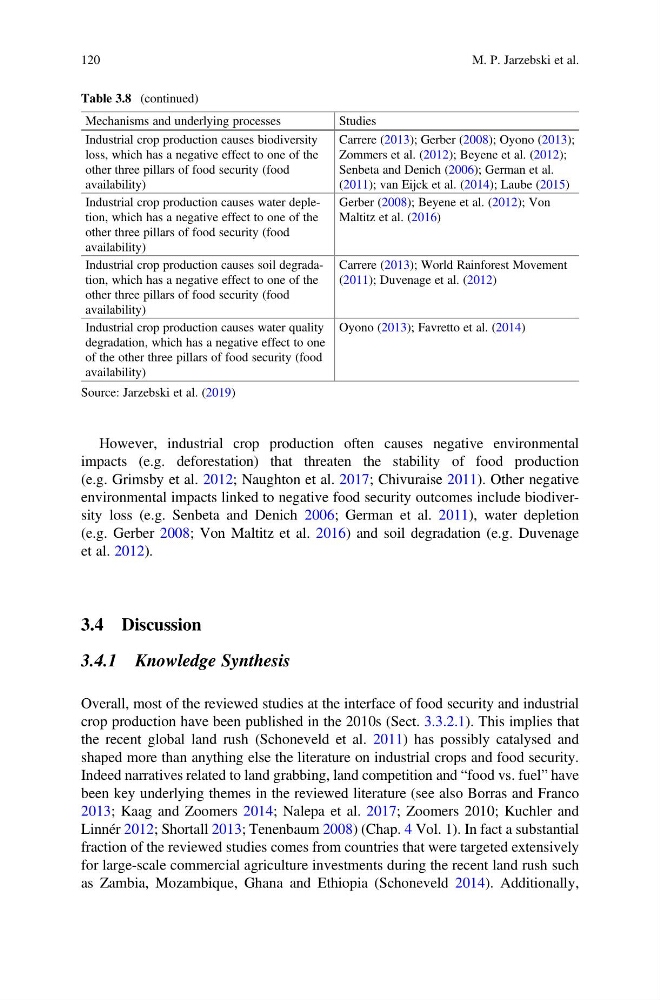
However, industrial crop production often causes negative environmental
impacts (e.g. deforestation) that threaten the stability of food production
(e.g. Grimsby et al. 2012; Naughton et al. 2017; Chivuraise 2011). Other negative
environmental impacts linked to negative food security outcomes include biodiversity loss (e.g. Senbeta and Denich 2006; German et al. 2011), water depletion
(e.g. Gerber 2008; Von Maltitz et al. 2016) and soil degradation (e.g. Duvenage
et al. 2012).
3.4 Discussion
3.4.1 Knowledge Synthesis
Overall, most of the reviewed studies at the interface of food security and industrial
crop production have been published in the 2010s (Sect. 3.3.2.1). This implies that
the recent global land rush (Schoneveld et al. 2011) has possibly catalysed and
shaped more than anything else the literature on industrial crops and food security.
Indeed narratives related to land grabbing, land competition and “food vs. fuel” have
been key underlying themes in the reviewed literature (see also Borras and Franco
2013; Kaag and Zoomers 2014; Nalepa et al. 2017; Zoomers 2010; Kuchler and
Linnér 2012; Shortall 2013; Tenenbaum 2008) (Chap. 4 Vol. 1). In fact a substantial
fraction of the reviewed studies comes from countries that were targeted extensively
for large-scale commercial agriculture investments during the recent land rush such
as Zambia, Mozambique, Ghana and Ethiopia (Schoneveld 2014). Additionally,
Table 3.8 (continued)
Mechanisms and underlying processes
Studies
Industrial crop production causes biodiversity
loss, which has a negative effect to one of the
other three pillars of food security (food
availability)
Carrere (2013); Gerber (2008); Oyono (2013);
Zommers et al. (2012); Beyene et al. (2012);
Senbeta and Denich (2006); German et al.
(2011); van Eijck et al. (2014); Laube (2015)
Industrial crop production causes water depletion, which has a negative effect to one of the
other three pillars of food security (food
availability)
Gerber (2008); Beyene et al. (2012); Von
Maltitz et al. (2016)
Industrial crop production causes soil degradation, which has a negative effect to one of the
other three pillars of food security (food
availability)
Carrere (2013); World Rainforest Movement
(2011); Duvenage et al. (2012)
Industrial crop production causes water quality
degradation, which has a negative effect to one
of the other three pillars of food security (food
availability)
Oyono (2013); Favretto et al. (2014)
Source: Jarzebski et al. (2019)
120
M. P. Jarzebski et al.
impacts (e.g. deforestation) that threaten the stability of food production
(e.g. Grimsby et al. 2012; Naughton et al. 2017; Chivuraise 2011). Other negative
environmental impacts linked to negative food security outcomes include biodiversity loss (e.g. Senbeta and Denich 2006; German et al. 2011), water depletion
(e.g. Gerber 2008; Von Maltitz et al. 2016) and soil degradation (e.g. Duvenage
et al. 2012).
3.4 Discussion
3.4.1 Knowledge Synthesis
Overall, most of the reviewed studies at the interface of food security and industrial
crop production have been published in the 2010s (Sect. 3.3.2.1). This implies that
the recent global land rush (Schoneveld et al. 2011) has possibly catalysed and
shaped more than anything else the literature on industrial crops and food security.
Indeed narratives related to land grabbing, land competition and “food vs. fuel” have
been key underlying themes in the reviewed literature (see also Borras and Franco
2013; Kaag and Zoomers 2014; Nalepa et al. 2017; Zoomers 2010; Kuchler and
Linnér 2012; Shortall 2013; Tenenbaum 2008) (Chap. 4 Vol. 1). In fact a substantial
fraction of the reviewed studies comes from countries that were targeted extensively
for large-scale commercial agriculture investments during the recent land rush such
as Zambia, Mozambique, Ghana and Ethiopia (Schoneveld 2014). Additionally,
Table 3.8 (continued)
Mechanisms and underlying processes
Studies
Industrial crop production causes biodiversity
loss, which has a negative effect to one of the
other three pillars of food security (food
availability)
Carrere (2013); Gerber (2008); Oyono (2013);
Zommers et al. (2012); Beyene et al. (2012);
Senbeta and Denich (2006); German et al.
(2011); van Eijck et al. (2014); Laube (2015)
Industrial crop production causes water depletion, which has a negative effect to one of the
other three pillars of food security (food
availability)
Gerber (2008); Beyene et al. (2012); Von
Maltitz et al. (2016)
Industrial crop production causes soil degradation, which has a negative effect to one of the
other three pillars of food security (food
availability)
Carrere (2013); World Rainforest Movement
(2011); Duvenage et al. (2012)
Industrial crop production causes water quality
degradation, which has a negative effect to one
of the other three pillars of food security (food
availability)
Oyono (2013); Favretto et al. (2014)
Source: Jarzebski et al. (2019)
120
M. P. Jarzebski et al.