

span the four pillars of food security. Most of the tobacco, sugarcane and cocoa
studies focus on mechanisms related to “food availability” and “access to food”,
whereas most rubber and oil palm studies focus on the “food availability” and “food
stability” pillars (Fig. 3.11a, b).
The most frequently studied are (in descending order): “Income generation” (B4),
“Food crop area” (A1), “Job creation” (B5), “Labour/capital diversion” (A4), “Market linkages” (B2), “Farming inputs” (A5), “Environmental impacts” (D7), “Market
stability” (D2), “Women empowerment” (D6) and “Technology” (A6) (Fig. 3.12).
Of these mechanisms A1, A4, B2, A5, D2 and D7 tend to have a negative outcome
on food security, while B4, B5 and A5 tend to have a positive outcome (Fig. 3.13).
When reading deeper the different studies it is possible to identify the underlying
processes the mediate these effects on food security. Sections 3.3.2.2–3.3.2.5 discuss
in more depth these underlying processes for most of the main mechanisms across
the four pillars of food security.
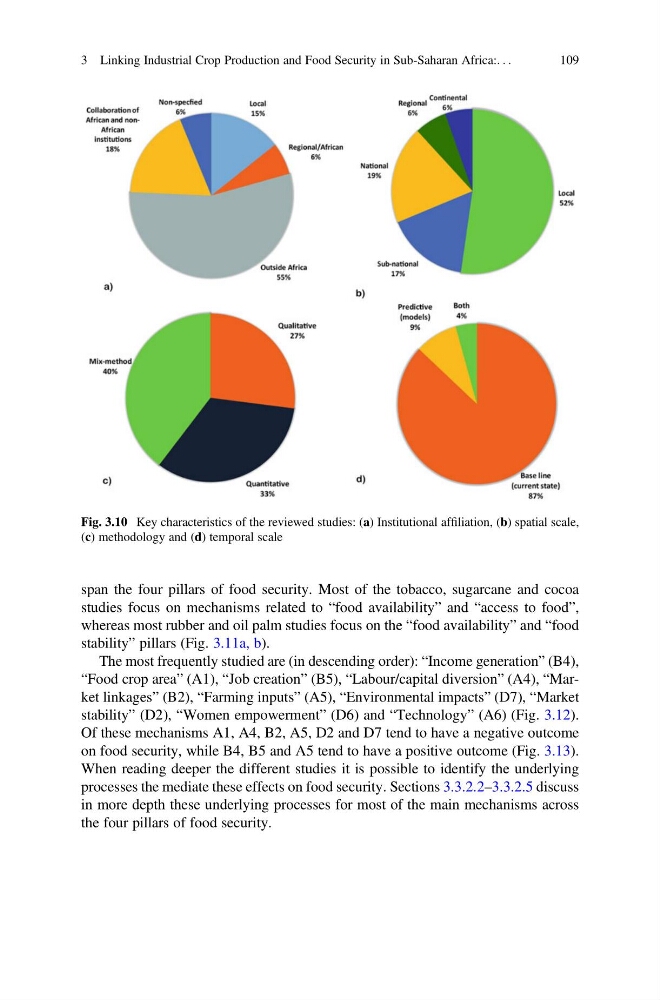
Fig. 3.10 Key characteristics of the reviewed studies: (a) Institutional affiliation, (b) spatial scale,
(c) methodology and (d) temporal scale
3 Linking Industrial Crop Production and Food Security in Sub-Saharan Africa:. . .
109
studies focus on mechanisms related to “food availability” and “access to food”,
whereas most rubber and oil palm studies focus on the “food availability” and “food
stability” pillars (Fig. 3.11a, b).
The most frequently studied are (in descending order): “Income generation” (B4),
“Food crop area” (A1), “Job creation” (B5), “Labour/capital diversion” (A4), “Market linkages” (B2), “Farming inputs” (A5), “Environmental impacts” (D7), “Market
stability” (D2), “Women empowerment” (D6) and “Technology” (A6) (Fig. 3.12).
Of these mechanisms A1, A4, B2, A5, D2 and D7 tend to have a negative outcome
on food security, while B4, B5 and A5 tend to have a positive outcome (Fig. 3.13).
When reading deeper the different studies it is possible to identify the underlying
processes the mediate these effects on food security. Sections 3.3.2.2–3.3.2.5 discuss
in more depth these underlying processes for most of the main mechanisms across
the four pillars of food security.
Fig. 3.10 Key characteristics of the reviewed studies: (a) Institutional affiliation, (b) spatial scale,
(c) methodology and (d) temporal scale
3 Linking Industrial Crop Production and Food Security in Sub-Saharan Africa:. . .
109