

3.3 Results
3.3.1 Drivers and Production Patterns
3.3.1.1 Continental Perspectives
Some industrial crops such as cotton have been produced for a long period in some
parts of SSA, sometimes predating the colonial period (e.g. Kriger 2005). During the
colonial era, the production of cotton, cocoa, coffee and rubber expanded rapidly
across many parts of SSA to meet the large demand in Europe (Brun 1991). In the
post-colonial era, industrial crop production became a major component in the
economies of several SSA countries. For example, tobacco and sugarcane are the
major export commodities in Malawi (Chinangwa et al. 2017), while cocoa has
contributed substantially to the national economies of Ghana and the Ivory Coast
(Breisinger et al. 2008). Sugarcane and cotton have dominated the economies of
countries in Southern and Western Africa, such as Swaziland and Mauritius (Terry
and Ogg 2017; Kwong 2005) and Burkina Faso and Mali respectively (Tschirley
et al. 2009; Vitale 2018).
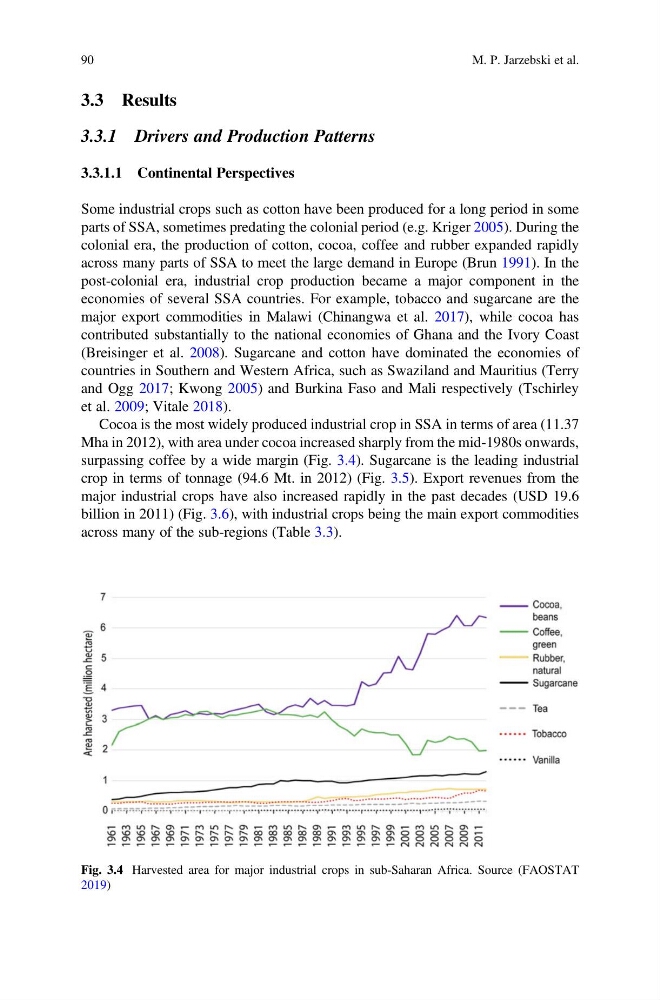
Cocoa is the most widely produced industrial crop in SSA in terms of area (11.37
Mha in 2012), with area under cocoa increased sharply from the mid-1980s onwards,
surpassing coffee by a wide margin (Fig. 3.4). Sugarcane is the leading industrial
crop in terms of tonnage (94.6 Mt. in 2012) (Fig. 3.5). Export revenues from the
major industrial crops have also increased rapidly in the past decades (USD 19.6
billion in 2011) (Fig. 3.6), with industrial crops being the main export commodities
across many of the sub-regions (Table 3.3).
Fig. 3.4 Harvested area for major industrial crops in sub-Saharan Africa. Source (FAOSTAT
2019)
90
M. P. Jarzebski et al.
3.3.1 Drivers and Production Patterns
3.3.1.1 Continental Perspectives
Some industrial crops such as cotton have been produced for a long period in some
parts of SSA, sometimes predating the colonial period (e.g. Kriger 2005). During the
colonial era, the production of cotton, cocoa, coffee and rubber expanded rapidly
across many parts of SSA to meet the large demand in Europe (Brun 1991). In the
post-colonial era, industrial crop production became a major component in the
economies of several SSA countries. For example, tobacco and sugarcane are the
major export commodities in Malawi (Chinangwa et al. 2017), while cocoa has
contributed substantially to the national economies of Ghana and the Ivory Coast
(Breisinger et al. 2008). Sugarcane and cotton have dominated the economies of
countries in Southern and Western Africa, such as Swaziland and Mauritius (Terry
and Ogg 2017; Kwong 2005) and Burkina Faso and Mali respectively (Tschirley
et al. 2009; Vitale 2018).
Cocoa is the most widely produced industrial crop in SSA in terms of area (11.37
Mha in 2012), with area under cocoa increased sharply from the mid-1980s onwards,
surpassing coffee by a wide margin (Fig. 3.4). Sugarcane is the leading industrial
crop in terms of tonnage (94.6 Mt. in 2012) (Fig. 3.5). Export revenues from the
major industrial crops have also increased rapidly in the past decades (USD 19.6
billion in 2011) (Fig. 3.6), with industrial crops being the main export commodities
across many of the sub-regions (Table 3.3).
Fig. 3.4 Harvested area for major industrial crops in sub-Saharan Africa. Source (FAOSTAT
2019)
90
M. P. Jarzebski et al.