

Microalgae Chlorella as a Sustainable Feedstock …
89
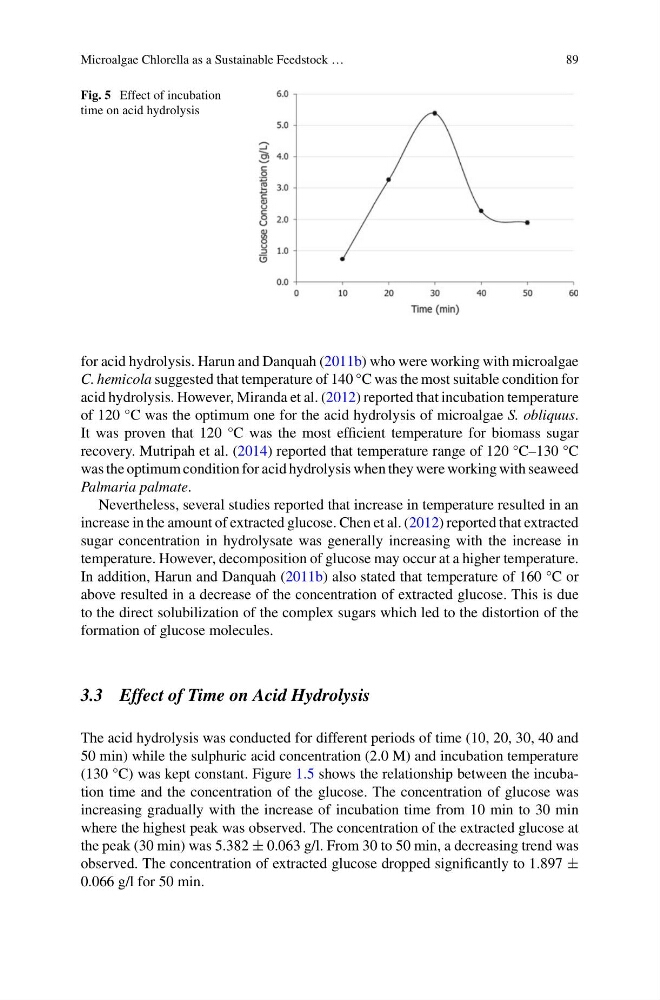
Fig. 5 Effect of incubation
time on acid hydrolysis
for acid hydrolysis. Harun and Danquah (2011b) who were working with microalgae
C. hemicola suggested that temperature of 140 °C was the most suitable condition for
acid hydrolysis. However, Miranda et al. (2012) reported that incubation temperature
of 120 °C was the optimum one for the acid hydrolysis of microalgae S. obliquus.
It was proven that 120 °C was the most efficient temperature for biomass sugar
recovery. Mutripah et al. (2014) reported that temperature range of 120 °C–130 °C
was the optimum condition for acid hydrolysis when they were working with seaweed
Palmaria palmate.
Nevertheless, several studies reported that increase in temperature resulted in an
increase in the amount of extracted glucose. Chen et al. (2012) reported that extracted
sugar concentration in hydrolysate was generally increasing with the increase in
temperature. However, decomposition of glucose may occur at a higher temperature.
In addition, Harun and Danquah (2011b) also stated that temperature of 160 °C or
above resulted in a decrease of the concentration of extracted glucose. This is due
to the direct solubilization of the complex sugars which led to the distortion of the
formation of glucose molecules.
3.3 Effect of Time on Acid Hydrolysis
The acid hydrolysis was conducted for different periods of time (10, 20, 30, 40 and
50 min) while the sulphuric acid concentration (2.0 M) and incubation temperature
(130 °C) was kept constant. Figure 1.5 shows the relationship between the incubation time and the concentration of the glucose. The concentration of glucose was
increasing gradually with the increase of incubation time from 10 min to 30 min
where the highest peak was observed. The concentration of the extracted glucose at
the peak (30 min) was 5.382 ± 0.063 g/l. From 30 to 50 min, a decreasing trend was
observed. The concentration of extracted glucose dropped significantly to 1.897 ±
0.066 g/l for 50 min.
89
Fig. 5 Effect of incubation
time on acid hydrolysis
for acid hydrolysis. Harun and Danquah (2011b) who were working with microalgae
C. hemicola suggested that temperature of 140 °C was the most suitable condition for
acid hydrolysis. However, Miranda et al. (2012) reported that incubation temperature
of 120 °C was the optimum one for the acid hydrolysis of microalgae S. obliquus.
It was proven that 120 °C was the most efficient temperature for biomass sugar
recovery. Mutripah et al. (2014) reported that temperature range of 120 °C–130 °C
was the optimum condition for acid hydrolysis when they were working with seaweed
Palmaria palmate.
Nevertheless, several studies reported that increase in temperature resulted in an
increase in the amount of extracted glucose. Chen et al. (2012) reported that extracted
sugar concentration in hydrolysate was generally increasing with the increase in
temperature. However, decomposition of glucose may occur at a higher temperature.
In addition, Harun and Danquah (2011b) also stated that temperature of 160 °C or
above resulted in a decrease of the concentration of extracted glucose. This is due
to the direct solubilization of the complex sugars which led to the distortion of the
formation of glucose molecules.
3.3 Effect of Time on Acid Hydrolysis
The acid hydrolysis was conducted for different periods of time (10, 20, 30, 40 and
50 min) while the sulphuric acid concentration (2.0 M) and incubation temperature
(130 °C) was kept constant. Figure 1.5 shows the relationship between the incubation time and the concentration of the glucose. The concentration of glucose was
increasing gradually with the increase of incubation time from 10 min to 30 min
where the highest peak was observed. The concentration of the extracted glucose at
the peak (30 min) was 5.382 ± 0.063 g/l. From 30 to 50 min, a decreasing trend was
observed. The concentration of extracted glucose dropped significantly to 1.897 ±
0.066 g/l for 50 min.