

70
H. A. Tajarudin et al.
D-xylose
Xylitol
D-Xylulose-5-P
D-xylulose
Pentose Phosphate
Pathway
Xylose reductase
NADH
NAD+
Xylitol dehydrogenase
NAD+
NADH
ADP
ATP
Xylulokinase
H 2 O
CO 2
Xylose isomerase
Xylitol
NADPH
NADP
D-xylose
Ethanol
Xylose reductase
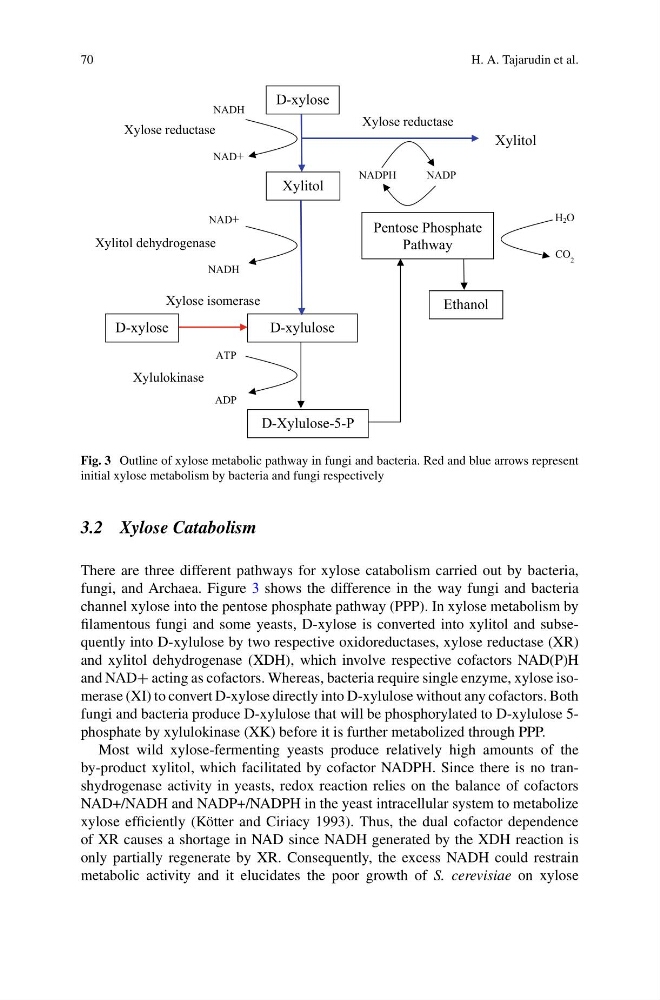
Fig. 3 Outline of xylose metabolic pathway in fungi and bacteria. Red and blue arrows represent
initial xylose metabolism by bacteria and fungi respectively
3.2 Xylose Catabolism
There are three different pathways for xylose catabolism carried out by bacteria,
fungi, and Archaea. Figure 3 shows the difference in the way fungi and bacteria
channel xylose into the pentose phosphate pathway (PPP). In xylose metabolism by
filamentous fungi and some yeasts, D-xylose is converted into xylitol and subsequently into D-xylulose by two respective oxidoreductases, xylose reductase (XR)
and xylitol dehydrogenase (XDH), which involve respective cofactors NAD(P)H
and NAD+ acting as cofactors. Whereas, bacteria require single enzyme, xylose isomerase (XI) to convert D-xylose directly into D-xylulose without any cofactors. Both
fungi and bacteria produce D-xylulose that will be phosphorylated to D-xylulose 5phosphate by xylulokinase (XK) before it is further metabolized through PPP.
Most wild xylose-fermenting yeasts produce relatively high amounts of the
by-product xylitol, which facilitated by cofactor NADPH. Since there is no transhydrogenase activity in yeasts, redox reaction relies on the balance of cofactors
NAD+/NADH and NADP+/NADPH in the yeast intracellular system to metabolize
xylose efficiently (Kötter and Ciriacy 1993). Thus, the dual cofactor dependence
of XR causes a shortage in NAD since NADH generated by the XDH reaction is
only partially regenerate by XR. Consequently, the excess NADH could restrain
metabolic activity and it elucidates the poor growth of S. cerevisiae on xylose
H. A. Tajarudin et al.
D-xylose
Xylitol
D-Xylulose-5-P
D-xylulose
Pentose Phosphate
Pathway
Xylose reductase
NADH
NAD+
Xylitol dehydrogenase
NAD+
NADH
ADP
ATP
Xylulokinase
H 2 O
CO 2
Xylose isomerase
Xylitol
NADPH
NADP
D-xylose
Ethanol
Xylose reductase
Fig. 3 Outline of xylose metabolic pathway in fungi and bacteria. Red and blue arrows represent
initial xylose metabolism by bacteria and fungi respectively
3.2 Xylose Catabolism
There are three different pathways for xylose catabolism carried out by bacteria,
fungi, and Archaea. Figure 3 shows the difference in the way fungi and bacteria
channel xylose into the pentose phosphate pathway (PPP). In xylose metabolism by
filamentous fungi and some yeasts, D-xylose is converted into xylitol and subsequently into D-xylulose by two respective oxidoreductases, xylose reductase (XR)
and xylitol dehydrogenase (XDH), which involve respective cofactors NAD(P)H
and NAD+ acting as cofactors. Whereas, bacteria require single enzyme, xylose isomerase (XI) to convert D-xylose directly into D-xylulose without any cofactors. Both
fungi and bacteria produce D-xylulose that will be phosphorylated to D-xylulose 5phosphate by xylulokinase (XK) before it is further metabolized through PPP.
Most wild xylose-fermenting yeasts produce relatively high amounts of the
by-product xylitol, which facilitated by cofactor NADPH. Since there is no transhydrogenase activity in yeasts, redox reaction relies on the balance of cofactors
NAD+/NADH and NADP+/NADPH in the yeast intracellular system to metabolize
xylose efficiently (Kötter and Ciriacy 1993). Thus, the dual cofactor dependence
of XR causes a shortage in NAD since NADH generated by the XDH reaction is
only partially regenerate by XR. Consequently, the excess NADH could restrain
metabolic activity and it elucidates the poor growth of S. cerevisiae on xylose