

Second-Generation Bioethanol: Advancement of Ethanologenic …
63
1991). Results from various pilot-scale researches have indicated positive outcomes,
which in turn support that assertion of second-generation bioethanol as fuel for the
future (Menetrez 2014; Naik et al. 2010).
Ethanologenic microorganisms serve as a collective ‘mini-factories’ in the production of bioethanol. These microbes have distinct fermentation behaviors depending on feedstock’s origin. For lignocellulosic biomass, there is lack of wild strain
ethanologens that capable of fermenting all sugars (hexose and pentose) released
by hydrolysis. This major challenge promotes metabolic engineering technology
to tailor an advanced ethanologens by combining advantageous traits from various
microbes. To date, mostly, studied ethanologens for plant biomass conversion are
Escherichia coli, Saccharomyces cerevisiae and Zymomonas mobilis (Saxena et al.
2009; Sprenger 1993; Taylor et al. 2012). Other approach includes random mutagenesis and screening to resolve high sensitivity of ethanologens toward process
hardiness.
Presently, most review articles have focused on pretreatment and hydrolysis processes due to their high impact on the economic viability of bioethanol production
(Sun and Cheng 2002; Taherzadeh and Karimi 2008; Yang and Wyman 2008). Nevertheless, fermentation is another important process in achieving high yield, faster
conversion rate and high concentration bioethanol. This review presents a discussion
on the development of ethanologenic microorganisms for high-performance fermentation, its desired characteristics, feedstock resources, and the employed fermentation system for production of second-generation bioethanol. In addition, this review
includes current efforts in the creation of superior ethanologenic microorganism or
also known as superbug for industrial production of bioethanol.
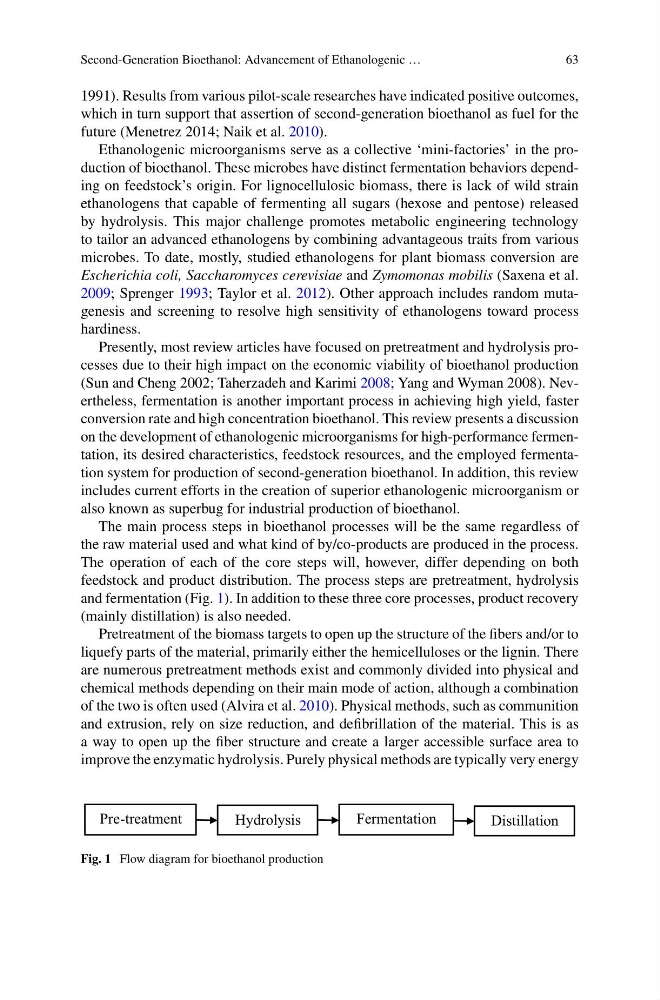
The main process steps in bioethanol processes will be the same regardless of
the raw material used and what kind of by/co-products are produced in the process.
The operation of each of the core steps will, however, differ depending on both
feedstock and product distribution. The process steps are pretreatment, hydrolysis
and fermentation (Fig. 1). In addition to these three core processes, product recovery
(mainly distillation) is also needed.
Pretreatment of the biomass targets to open up the structure of the fibers and/or to
liquefy parts of the material, primarily either the hemicelluloses or the lignin. There
are numerous pretreatment methods exist and commonly divided into physical and
chemical methods depending on their main mode of action, although a combination
of the two is often used (Alvira et al. 2010). Physical methods, such as communition
and extrusion, rely on size reduction, and defibrillation of the material. This is as
a way to open up the fiber structure and create a larger accessible surface area to
improve the enzymatic hydrolysis. Purely physical methods are typically very energy
Pre-treatment
Hydrolysis
Fermentation
Distillation
Fig. 1 Flow diagram for bioethanol production
63
1991). Results from various pilot-scale researches have indicated positive outcomes,
which in turn support that assertion of second-generation bioethanol as fuel for the
future (Menetrez 2014; Naik et al. 2010).
Ethanologenic microorganisms serve as a collective ‘mini-factories’ in the production of bioethanol. These microbes have distinct fermentation behaviors depending on feedstock’s origin. For lignocellulosic biomass, there is lack of wild strain
ethanologens that capable of fermenting all sugars (hexose and pentose) released
by hydrolysis. This major challenge promotes metabolic engineering technology
to tailor an advanced ethanologens by combining advantageous traits from various
microbes. To date, mostly, studied ethanologens for plant biomass conversion are
Escherichia coli, Saccharomyces cerevisiae and Zymomonas mobilis (Saxena et al.
2009; Sprenger 1993; Taylor et al. 2012). Other approach includes random mutagenesis and screening to resolve high sensitivity of ethanologens toward process
hardiness.
Presently, most review articles have focused on pretreatment and hydrolysis processes due to their high impact on the economic viability of bioethanol production
(Sun and Cheng 2002; Taherzadeh and Karimi 2008; Yang and Wyman 2008). Nevertheless, fermentation is another important process in achieving high yield, faster
conversion rate and high concentration bioethanol. This review presents a discussion
on the development of ethanologenic microorganisms for high-performance fermentation, its desired characteristics, feedstock resources, and the employed fermentation system for production of second-generation bioethanol. In addition, this review
includes current efforts in the creation of superior ethanologenic microorganism or
also known as superbug for industrial production of bioethanol.
The main process steps in bioethanol processes will be the same regardless of
the raw material used and what kind of by/co-products are produced in the process.
The operation of each of the core steps will, however, differ depending on both
feedstock and product distribution. The process steps are pretreatment, hydrolysis
and fermentation (Fig. 1). In addition to these three core processes, product recovery
(mainly distillation) is also needed.
Pretreatment of the biomass targets to open up the structure of the fibers and/or to
liquefy parts of the material, primarily either the hemicelluloses or the lignin. There
are numerous pretreatment methods exist and commonly divided into physical and
chemical methods depending on their main mode of action, although a combination
of the two is often used (Alvira et al. 2010). Physical methods, such as communition
and extrusion, rely on size reduction, and defibrillation of the material. This is as
a way to open up the fiber structure and create a larger accessible surface area to
improve the enzymatic hydrolysis. Purely physical methods are typically very energy
Pre-treatment
Hydrolysis
Fermentation
Distillation
Fig. 1 Flow diagram for bioethanol production