

The Feasibility of Using Palm Oil Ash …
55
3 Properties of the Compressed POFA Brick
(i) Compressive Strength of Compressed POFA Brick
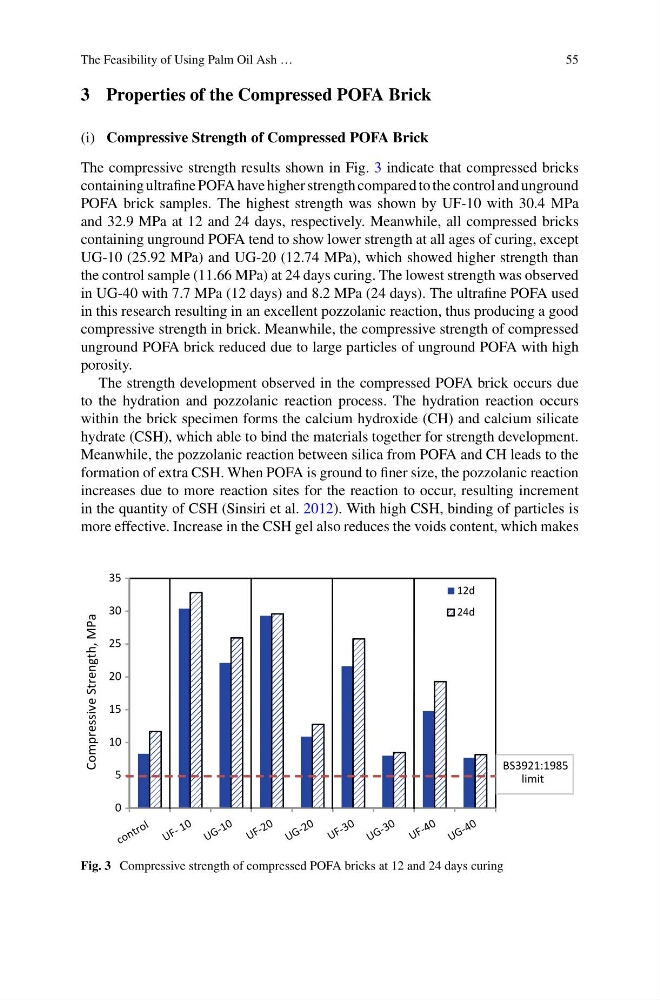
The compressive strength results shown in Fig. 3 indicate that compressed bricks
containing ultrafine POFA have higher strength compared to the control and unground
POFA brick samples. The highest strength was shown by UF-10 with 30.4 MPa
and 32.9 MPa at 12 and 24 days, respectively. Meanwhile, all compressed bricks
containing unground POFA tend to show lower strength at all ages of curing, except
UG-10 (25.92 MPa) and UG-20 (12.74 MPa), which showed higher strength than
the control sample (11.66 MPa) at 24 days curing. The lowest strength was observed
in UG-40 with 7.7 MPa (12 days) and 8.2 MPa (24 days). The ultrafine POFA used
in this research resulting in an excellent pozzolanic reaction, thus producing a good
compressive strength in brick. Meanwhile, the compressive strength of compressed
unground POFA brick reduced due to large particles of unground POFA with high
porosity.
The strength development observed in the compressed POFA brick occurs due
to the hydration and pozzolanic reaction process. The hydration reaction occurs
within the brick specimen forms the calcium hydroxide (CH) and calcium silicate
hydrate (CSH), which able to bind the materials together for strength development.
Meanwhile, the pozzolanic reaction between silica from POFA and CH leads to the
formation of extra CSH. When POFA is ground to finer size, the pozzolanic reaction
increases due to more reaction sites for the reaction to occur, resulting increment
in the quantity of CSH (Sinsiri et al. 2012). With high CSH, binding of particles is
more effective. Increase in the CSH gel also reduces the voids content, which makes
0
5
10
15
20
25
30
35
12d
24d
Compressive Strength, MPa
BS3921:1985
limit
Fig. 3 Compressive strength of compressed POFA bricks at 12 and 24 days curing
55
3 Properties of the Compressed POFA Brick
(i) Compressive Strength of Compressed POFA Brick
The compressive strength results shown in Fig. 3 indicate that compressed bricks
containing ultrafine POFA have higher strength compared to the control and unground
POFA brick samples. The highest strength was shown by UF-10 with 30.4 MPa
and 32.9 MPa at 12 and 24 days, respectively. Meanwhile, all compressed bricks
containing unground POFA tend to show lower strength at all ages of curing, except
UG-10 (25.92 MPa) and UG-20 (12.74 MPa), which showed higher strength than
the control sample (11.66 MPa) at 24 days curing. The lowest strength was observed
in UG-40 with 7.7 MPa (12 days) and 8.2 MPa (24 days). The ultrafine POFA used
in this research resulting in an excellent pozzolanic reaction, thus producing a good
compressive strength in brick. Meanwhile, the compressive strength of compressed
unground POFA brick reduced due to large particles of unground POFA with high
porosity.
The strength development observed in the compressed POFA brick occurs due
to the hydration and pozzolanic reaction process. The hydration reaction occurs
within the brick specimen forms the calcium hydroxide (CH) and calcium silicate
hydrate (CSH), which able to bind the materials together for strength development.
Meanwhile, the pozzolanic reaction between silica from POFA and CH leads to the
formation of extra CSH. When POFA is ground to finer size, the pozzolanic reaction
increases due to more reaction sites for the reaction to occur, resulting increment
in the quantity of CSH (Sinsiri et al. 2012). With high CSH, binding of particles is
more effective. Increase in the CSH gel also reduces the voids content, which makes
0
5
10
15
20
25
30
35
12d
24d
Compressive Strength, MPa
BS3921:1985
limit
Fig. 3 Compressive strength of compressed POFA bricks at 12 and 24 days curing