

The Green Vision of Technical University of Crete’s Campus
31
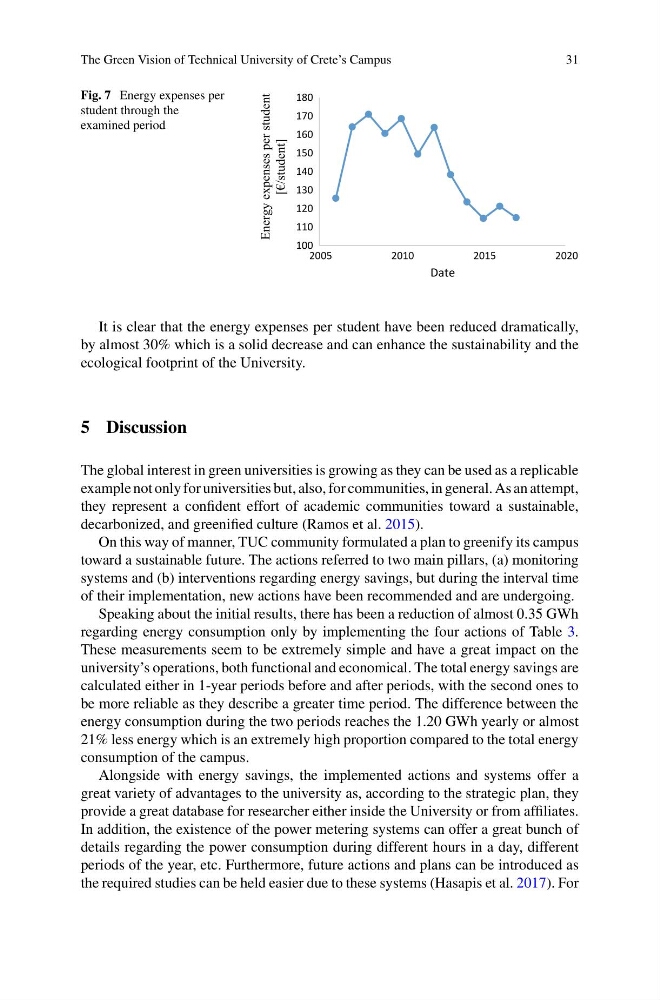
Fig. 7 Energy expenses per
student through the
examined period
100
110
120
130
140
150
160
170
180
2005
2010
2015
2020
Energy expenses per student
[€/student]
Date
It is clear that the energy expenses per student have been reduced dramatically,
by almost 30% which is a solid decrease and can enhance the sustainability and the
ecological footprint of the University.
5 Discussion
The global interest in green universities is growing as they can be used as a replicable
example not only for universities but, also, for communities, in general. As an attempt,
they represent a confident effort of academic communities toward a sustainable,
decarbonized, and greenified culture (Ramos et al. 2015).
On this way of manner, TUC community formulated a plan to greenify its campus
toward a sustainable future. The actions referred to two main pillars, (a) monitoring
systems and (b) interventions regarding energy savings, but during the interval time
of their implementation, new actions have been recommended and are undergoing.
Speaking about the initial results, there has been a reduction of almost 0.35 GWh
regarding energy consumption only by implementing the four actions of Table 3.
These measurements seem to be extremely simple and have a great impact on the
university’s operations, both functional and economical. The total energy savings are
calculated either in 1-year periods before and after periods, with the second ones to
be more reliable as they describe a greater time period. The difference between the
energy consumption during the two periods reaches the 1.20 GWh yearly or almost
21% less energy which is an extremely high proportion compared to the total energy
consumption of the campus.
Alongside with energy savings, the implemented actions and systems offer a
great variety of advantages to the university as, according to the strategic plan, they
provide a great database for researcher either inside the University or from affiliates.
In addition, the existence of the power metering systems can offer a great bunch of
details regarding the power consumption during different hours in a day, different
periods of the year, etc. Furthermore, future actions and plans can be introduced as
the required studies can be held easier due to these systems (Hasapis et al. 2017). For
31
Fig. 7 Energy expenses per
student through the
examined period
100
110
120
130
140
150
160
170
180
2005
2010
2015
2020
Energy expenses per student
[€/student]
Date
It is clear that the energy expenses per student have been reduced dramatically,
by almost 30% which is a solid decrease and can enhance the sustainability and the
ecological footprint of the University.
5 Discussion
The global interest in green universities is growing as they can be used as a replicable
example not only for universities but, also, for communities, in general. As an attempt,
they represent a confident effort of academic communities toward a sustainable,
decarbonized, and greenified culture (Ramos et al. 2015).
On this way of manner, TUC community formulated a plan to greenify its campus
toward a sustainable future. The actions referred to two main pillars, (a) monitoring
systems and (b) interventions regarding energy savings, but during the interval time
of their implementation, new actions have been recommended and are undergoing.
Speaking about the initial results, there has been a reduction of almost 0.35 GWh
regarding energy consumption only by implementing the four actions of Table 3.
These measurements seem to be extremely simple and have a great impact on the
university’s operations, both functional and economical. The total energy savings are
calculated either in 1-year periods before and after periods, with the second ones to
be more reliable as they describe a greater time period. The difference between the
energy consumption during the two periods reaches the 1.20 GWh yearly or almost
21% less energy which is an extremely high proportion compared to the total energy
consumption of the campus.
Alongside with energy savings, the implemented actions and systems offer a
great variety of advantages to the university as, according to the strategic plan, they
provide a great database for researcher either inside the University or from affiliates.
In addition, the existence of the power metering systems can offer a great bunch of
details regarding the power consumption during different hours in a day, different
periods of the year, etc. Furthermore, future actions and plans can be introduced as
the required studies can be held easier due to these systems (Hasapis et al. 2017). For