

Environmental Sustainability of Universities: Critical Review …
11
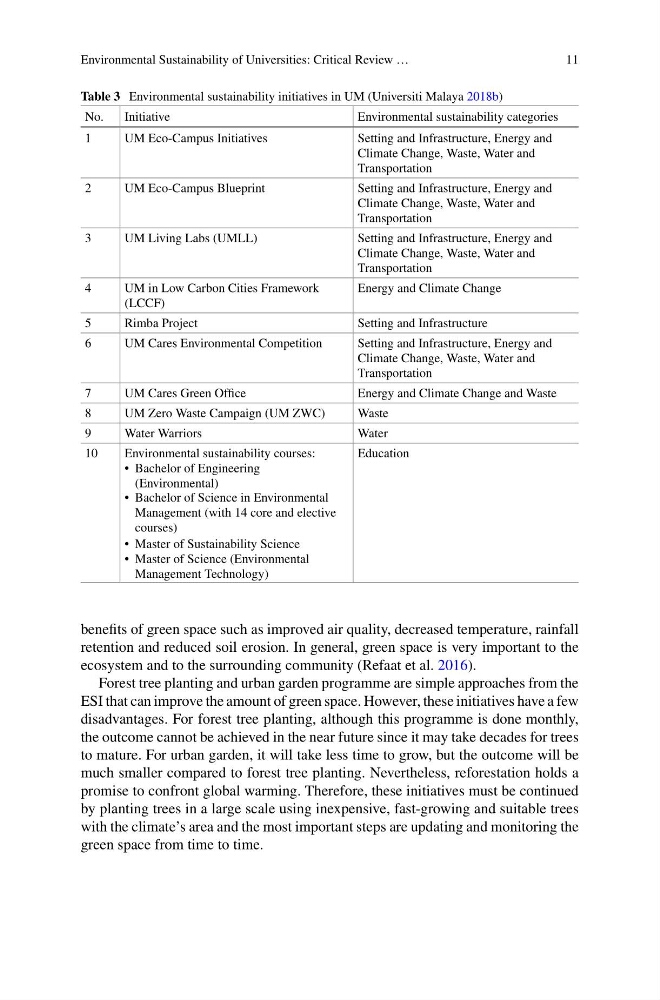
Table 3 Environmental sustainability initiatives in UM (Universiti Malaya 2018b)
No.
Initiative
Environmental sustainability categories
1
UM Eco-Campus Initiatives
Setting and Infrastructure, Energy and
Climate Change, Waste, Water and
Transportation
2
UM Eco-Campus Blueprint
Setting and Infrastructure, Energy and
Climate Change, Waste, Water and
Transportation
3
UM Living Labs (UMLL)
Setting and Infrastructure, Energy and
Climate Change, Waste, Water and
Transportation
4
UM in Low Carbon Cities Framework
(LCCF)
Energy and Climate Change
5
Rimba Project
Setting and Infrastructure
6
UM Cares Environmental Competition
Setting and Infrastructure, Energy and
Climate Change, Waste, Water and
Transportation
7
UM Cares Green Office
Energy and Climate Change and Waste
8
UM Zero Waste Campaign (UM ZWC)
Waste
9
Water Warriors
Water
10
Environmental sustainability courses:
• Bachelor of Engineering
(Environmental)
• Bachelor of Science in Environmental
Management (with 14 core and elective
courses)
• Master of Sustainability Science
• Master of Science (Environmental
Management Technology)
Education
benefits of green space such as improved air quality, decreased temperature, rainfall
retention and reduced soil erosion. In general, green space is very important to the
ecosystem and to the surrounding community (Refaat et al. 2016).
Forest tree planting and urban garden programme are simple approaches from the
ESI that can improve the amount of green space. However, these initiatives have a few
disadvantages. For forest tree planting, although this programme is done monthly,
the outcome cannot be achieved in the near future since it may take decades for trees
to mature. For urban garden, it will take less time to grow, but the outcome will be
much smaller compared to forest tree planting. Nevertheless, reforestation holds a
promise to confront global warming. Therefore, these initiatives must be continued
by planting trees in a large scale using inexpensive, fast-growing and suitable trees
with the climate’s area and the most important steps are updating and monitoring the
green space from time to time.
11
Table 3 Environmental sustainability initiatives in UM (Universiti Malaya 2018b)
No.
Initiative
Environmental sustainability categories
1
UM Eco-Campus Initiatives
Setting and Infrastructure, Energy and
Climate Change, Waste, Water and
Transportation
2
UM Eco-Campus Blueprint
Setting and Infrastructure, Energy and
Climate Change, Waste, Water and
Transportation
3
UM Living Labs (UMLL)
Setting and Infrastructure, Energy and
Climate Change, Waste, Water and
Transportation
4
UM in Low Carbon Cities Framework
(LCCF)
Energy and Climate Change
5
Rimba Project
Setting and Infrastructure
6
UM Cares Environmental Competition
Setting and Infrastructure, Energy and
Climate Change, Waste, Water and
Transportation
7
UM Cares Green Office
Energy and Climate Change and Waste
8
UM Zero Waste Campaign (UM ZWC)
Waste
9
Water Warriors
Water
10
Environmental sustainability courses:
• Bachelor of Engineering
(Environmental)
• Bachelor of Science in Environmental
Management (with 14 core and elective
courses)
• Master of Sustainability Science
• Master of Science (Environmental
Management Technology)
Education
benefits of green space such as improved air quality, decreased temperature, rainfall
retention and reduced soil erosion. In general, green space is very important to the
ecosystem and to the surrounding community (Refaat et al. 2016).
Forest tree planting and urban garden programme are simple approaches from the
ESI that can improve the amount of green space. However, these initiatives have a few
disadvantages. For forest tree planting, although this programme is done monthly,
the outcome cannot be achieved in the near future since it may take decades for trees
to mature. For urban garden, it will take less time to grow, but the outcome will be
much smaller compared to forest tree planting. Nevertheless, reforestation holds a
promise to confront global warming. Therefore, these initiatives must be continued
by planting trees in a large scale using inexpensive, fast-growing and suitable trees
with the climate’s area and the most important steps are updating and monitoring the
green space from time to time.