

Sewage Treatment in Campus for Recycling Purpose: A Review
225
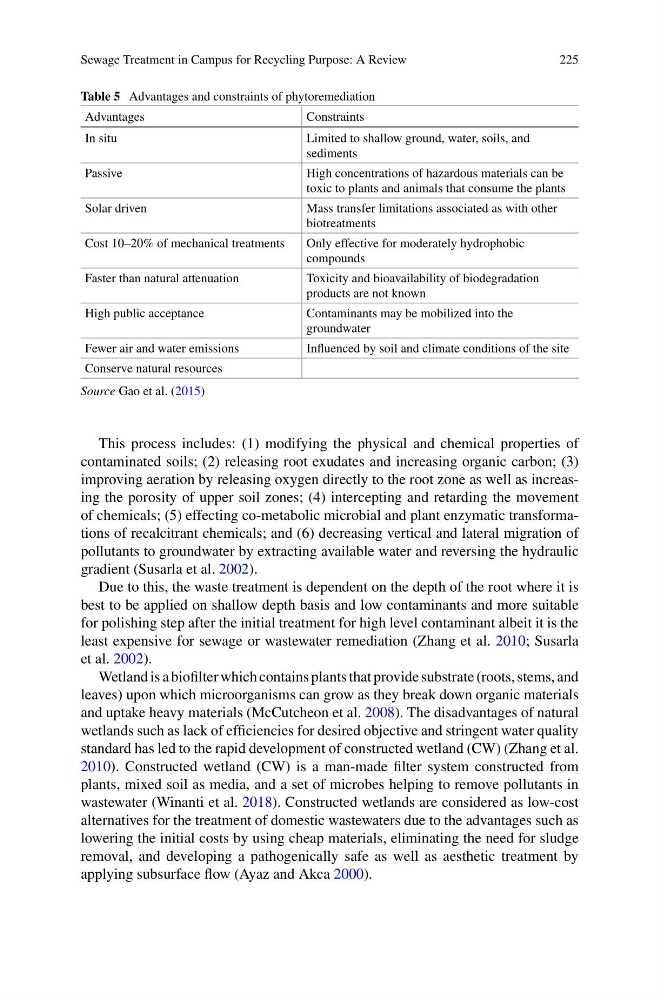
Table 5 Advantages and constraints of phytoremediation
Advantages
Constraints
In situ
Limited to shallow ground, water, soils, and
sediments
Passive
High concentrations of hazardous materials can be
toxic to plants and animals that consume the plants
Solar driven
Mass transfer limitations associated as with other
biotreatments
Cost 10–20% of mechanical treatments
Only effective for moderately hydrophobic
compounds
Faster than natural attenuation
Toxicity and bioavailability of biodegradation
products are not known
High public acceptance
Contaminants may be mobilized into the
groundwater
Fewer air and water emissions
Influenced by soil and climate conditions of the site
Conserve natural resources
Source Gao et al. (2015)
This process includes: (1) modifying the physical and chemical properties of
contaminated soils; (2) releasing root exudates and increasing organic carbon; (3)
improving aeration by releasing oxygen directly to the root zone as well as increasing the porosity of upper soil zones; (4) intercepting and retarding the movement
of chemicals; (5) effecting co-metabolic microbial and plant enzymatic transformations of recalcitrant chemicals; and (6) decreasing vertical and lateral migration of
pollutants to groundwater by extracting available water and reversing the hydraulic
gradient (Susarla et al. 2002).
Due to this, the waste treatment is dependent on the depth of the root where it is
best to be applied on shallow depth basis and low contaminants and more suitable
for polishing step after the initial treatment for high level contaminant albeit it is the
least expensive for sewage or wastewater remediation (Zhang et al. 2010; Susarla
et al. 2002).
Wetland is a biofilter which contains plants that provide substrate (roots, stems, and
leaves) upon which microorganisms can grow as they break down organic materials
and uptake heavy materials (McCutcheon et al. 2008). The disadvantages of natural
wetlands such as lack of efficiencies for desired objective and stringent water quality
standard has led to the rapid development of constructed wetland (CW) (Zhang et al.
2010). Constructed wetland (CW) is a man-made filter system constructed from
plants, mixed soil as media, and a set of microbes helping to remove pollutants in
wastewater (Winanti et al. 2018). Constructed wetlands are considered as low-cost
alternatives for the treatment of domestic wastewaters due to the advantages such as
lowering the initial costs by using cheap materials, eliminating the need for sludge
removal, and developing a pathogenically safe as well as aesthetic treatment by
applying subsurface flow (Ayaz and Akca 2000).
225
Table 5 Advantages and constraints of phytoremediation
Advantages
Constraints
In situ
Limited to shallow ground, water, soils, and
sediments
Passive
High concentrations of hazardous materials can be
toxic to plants and animals that consume the plants
Solar driven
Mass transfer limitations associated as with other
biotreatments
Cost 10–20% of mechanical treatments
Only effective for moderately hydrophobic
compounds
Faster than natural attenuation
Toxicity and bioavailability of biodegradation
products are not known
High public acceptance
Contaminants may be mobilized into the
groundwater
Fewer air and water emissions
Influenced by soil and climate conditions of the site
Conserve natural resources
Source Gao et al. (2015)
This process includes: (1) modifying the physical and chemical properties of
contaminated soils; (2) releasing root exudates and increasing organic carbon; (3)
improving aeration by releasing oxygen directly to the root zone as well as increasing the porosity of upper soil zones; (4) intercepting and retarding the movement
of chemicals; (5) effecting co-metabolic microbial and plant enzymatic transformations of recalcitrant chemicals; and (6) decreasing vertical and lateral migration of
pollutants to groundwater by extracting available water and reversing the hydraulic
gradient (Susarla et al. 2002).
Due to this, the waste treatment is dependent on the depth of the root where it is
best to be applied on shallow depth basis and low contaminants and more suitable
for polishing step after the initial treatment for high level contaminant albeit it is the
least expensive for sewage or wastewater remediation (Zhang et al. 2010; Susarla
et al. 2002).
Wetland is a biofilter which contains plants that provide substrate (roots, stems, and
leaves) upon which microorganisms can grow as they break down organic materials
and uptake heavy materials (McCutcheon et al. 2008). The disadvantages of natural
wetlands such as lack of efficiencies for desired objective and stringent water quality
standard has led to the rapid development of constructed wetland (CW) (Zhang et al.
2010). Constructed wetland (CW) is a man-made filter system constructed from
plants, mixed soil as media, and a set of microbes helping to remove pollutants in
wastewater (Winanti et al. 2018). Constructed wetlands are considered as low-cost
alternatives for the treatment of domestic wastewaters due to the advantages such as
lowering the initial costs by using cheap materials, eliminating the need for sludge
removal, and developing a pathogenically safe as well as aesthetic treatment by
applying subsurface flow (Ayaz and Akca 2000).