

156
A. Kusumawanto and M. Setyowati
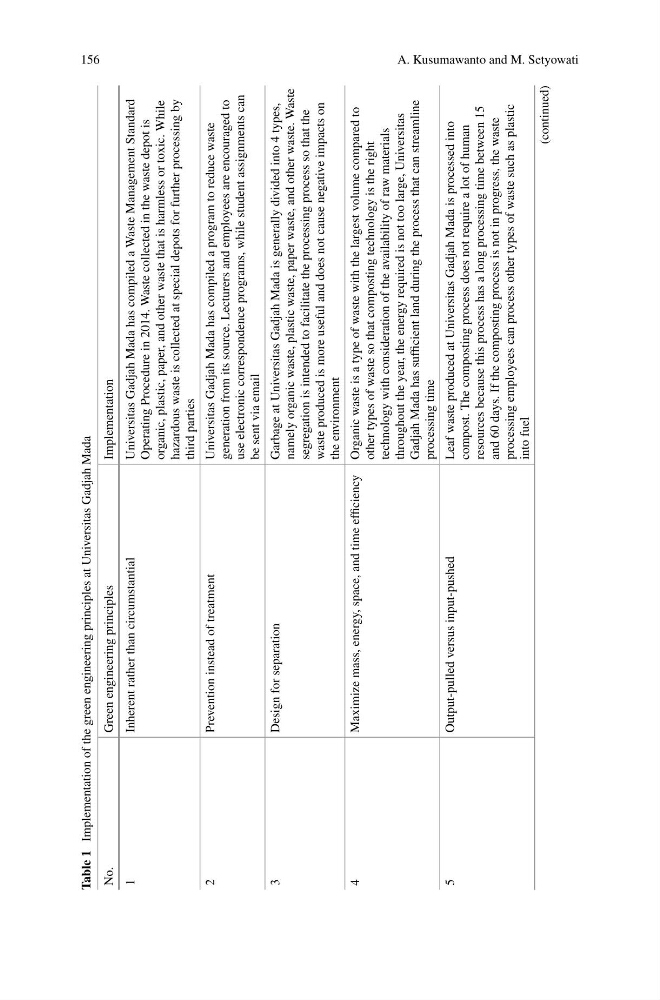
Table 1
Implementation of the green engineering principles at Universitas Gadjah Mada
No.
Green engineering principles
Implementation
1
Inherent rather than circumstantial
Universitas Gadjah Mada has compiled a Waste Management Standard
Operating Procedure in 2014. Waste collected in the waste depot is
organic, plastic, paper, and other waste that is harmless or toxic. While
hazardous waste is collected at special depots for further processing by
third parties
2
Prevention instead of treatment
Universitas Gadjah Mada has compiled a program to reduce waste
generation from its source. Lecturers and employees are encouraged to
use electronic correspondence programs, while student assignments can
be sent via email
3
Design for separation
Garbage at Universitas Gadjah Mada is generally divided into 4 types,
namely organic waste, plastic waste, paper waste, and other waste. Waste
segregation is intended to facilitate the processing process so that the
waste produced is more useful and does not cause negative impacts on
the environment
4
Maximize mass, energy, space, and time efficiency Organic waste is a type of waste with the largest volume compared to
other types of waste so that composting technology is the right
technology with consideration of the availability of raw materials
throughout the year, the energy required is not too large, Universitas
Gadjah Mada has sufficient land during the process that can streamline
processing time
5
Output-pulled versus input-pushed
Leaf waste produced at Universitas Gadjah Mada is processed into
compost. The composting process does not require a lot of human
resources because this process has a long processing time between 15
and 60 days. If the composting process is not in progress, the waste
processing employees can process other types of waste such as plastic
into fuel
(continued)
A. Kusumawanto and M. Setyowati
Table 1
Implementation of the green engineering principles at Universitas Gadjah Mada
No.
Green engineering principles
Implementation
1
Inherent rather than circumstantial
Universitas Gadjah Mada has compiled a Waste Management Standard
Operating Procedure in 2014. Waste collected in the waste depot is
organic, plastic, paper, and other waste that is harmless or toxic. While
hazardous waste is collected at special depots for further processing by
third parties
2
Prevention instead of treatment
Universitas Gadjah Mada has compiled a program to reduce waste
generation from its source. Lecturers and employees are encouraged to
use electronic correspondence programs, while student assignments can
be sent via email
3
Design for separation
Garbage at Universitas Gadjah Mada is generally divided into 4 types,
namely organic waste, plastic waste, paper waste, and other waste. Waste
segregation is intended to facilitate the processing process so that the
waste produced is more useful and does not cause negative impacts on
the environment
4
Maximize mass, energy, space, and time efficiency Organic waste is a type of waste with the largest volume compared to
other types of waste so that composting technology is the right
technology with consideration of the availability of raw materials
throughout the year, the energy required is not too large, Universitas
Gadjah Mada has sufficient land during the process that can streamline
processing time
5
Output-pulled versus input-pushed
Leaf waste produced at Universitas Gadjah Mada is processed into
compost. The composting process does not require a lot of human
resources because this process has a long processing time between 15
and 60 days. If the composting process is not in progress, the waste
processing employees can process other types of waste such as plastic
into fuel
(continued)