

140
N. Wid and L. F. Ayut
Table 2 Comparison of P
recovery with previous
studies
Type of substrate
P recovery (mg/L) References
POME
139
Wid et al. (2017)
POME
180
Madaki and Seng
(2013)
Sewage sludge
400
Murto et al. (2004)
Food waste
483
El-Mashad and
Zhang (2010)
Food waste
355
Kubaska et al.
(2010)
Food waste (fiber) 147
Selaman and
Wid (2016)
Food waste
520
Shin et al. (2004)
Food waste
554
This study
Table 3 Potential of P
recovery in a form of struvite
Recovery (unit)
Value
Struvite recovery (g/L)
1.00
Struvite recovery from the wet weight of food
waste (mg struvite/g food waste)
136
Struvite recovery from food waste in UMS (Tun
Mustapha Residences) (mg struvite/g food waste)
340,816
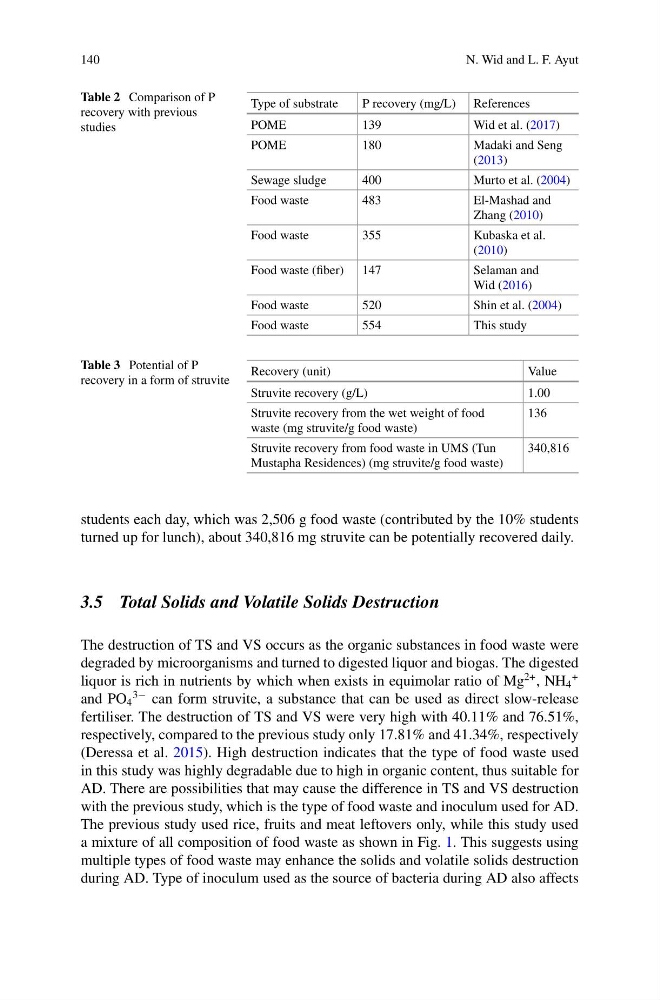
students each day, which was 2,506 g food waste (contributed by the 10% students
turned up for lunch), about 340,816 mg struvite can be potentially recovered daily.
3.5 Total Solids and Volatile Solids Destruction
The destruction of TS and VS occurs as the organic substances in food waste were
degraded by microorganisms and turned to digested liquor and biogas. The digested
liquor is rich in nutrients by which when exists in equimolar ratio of Mg
2+ , NH 4
+
and PO 4
3− can form struvite, a substance that can be used as direct slow-release
fertiliser. The destruction of TS and VS were very high with 40.11% and 76.51%,
respectively, compared to the previous study only 17.81% and 41.34%, respectively
(Deressa et al. 2015). High destruction indicates that the type of food waste used
in this study was highly degradable due to high in organic content, thus suitable for
AD. There are possibilities that may cause the difference in TS and VS destruction
with the previous study, which is the type of food waste and inoculum used for AD.
The previous study used rice, fruits and meat leftovers only, while this study used
a mixture of all composition of food waste as shown in Fig. 1. This suggests using
multiple types of food waste may enhance the solids and volatile solids destruction
during AD. Type of inoculum used as the source of bacteria during AD also affects
N. Wid and L. F. Ayut
Table 2 Comparison of P
recovery with previous
studies
Type of substrate
P recovery (mg/L) References
POME
139
Wid et al. (2017)
POME
180
Madaki and Seng
(2013)
Sewage sludge
400
Murto et al. (2004)
Food waste
483
El-Mashad and
Zhang (2010)
Food waste
355
Kubaska et al.
(2010)
Food waste (fiber) 147
Selaman and
Wid (2016)
Food waste
520
Shin et al. (2004)
Food waste
554
This study
Table 3 Potential of P
recovery in a form of struvite
Recovery (unit)
Value
Struvite recovery (g/L)
1.00
Struvite recovery from the wet weight of food
waste (mg struvite/g food waste)
136
Struvite recovery from food waste in UMS (Tun
Mustapha Residences) (mg struvite/g food waste)
340,816
students each day, which was 2,506 g food waste (contributed by the 10% students
turned up for lunch), about 340,816 mg struvite can be potentially recovered daily.
3.5 Total Solids and Volatile Solids Destruction
The destruction of TS and VS occurs as the organic substances in food waste were
degraded by microorganisms and turned to digested liquor and biogas. The digested
liquor is rich in nutrients by which when exists in equimolar ratio of Mg
2+ , NH 4
+
and PO 4
3− can form struvite, a substance that can be used as direct slow-release
fertiliser. The destruction of TS and VS were very high with 40.11% and 76.51%,
respectively, compared to the previous study only 17.81% and 41.34%, respectively
(Deressa et al. 2015). High destruction indicates that the type of food waste used
in this study was highly degradable due to high in organic content, thus suitable for
AD. There are possibilities that may cause the difference in TS and VS destruction
with the previous study, which is the type of food waste and inoculum used for AD.
The previous study used rice, fruits and meat leftovers only, while this study used
a mixture of all composition of food waste as shown in Fig. 1. This suggests using
multiple types of food waste may enhance the solids and volatile solids destruction
during AD. Type of inoculum used as the source of bacteria during AD also affects