

Anaerobic Digestion of Organic Waste in UMS Campus …
135
2 Materials and Methods
2.1 Sample Collection and Preparation
The sample used in this study was food waste collected from the café of Tun Mustapha
residence, UMS. The type of sample used was degradable food waste which was
collected after lunchtime when needed. The sample included vegetable and fruit
peels, chicken and fish bones, egg shells, onion and garlic skins, tea leaves and
coffee dregs, waste cooking oil, and leftover rice. The collected samples were cut
into small pieces and stored in a fridge at −20 °C to maintain the freshness. Primary
sludge (PS) was collected from a water treatment plant and used as inoculum to boost
up anaerobic digestion. The PS was stored in a polystyrene bottle and undergone
degasification in a water bath at 37 °C for 7 days. The water bath level was set to
be a little higher from the PS level in the bottle. Upon completing the degasification
process, the PS was then incubated in the water bath at the same temperature (as
degasification) for storage.
2.2 Determination of Food Waste Composition
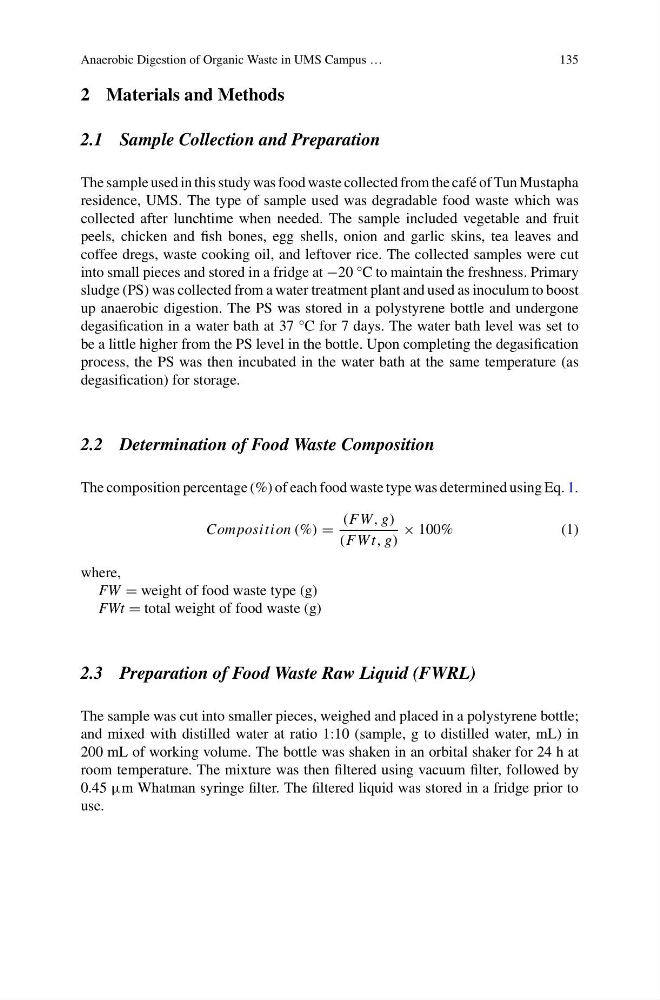
The composition percentage (%) of each food waste type was determined using Eq. 1.
Composition (%) =
(F W, g)
(F W t, g)
× 100%
(1)
where,
FW = weight of food waste type (g)
FWt = total weight of food waste (g)
2.3 Preparation of Food Waste Raw Liquid (FWRL)
The sample was cut into smaller pieces, weighed and placed in a polystyrene bottle;
and mixed with distilled water at ratio 1:10 (sample, g to distilled water, mL) in
200 mL of working volume. The bottle was shaken in an orbital shaker for 24 h at
room temperature. The mixture was then filtered using vacuum filter, followed by
0.45 μm Whatman syringe filter. The filtered liquid was stored in a fridge prior to
use.
135
2 Materials and Methods
2.1 Sample Collection and Preparation
The sample used in this study was food waste collected from the café of Tun Mustapha
residence, UMS. The type of sample used was degradable food waste which was
collected after lunchtime when needed. The sample included vegetable and fruit
peels, chicken and fish bones, egg shells, onion and garlic skins, tea leaves and
coffee dregs, waste cooking oil, and leftover rice. The collected samples were cut
into small pieces and stored in a fridge at −20 °C to maintain the freshness. Primary
sludge (PS) was collected from a water treatment plant and used as inoculum to boost
up anaerobic digestion. The PS was stored in a polystyrene bottle and undergone
degasification in a water bath at 37 °C for 7 days. The water bath level was set to
be a little higher from the PS level in the bottle. Upon completing the degasification
process, the PS was then incubated in the water bath at the same temperature (as
degasification) for storage.
2.2 Determination of Food Waste Composition
The composition percentage (%) of each food waste type was determined using Eq. 1.
Composition (%) =
(F W, g)
(F W t, g)
× 100%
(1)
where,
FW = weight of food waste type (g)
FWt = total weight of food waste (g)
2.3 Preparation of Food Waste Raw Liquid (FWRL)
The sample was cut into smaller pieces, weighed and placed in a polystyrene bottle;
and mixed with distilled water at ratio 1:10 (sample, g to distilled water, mL) in
200 mL of working volume. The bottle was shaken in an orbital shaker for 24 h at
room temperature. The mixture was then filtered using vacuum filter, followed by
0.45 μm Whatman syringe filter. The filtered liquid was stored in a fridge prior to
use.