

Conversion of Landscape Waste into Bio-coke Solid Fuel
111
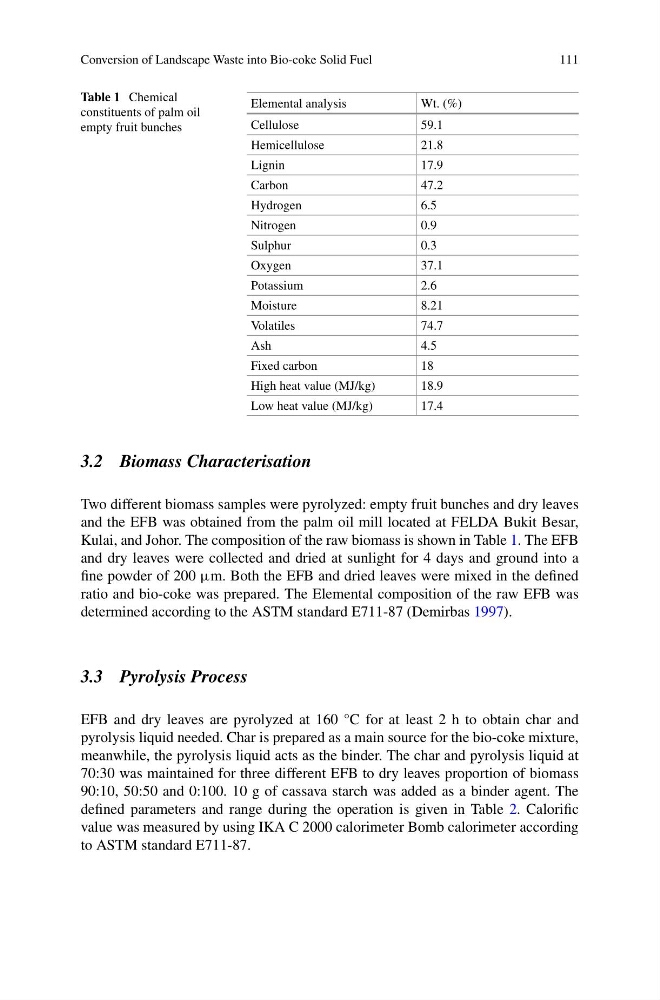
Table 1 Chemical
constituents of palm oil
empty fruit bunches
Elemental analysis
Wt. (%)
Cellulose
59.1
Hemicellulose
21.8
Lignin
17.9
Carbon
47.2
Hydrogen
6.5
Nitrogen
0.9
Sulphur
0.3
Oxygen
37.1
Potassium
2.6
Moisture
8.21
Volatiles
74.7
Ash
4.5
Fixed carbon
18
High heat value (MJ/kg)
18.9
Low heat value (MJ/kg)
17.4
3.2 Biomass Characterisation
Two different biomass samples were pyrolyzed: empty fruit bunches and dry leaves
and the EFB was obtained from the palm oil mill located at FELDA Bukit Besar,
Kulai, and Johor. The composition of the raw biomass is shown in Table 1. The EFB
and dry leaves were collected and dried at sunlight for 4 days and ground into a
fine powder of 200 µm. Both the EFB and dried leaves were mixed in the defined
ratio and bio-coke was prepared. The Elemental composition of the raw EFB was
determined according to the ASTM standard E711-87 (Demirbas 1997).
3.3 Pyrolysis Process
EFB and dry leaves are pyrolyzed at 160 °C for at least 2 h to obtain char and
pyrolysis liquid needed. Char is prepared as a main source for the bio-coke mixture,
meanwhile, the pyrolysis liquid acts as the binder. The char and pyrolysis liquid at
70:30 was maintained for three different EFB to dry leaves proportion of biomass
90:10, 50:50 and 0:100. 10 g of cassava starch was added as a binder agent. The
defined parameters and range during the operation is given in Table 2. Calorific
value was measured by using IKA C 2000 calorimeter Bomb calorimeter according
to ASTM standard E711-87.
111
Table 1 Chemical
constituents of palm oil
empty fruit bunches
Elemental analysis
Wt. (%)
Cellulose
59.1
Hemicellulose
21.8
Lignin
17.9
Carbon
47.2
Hydrogen
6.5
Nitrogen
0.9
Sulphur
0.3
Oxygen
37.1
Potassium
2.6
Moisture
8.21
Volatiles
74.7
Ash
4.5
Fixed carbon
18
High heat value (MJ/kg)
18.9
Low heat value (MJ/kg)
17.4
3.2 Biomass Characterisation
Two different biomass samples were pyrolyzed: empty fruit bunches and dry leaves
and the EFB was obtained from the palm oil mill located at FELDA Bukit Besar,
Kulai, and Johor. The composition of the raw biomass is shown in Table 1. The EFB
and dry leaves were collected and dried at sunlight for 4 days and ground into a
fine powder of 200 µm. Both the EFB and dried leaves were mixed in the defined
ratio and bio-coke was prepared. The Elemental composition of the raw EFB was
determined according to the ASTM standard E711-87 (Demirbas 1997).
3.3 Pyrolysis Process
EFB and dry leaves are pyrolyzed at 160 °C for at least 2 h to obtain char and
pyrolysis liquid needed. Char is prepared as a main source for the bio-coke mixture,
meanwhile, the pyrolysis liquid acts as the binder. The char and pyrolysis liquid at
70:30 was maintained for three different EFB to dry leaves proportion of biomass
90:10, 50:50 and 0:100. 10 g of cassava starch was added as a binder agent. The
defined parameters and range during the operation is given in Table 2. Calorific
value was measured by using IKA C 2000 calorimeter Bomb calorimeter according
to ASTM standard E711-87.