

Microalgae Chlorella as a Sustainable Feedstock …
97
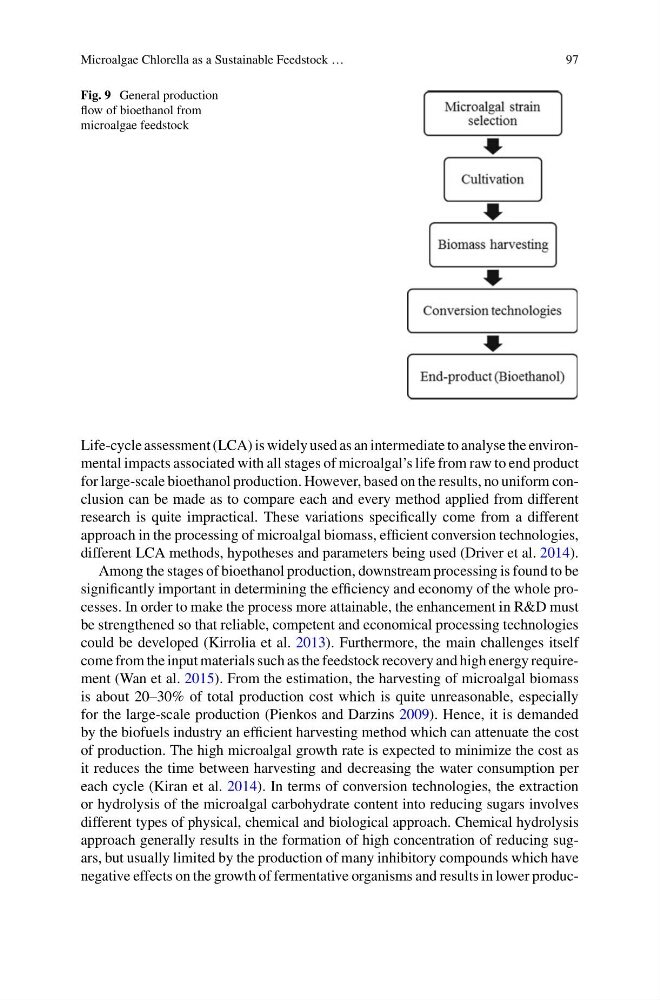
Fig. 9 General production
flow of bioethanol from
microalgae feedstock
Life-cycle assessment (LCA) is widely used as an intermediate to analyse the environmental impacts associated with all stages of microalgal’s life from raw to end product
for large-scale bioethanol production. However, based on the results, no uniform conclusion can be made as to compare each and every method applied from different
research is quite impractical. These variations specifically come from a different
approach in the processing of microalgal biomass, efficient conversion technologies,
different LCA methods, hypotheses and parameters being used (Driver et al. 2014).
Among the stages of bioethanol production, downstream processing is found to be
significantly important in determining the efficiency and economy of the whole processes. In order to make the process more attainable, the enhancement in R&D must
be strengthened so that reliable, competent and economical processing technologies
could be developed (Kirrolia et al. 2013). Furthermore, the main challenges itself
come from the input materials such as the feedstock recovery and high energy requirement (Wan et al. 2015). From the estimation, the harvesting of microalgal biomass
is about 20–30% of total production cost which is quite unreasonable, especially
for the large-scale production (Pienkos and Darzins 2009). Hence, it is demanded
by the biofuels industry an efficient harvesting method which can attenuate the cost
of production. The high microalgal growth rate is expected to minimize the cost as
it reduces the time between harvesting and decreasing the water consumption per
each cycle (Kiran et al. 2014). In terms of conversion technologies, the extraction
or hydrolysis of the microalgal carbohydrate content into reducing sugars involves
different types of physical, chemical and biological approach. Chemical hydrolysis
approach generally results in the formation of high concentration of reducing sugars, but usually limited by the production of many inhibitory compounds which have
negative effects on the growth of fermentative organisms and results in lower produc-
97
Fig. 9 General production
flow of bioethanol from
microalgae feedstock
Life-cycle assessment (LCA) is widely used as an intermediate to analyse the environmental impacts associated with all stages of microalgal’s life from raw to end product
for large-scale bioethanol production. However, based on the results, no uniform conclusion can be made as to compare each and every method applied from different
research is quite impractical. These variations specifically come from a different
approach in the processing of microalgal biomass, efficient conversion technologies,
different LCA methods, hypotheses and parameters being used (Driver et al. 2014).
Among the stages of bioethanol production, downstream processing is found to be
significantly important in determining the efficiency and economy of the whole processes. In order to make the process more attainable, the enhancement in R&D must
be strengthened so that reliable, competent and economical processing technologies
could be developed (Kirrolia et al. 2013). Furthermore, the main challenges itself
come from the input materials such as the feedstock recovery and high energy requirement (Wan et al. 2015). From the estimation, the harvesting of microalgal biomass
is about 20–30% of total production cost which is quite unreasonable, especially
for the large-scale production (Pienkos and Darzins 2009). Hence, it is demanded
by the biofuels industry an efficient harvesting method which can attenuate the cost
of production. The high microalgal growth rate is expected to minimize the cost as
it reduces the time between harvesting and decreasing the water consumption per
each cycle (Kiran et al. 2014). In terms of conversion technologies, the extraction
or hydrolysis of the microalgal carbohydrate content into reducing sugars involves
different types of physical, chemical and biological approach. Chemical hydrolysis
approach generally results in the formation of high concentration of reducing sugars, but usually limited by the production of many inhibitory compounds which have
negative effects on the growth of fermentative organisms and results in lower produc-