

have the ability to record continuous-rotation MicroED data: SerialEM [2] and ParallEM [3]. Advances are being made in proprietary software from the microscope and camera manufacturers,
independent research groups, as well as in established software,
e.g., Leginon [4]. In this chapter, continuous-rotation MicroED
data collection automation as it relates to SerialEM is described,
based on a recently published method [5].
2 Materials
2.1 Microscope
For automated microscopy, the TEM must utilize electronically
controlled, servo-driven motors to move and rotate the stage, as
well as the ability to vary lens magnetism and deflectors through
software control. It must also have the ability to receive instructions
from, and send feedback to, control software such as SerialEM. The
procedure discussed here using SerialEM is currently compatible
with TEMs produced by Thermo Fisher Scientific, with the
computer-controlled sample goniometer known as the CompuStage; this includes models of the Tecnai, Titan, Spirit, Talos, and
Glacios ranges. Late-model TEMs from the Japanese manufacturer
JEOL have recently acquired support for the advanced SerialEM
commands required for the particular script mentioned in
this work.
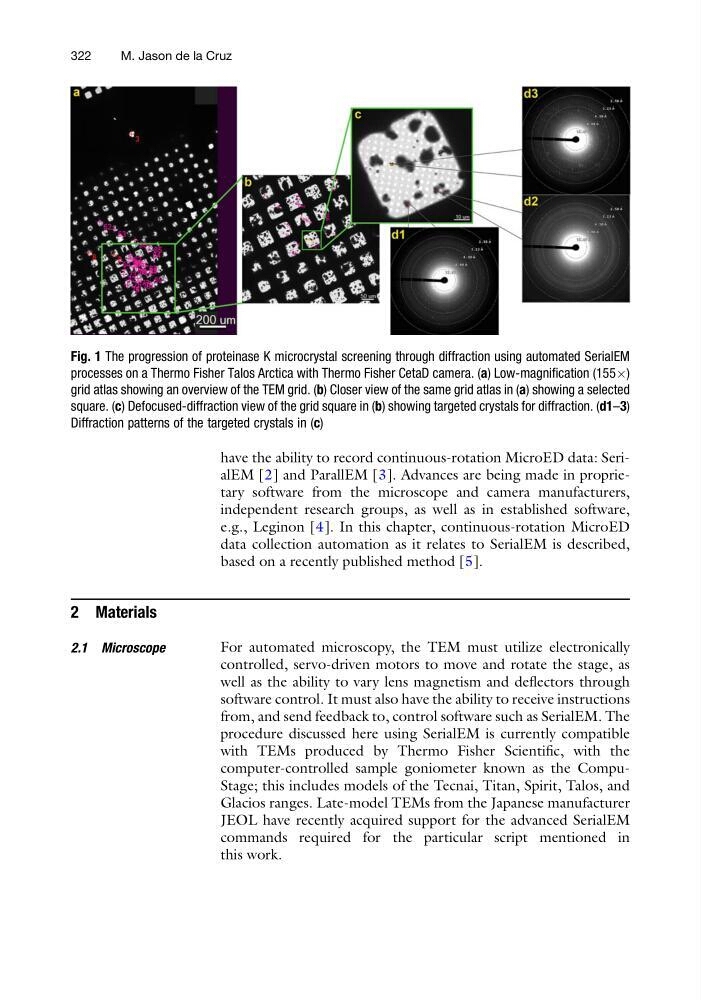
Fig. 1 The progression of proteinase K microcrystal screening through diffraction using automated SerialEM
processes on a Thermo Fisher Talos Arctica with Thermo Fisher CetaD camera. (a) Low-magnification (155Â)
grid atlas showing an overview of the TEM grid. (b) Closer view of the same grid atlas in (a) showing a selected
square. (c) Defocused-diffraction view of the grid square in (b) showing targeted crystals for diffraction. (d1–3)
Diffraction patterns of the targeted crystals in (c)
322
M. Jason de la Cruz
independent research groups, as well as in established software,
e.g., Leginon [4]. In this chapter, continuous-rotation MicroED
data collection automation as it relates to SerialEM is described,
based on a recently published method [5].
2 Materials
2.1 Microscope
For automated microscopy, the TEM must utilize electronically
controlled, servo-driven motors to move and rotate the stage, as
well as the ability to vary lens magnetism and deflectors through
software control. It must also have the ability to receive instructions
from, and send feedback to, control software such as SerialEM. The
procedure discussed here using SerialEM is currently compatible
with TEMs produced by Thermo Fisher Scientific, with the
computer-controlled sample goniometer known as the CompuStage; this includes models of the Tecnai, Titan, Spirit, Talos, and
Glacios ranges. Late-model TEMs from the Japanese manufacturer
JEOL have recently acquired support for the advanced SerialEM
commands required for the particular script mentioned in
this work.
Fig. 1 The progression of proteinase K microcrystal screening through diffraction using automated SerialEM
processes on a Thermo Fisher Talos Arctica with Thermo Fisher CetaD camera. (a) Low-magnification (155Â)
grid atlas showing an overview of the TEM grid. (b) Closer view of the same grid atlas in (a) showing a selected
square. (c) Defocused-diffraction view of the grid square in (b) showing targeted crystals for diffraction. (d1–3)
Diffraction patterns of the targeted crystals in (c)
322
M. Jason de la Cruz