

The Laplacian filter is commonly used to detect edges and
enhance contrast in noisy maps. A matrix representation of the
discrete Laplacian operator is convoluted with the map, producing
a transformed map. This filter has been successfully used to improve
scoring results with CCC in cryo-EM [86]. Other convolutions can
be applied with the same approach of generating a discretized
version of an operator in the form of a matrix to be convoluted
with the map. Another common approach is to obtain a Fourier
transform of the map, remove part of the power spectrum (e.g., the
high frequencies to low pass filter the map to smooth over background noise), and back transform to obtain a filtered map.
Often, only specific parts of the map are of interest, for example, protein components vs. the solvent or membrane regions. In
those cases, it is common to apply a mask to the map, a list of voxels
that will not be considered during scoring. The mask can be of any
shape although circular masks are most common.
6.3 CrossCorrelation
and Manders’
Coefficients
Note 3: The Manders’ coefficient described above is often called
the cross-correlation coefficient.
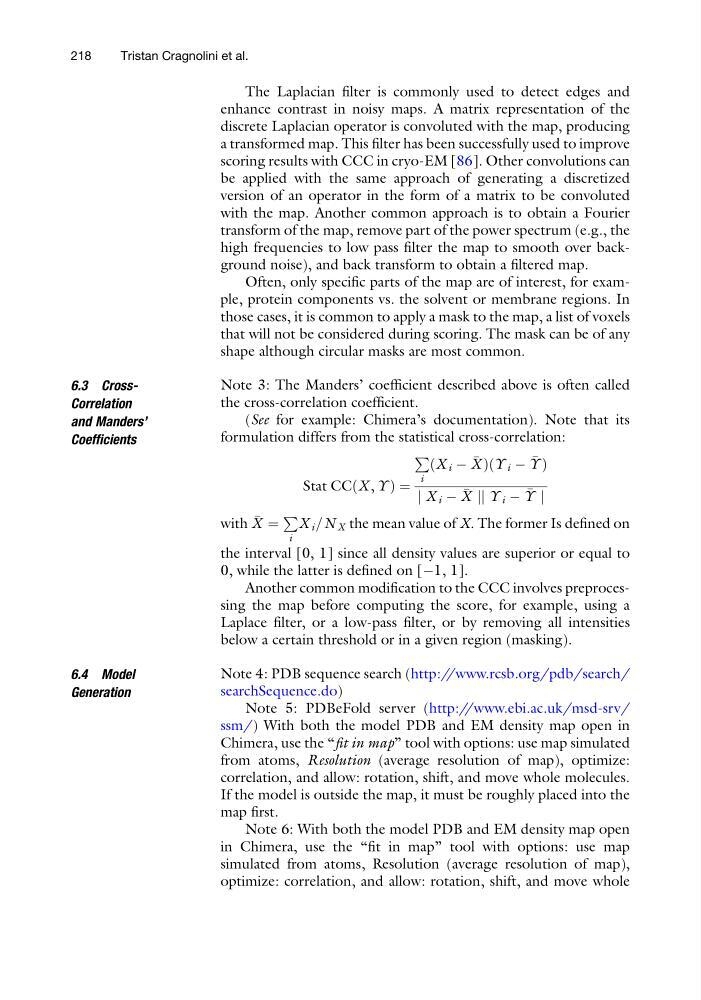
(See for example: Chimera’s documentation). Note that its
formulation differs from the statistical cross-correlation:
Stat CCðX , Y Þ ¼
P
i
ðX i À
X ÞðY i À
Y Þ
j X i À
X jj Y i À
Y j
with
X ¼
P
i
X i =N X the mean value of X. The former Is defined on
the interval [0, 1] since all density values are superior or equal to
0, while the latter is defined on [À1, 1].
Another common modification to the CCC involves preprocessing the map before computing the score, for example, using a
Laplace filter, or a low-pass filter, or by removing all intensities
below a certain threshold or in a given region (masking).
6.4 Model
Generation
Note 4: PDB sequence search (http://www.rcsb.org/pdb/search/
searchSequence.do)
Note 5: PDBeFold server (http://www.ebi.ac.uk/msd-srv/
ssm/) With both the model PDB and EM density map open in
Chimera, use the “fit in map” tool with options: use map simulated
from atoms, Resolution (average resolution of map), optimize:
correlation, and allow: rotation, shift, and move whole molecules.
If the model is outside the map, it must be roughly placed into the
map first.
Note 6: With both the model PDB and EM density map open
in Chimera, use the “fit in map” tool with options: use map
simulated from atoms, Resolution (average resolution of map),
optimize: correlation, and allow: rotation, shift, and move whole
218
Tristan Cragnolini et al.
enhance contrast in noisy maps. A matrix representation of the
discrete Laplacian operator is convoluted with the map, producing
a transformed map. This filter has been successfully used to improve
scoring results with CCC in cryo-EM [86]. Other convolutions can
be applied with the same approach of generating a discretized
version of an operator in the form of a matrix to be convoluted
with the map. Another common approach is to obtain a Fourier
transform of the map, remove part of the power spectrum (e.g., the
high frequencies to low pass filter the map to smooth over background noise), and back transform to obtain a filtered map.
Often, only specific parts of the map are of interest, for example, protein components vs. the solvent or membrane regions. In
those cases, it is common to apply a mask to the map, a list of voxels
that will not be considered during scoring. The mask can be of any
shape although circular masks are most common.
6.3 CrossCorrelation
and Manders’
Coefficients
Note 3: The Manders’ coefficient described above is often called
the cross-correlation coefficient.
(See for example: Chimera’s documentation). Note that its
formulation differs from the statistical cross-correlation:
Stat CCðX , Y Þ ¼
P
i
ðX i À
X ÞðY i À
Y Þ
j X i À
X jj Y i À
Y j
with
X ¼
P
i
X i =N X the mean value of X. The former Is defined on
the interval [0, 1] since all density values are superior or equal to
0, while the latter is defined on [À1, 1].
Another common modification to the CCC involves preprocessing the map before computing the score, for example, using a
Laplace filter, or a low-pass filter, or by removing all intensities
below a certain threshold or in a given region (masking).
6.4 Model
Generation
Note 4: PDB sequence search (http://www.rcsb.org/pdb/search/
searchSequence.do)
Note 5: PDBeFold server (http://www.ebi.ac.uk/msd-srv/
ssm/) With both the model PDB and EM density map open in
Chimera, use the “fit in map” tool with options: use map simulated
from atoms, Resolution (average resolution of map), optimize:
correlation, and allow: rotation, shift, and move whole molecules.
If the model is outside the map, it must be roughly placed into the
map first.
Note 6: With both the model PDB and EM density map open
in Chimera, use the “fit in map” tool with options: use map
simulated from atoms, Resolution (average resolution of map),
optimize: correlation, and allow: rotation, shift, and move whole
218
Tristan Cragnolini et al.